How Long Do You Need Gout Medicine Once Symptoms Improve?
A long stretch without pain and an improved urate result can make stopping medicine seem like the next step. However, urate-lowering therapy, or ULT, usually continues after improvement. Korean guidance conditionally supports ongoing treatment to prevent recurrence, and UK NICE describes it as typically lifelong.[1][3]
Long-term treatment does not mean leaving the same prescription unreviewed forever. Benefits, side effects, other medicines and changes in health still need attention. The useful questions are why treatment continues, whether the current plan suits you, and when it will be reassessed, rather than whether one good test means you should stop on your own.[2][3][6]
1. A pain-free interval is still part of gout care
The symptom-free period between attacks is called the intercritical period. Korea’s KDCA explains that urate crystals may still be present during that time. Feeling comfortable therefore does not establish that all deposits have disappeared or that treatment is complete.[5] Symptoms matter, but clinicians also consider urate results and the history of attacks, tophi and other findings when reviewing long-term management.[3]
A good result obtained while taking ULT describes your urate level under treatment. It does not prove that the same level would persist without medicine. The goal is sustained control while reducing future flare and crystal-related problems.[3] At a pain-free appointment, tell the clinician that there have been no attacks, then describe actual medicine use, any discomfort and new prescriptions from elsewhere. Stability is useful information, and you do not need to wait for another painful event to have a meaningful review.
2. Guidelines favor continuation, with uncertainty acknowledged
The Korean College of Rheumatology’s 2023 guideline conditionally recommends continuing ULT indefinitely to prevent recurrence. ACR 2020 also conditionally favors continuation over stopping. The Korean guideline notes that evidence about stopping comes from limited, small observational studies.[1][2] The recommendation should not be turned into a claim that every person will relapse immediately after missing treatment or that an individual outcome can be predicted with certainty.
NICE advises explaining that ULT usually continues after reaching the target and is typically lifelong.[3] For someone receiving care in Korea, that is general guidance, not a permanently fixed individual prescription. Say if the idea of lifelong treatment worries you, if the number of medicines feels overwhelming, or if you want to understand the monitoring burden. Reviewing the current medicine and follow-up plan is compatible with an overall long-term approach. Do not make an unsupervised trial of stopping to resolve that uncertainty.
3. Different gout medicines can have different durations
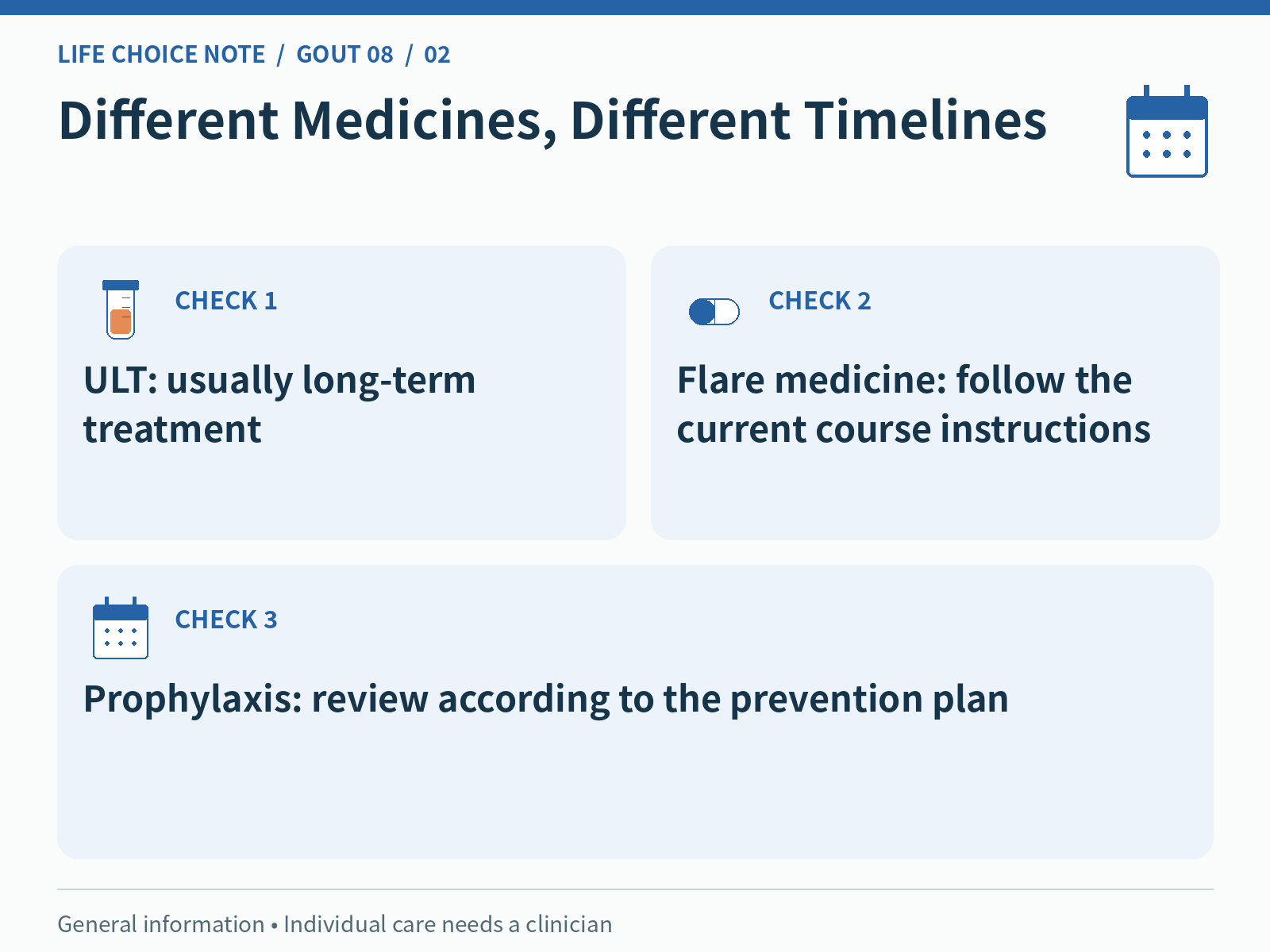
Your urate-lowering medicine, treatment for the present flare and temporary prevention during ULT initiation may have different schedules. Continuing ULT does not necessarily mean continuing every anti-inflammatory tablet that came with it. Equally, completing a short course for pain does not necessarily end the urate-lowering plan.[1][3] Ask for a clear instruction for each drug rather than treating everything in one prescription as a single course.
List the name, purpose, current directions and next review for each medicine. If you are unsure which tablet was meant to stop, show the packets or prescription instead of relying on color or shape. Also clarify whether the quantity supplied lasts only until the next appointment rather than marking the end of treatment. Contact the clinic before running out. Do not stretch supplies by changing the interval yourself, or borrow another person’s medicine to cover a gap.[6]
4. A short symptom-free break cannot test long-term safety
Recurrence after stopping ULT may be delayed; the studies reviewed by the Korean guideline varied in both their results and observation periods.[1] A week without pain after stopping is therefore not a reliable test of future risk. Before turning a regular urate-lowering prescription into something you take only when a joint hurts, discuss the change with your clinician. Pain relief and long-term urate control are different treatment purposes.
If you have already stopped, report the medicine, last dose, reason for stopping and any symptoms since then. Do not hide the gap or take extra tablets to compensate. Official allopurinol information specifically warns against doubling a dose to make up for a missed one.[6] Longer interruptions and suspected reactions need advice before restarting. If lifestyle changes have prompted your question, bring the details and subsequent results; they do not guarantee that medication can safely end, particularly with frequent flares or tophi.[4]
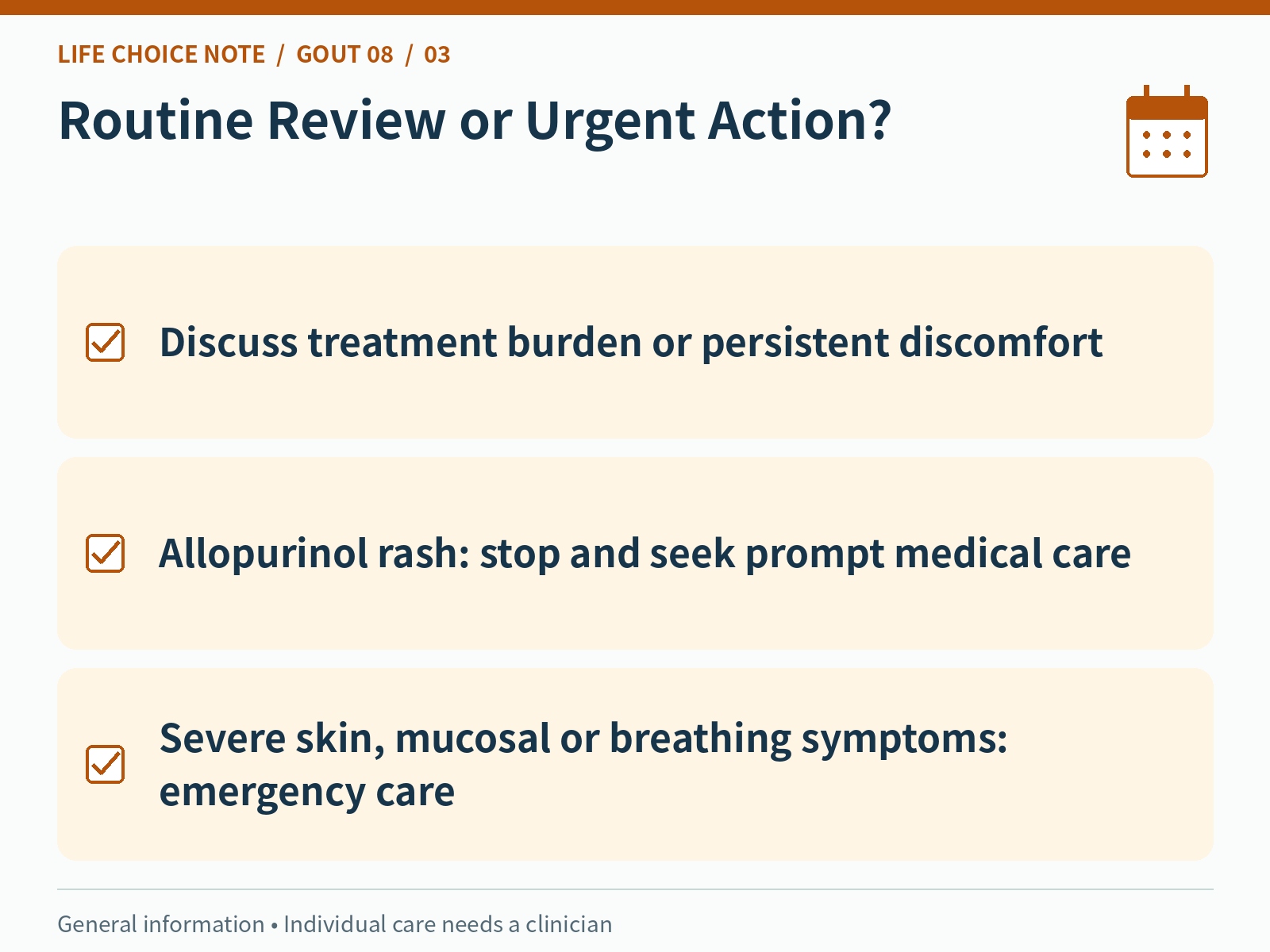
5. Review safety rather than accepting every problem as inevitable
Tell your clinician about new kidney or liver disease, additional medicines and discomfort that persists or affects daily life. Interaction risks and the balance of benefit and harm may need review.[6][7] A long-term prescription is not a reason to ignore problems, but neither does every symptom prove a dangerous reaction. Describe what happened, when it began and how it relates to medicine changes, so the next step can be based on an assessment.
There is a specific urgent exception for allopurinol: the Korean product label directs immediate discontinuation for rash or other hypersensitivity signs. Blisters, progressive rash, mouth or eye involvement, or associated fever need urgent assessment; severe symptoms or breathing difficulty require emergency care.[7] General advice not to stop a long-term medicine must not obscure this warning. Do not restart a suspected culprit yourself after symptoms fade, or switch to another brand of the same ingredient as a way of trying it again.
6. Make maintenance workable in everyday life
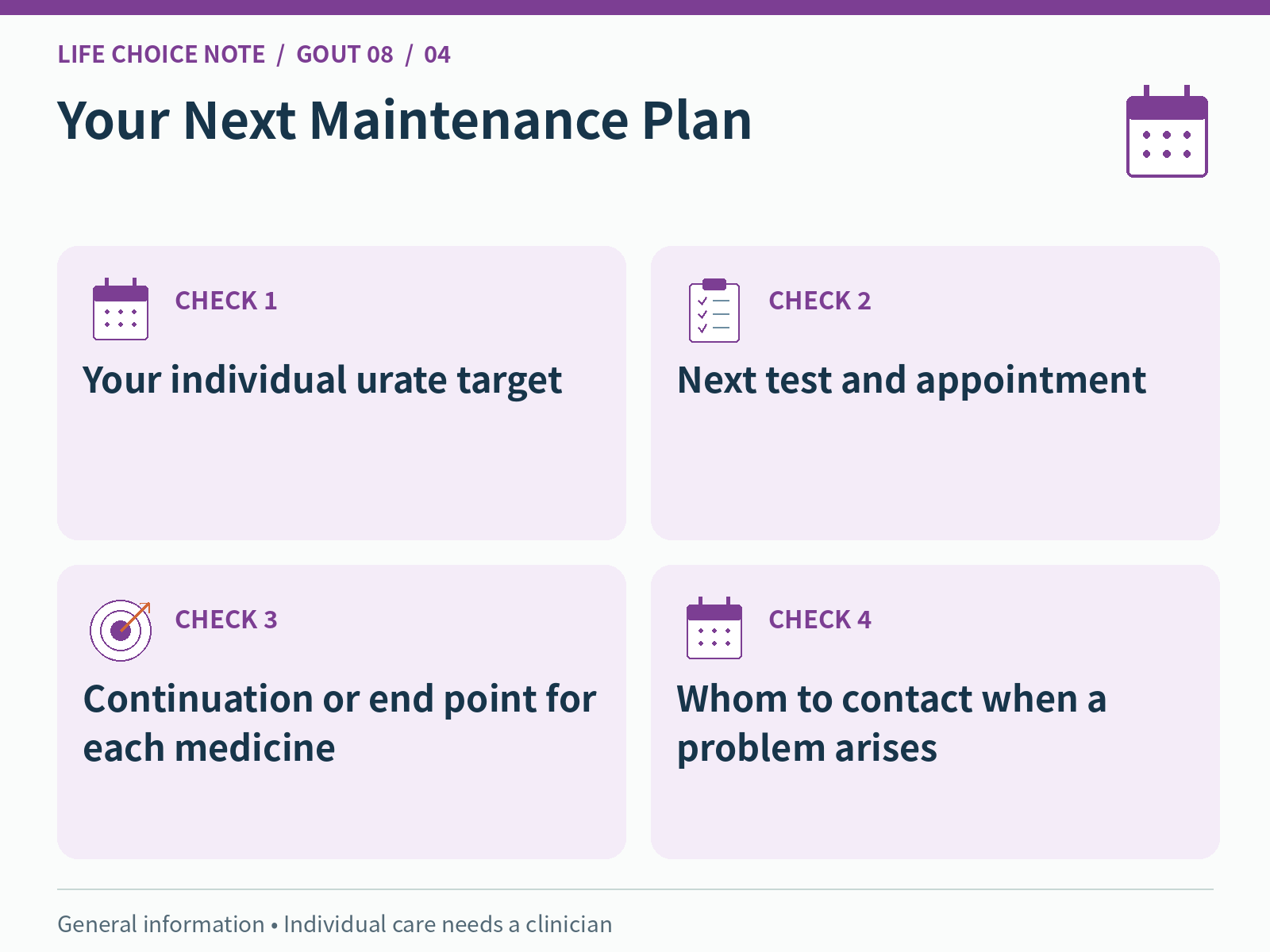
NICE suggests considering annual urate monitoring once the target has been reached during continuing treatment. Your actual schedule in Korea is individualized; changes in symptoms, medicine or health may need earlier review.[3] Confirm the next test and appointment instead of assuming that “annual monitoring” means every question can wait a year. Ask how to arrange a refill or seek advice if your usual clinic becomes difficult to attend.
Choose a simple way to support the prescribed routine, such as a reminder or a record of doses taken. Explain barriers such as shift work, travel, cost or access to appointments. A useful maintenance summary includes your target, recent results, attacks or pain-free periods, current medicines and concerns. Ask, “Why continue?”, “Does this plan still fit me?”, and “When will we reassess it?” Long-term care should remain an understandable plan that you can carry out, rather than a prescription whose purpose has been forgotten.
What to bring to your appointment
- Identify long-term ULT separately from short-term medicines.
- Record recent urate results and attacks or pain-free periods.
- Describe missed doses or interruptions honestly.
- Report new diagnoses, medicines and persistent discomfort.
- Confirm testing, appointments and supply arrangements.
- Know the allopurinol rash and hypersensitivity warning.
Common questions
Can everyone stop after several years without a flare?
There is no universal symptom-free duration that makes stopping appropriate. Korean and ACR guidance conditionally favors continuing, with individual benefits and risks reviewed.[1][2]
Does lifelong treatment mean the same dose forever?
No. The long-term strategy and the current medicine, dose and monitoring plan are separate matters for clinical reassessment.[2][3]
Should I catch up on several missed doses at once?
Do not take a catch-up batch. Check your medicine’s missed-dose instructions; allopurinol information says not to double doses. Seek advice before restarting after a longer gap or a suspected reaction.[6]
General adult health information, not an individual treatment-duration decision. Do not stop, reduce or restart medicine because symptoms have improved. Stop allopurinol immediately and seek prompt care for rash or hypersensitivity signs; severe skin or mucosal symptoms or breathing difficulty require emergency assessment.[7]
Related published reading
- CKD and Supplements: Bring the Bottle, Labs and Medicine List
- Supplements That Can Interfere With Lab Tests: Biotin and Beyond
- Previous: Can Urate-Lowering Treatment Start During a Gout Flare?
- Next: Should People of Korean Ancestry Have HLA-B*58:01 Testing Before Allopurinol?
Official and primary sources
- Korean guidelines for the management of gout · Korean College of Rheumatology · Published 2023-07-01 · Checked 2026-10-15
- 2020 American College of Rheumatology Guideline for the Management of Gout · American College of Rheumatology · Published June 2020 · Checked 2026-10-15
- Gout: diagnosis and management (NG219), Recommendations · National Institute for Health and Care Excellence (NICE) · Published 2022-06-09 · Checked 2026-10-15
- Gout: Diagnosis, Treatment, and Steps to Take · US National Institute of Arthritis and Musculoskeletal and Skin Diseases (NIAMS) · Last reviewed December 2023 · Checked 2026-10-15
- 통풍 · 질병관리청 국가건강정보포털 · Registered 2025-05-19; updated 2026-05-18 · Checked 2026-10-15
- Allopurinol: Drug Information · MedlinePlus, US National Library of Medicine · Last revised 2023-09-15 · Checked 2026-10-15
- 자이로릭정(알로푸리놀): 품목 허가사항 · 대한민국 식품의약품안전처 의약품안전나라 · Initial approval 1970-09-25; latest listed precautions change 2026-06-29 · Checked 2026-10-15