Can Urate-Lowering Treatment Start During a Gout Flare?
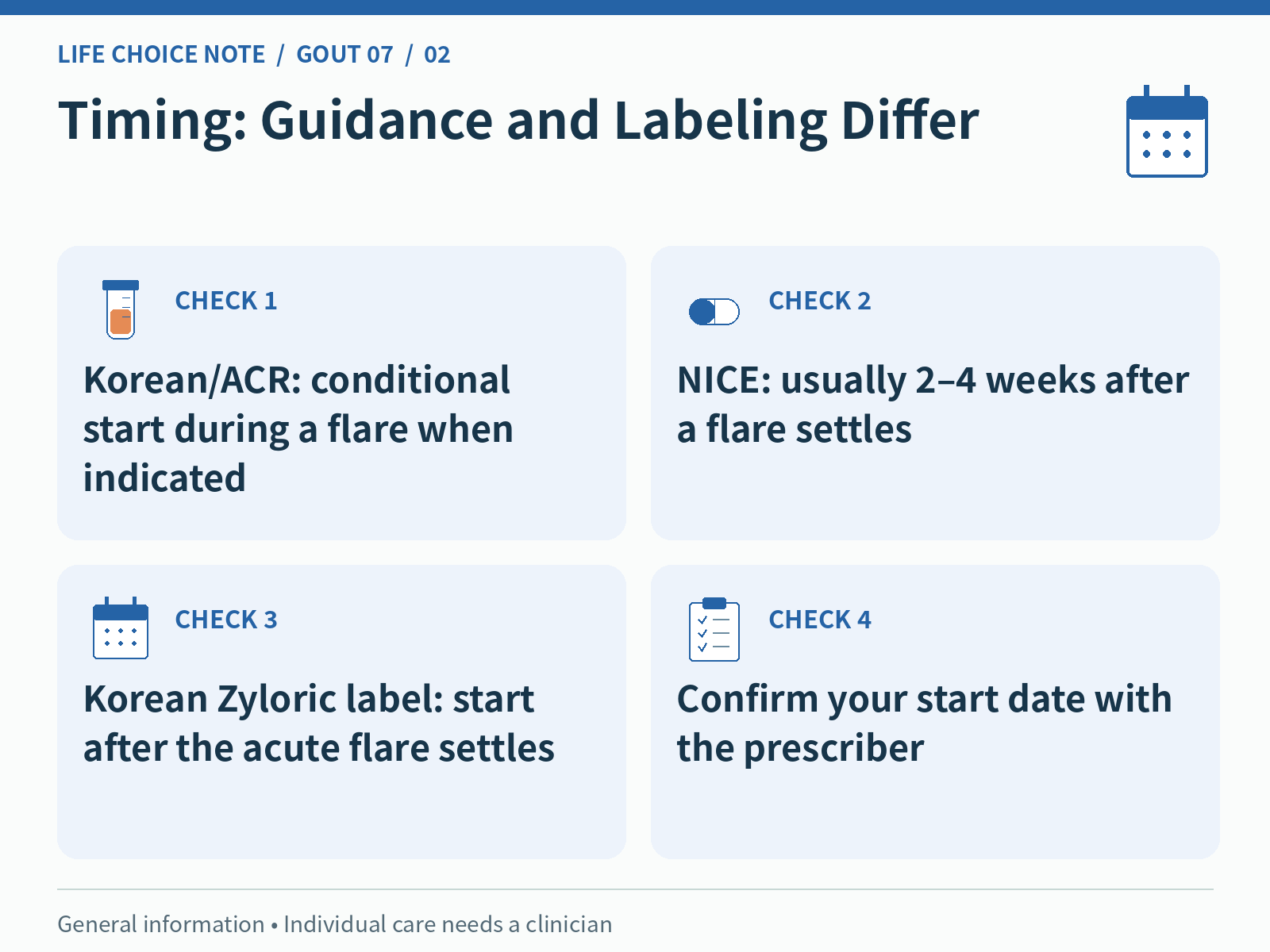
The timing of new urate-lowering therapy, or ULT, needs more than a yes-or-no rule. Korean and American College of Rheumatology guidance conditionally supports starting during a flare when long-term treatment is indicated. NICE usually recommends waiting. A Korean allopurinol product label also advises waiting for the acute flare to settle before starting.[1][2][3][4]
If you receive care in Korea, your prescriber needs to consider the guideline, the actual product’s Korean labeling and your circumstances together. Starting a new medicine and continuing an existing one are separate questions. This article explains the distinction; it does not set your start date or dose.
1. Separate the three purposes of gout medication
A prescription may address the current inflammation, long-term urate control and prevention of early flares after ULT begins. Some anti-inflammatory medicines can be used for more than one of these purposes, making a generic label such as “gout medicine” confusing. Ask what each tablet is intended to do and which instructions apply to it. Starting ULT should not create an expectation that it will immediately relieve severe pain from the current attack.[1][2][3]
A practical medicine list can include the product name, purpose and current prescribed instructions. Distinguish “treat this flare,” “lower urate” and “prevent early flares” in your own words, then check that understanding with the pharmacist or clinician. Ask which medicines start today and which need another assessment first. Do not combine leftover prescriptions with the new plan simply because they were previously described as gout treatment. Keep uncertain start dates as questions rather than filling them in yourself.
2. Korean and ACR guidance allows a conditional approach
ACR 2020 conditionally recommends starting ULT during a flare, rather than waiting, when the decision to use it has already been made. Korean 2023 guidance conditionally supports starting ULT alongside anti-inflammatory treatment in patients who have an indication for it.[1][2] Neither recommendation says that every painful joint needs immediate urate-lowering medication. The diagnosis, long-term indication and management of the present inflammation remain important.
A conditional recommendation also does not prove that timing makes no difference for every patient. It leaves room for circumstances, evidence limitations and informed preferences.[1][2] If starting now is proposed, ask why, how the current flare will be treated and what follow-up is planned. If waiting is proposed, that does not automatically mean the clinician is unaware of newer evidence. First clarify why ULT is needed; then discuss when that particular plan should begin.
3. NICE and Korean product labeling require separate attention
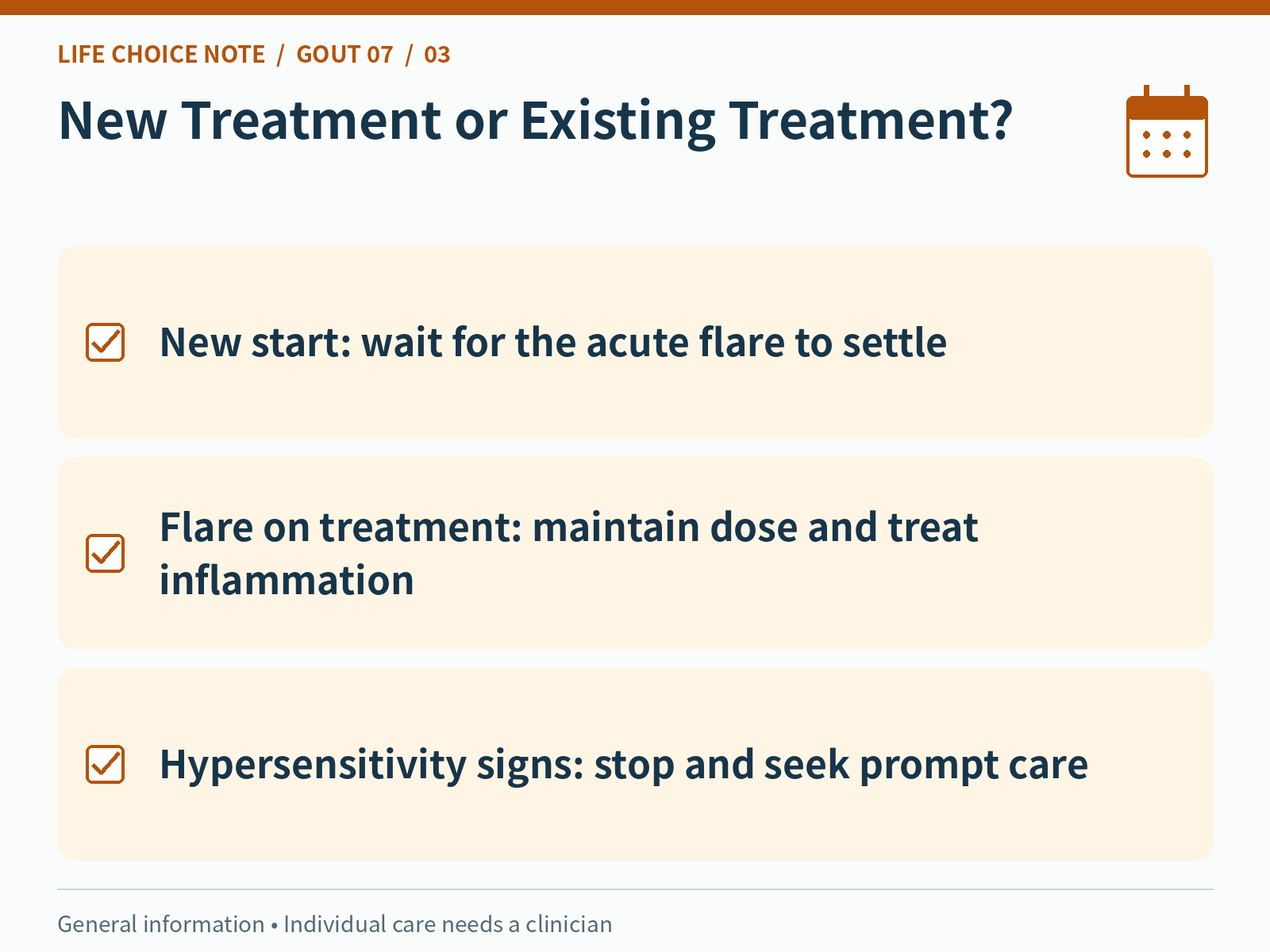
UK NICE guidance generally advises starting ULT 2–4 weeks after a flare has settled, while allowing initiation during a flare when attacks are more frequent.[3] This differs from the wording of ACR guidance. When reading advice online, check the country and the qualifying circumstances. A waiting interval quoted without its surrounding recommendation can become a misleading universal rule.
Korea’s MFDS information for Zyloric tablets (allopurinol; item code 197000050) advises against beginning treatment until the acute flare has settled.[4] A guideline does not automatically replace that product label. Ask your prescriber to reconcile the guidance and the Korean labeling for your actual medicine. This article identifies one product’s wording; it does not assume that every ULT product has identical instructions. Do not advance a start date using tablets already at home while the plan remains unclear.
4. Continuing existing therapy is a different decision
The same Korean Zyloric label says that if a gout flare occurs during treatment, the dose is maintained and the flare is treated with anti-inflammatory medicine.[4] Its warning about a new start should therefore not be read as an instruction to stop established treatment whenever a joint becomes painful. Tell the clinician what you already take and confirm the separate flare-management plan.
Suspected hypersensitivity is an important exception. The label directs immediate discontinuation for rash or other hypersensitivity signs. Blistering, mucosal lesions or skin symptoms with fever need urgent assessment; severe symptoms or breathing difficulty require emergency care.[4] Describe whether the problem involves the joint, skin, mouth, eyes or general wellbeing, and when each medicine was started. Do not wait until you can prove that a symptom is a drug reaction before seeking advice, or restart a suspected culprit because the symptoms have faded.
5. Include early flare prevention in the start-up plan
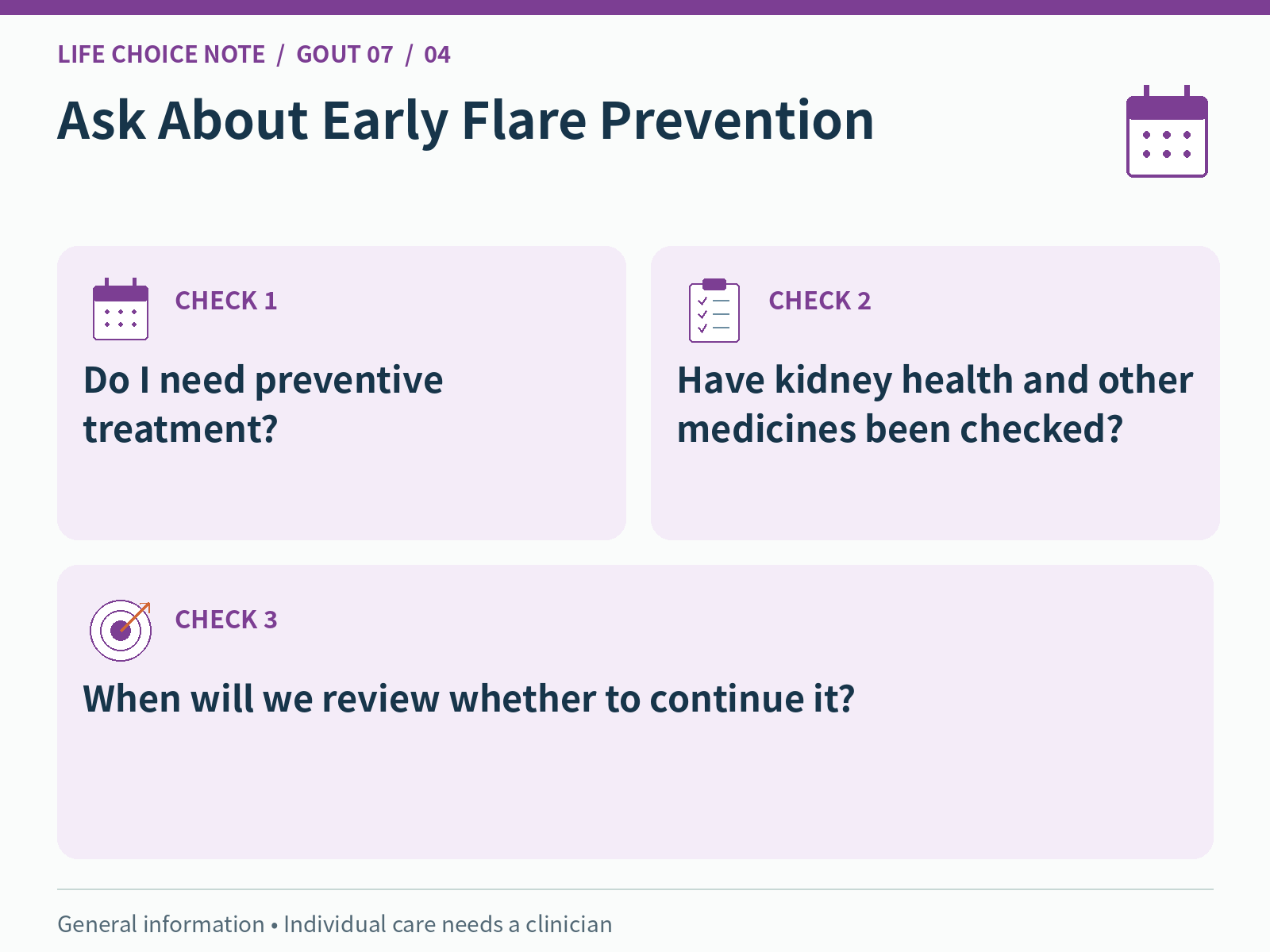
Flares can occur early in ULT, so preventive anti-inflammatory treatment is discussed. Korean guidance conditionally supports concomitant colchicine. ACR recommends prophylaxis for at least 3–6 months with reassessment and continuation when needed for ongoing flares. NICE offers colchicine during the process of reaching the urate target for people choosing prophylaxis.[1][2][3] These recommendations should not be simplified to “everyone stops prevention at exactly three months.”
Preventive medicines also require safety checks, including kidney health, other drugs and previous intolerance. Ask whether prophylaxis is part of your plan, what to do if it causes problems and when the decision to continue it will be reviewed.[2][3] It does not guarantee that every attack will be prevented. New or unusual joint pain with fever or feeling very unwell needs prompt evaluation rather than being assumed to be an expected early flare.[5] Do not improvise by adding leftover painkillers or changing doses.
6. Leave with a connected plan, not only a start date
Before leaving the clinic, check four linked items: treatment of the present flare, whether ULT is new or ongoing, prevention of early flares and the next review. Ask which medicines have a defined end point and which continue after the pain settles. Treat-to-target care involves follow-up assessment and clinician-led adjustment, so a first-day prescription is only one part of the process.[2][3]
Bring the date your current symptoms began, the names of new and established medicines, and any kidney disease or drug-reaction history. If two instructions appear contradictory, show both prescriptions rather than choosing one yourself. They may concern different products or treatment stages. Ask how to contact the clinic before the next routine visit, and which symptoms need urgent care. Clear instructions about starting, continuing and responding to adverse reactions are more useful than a single blanket rule about flares.
What to bring to your appointment
- Identify each medicine’s purpose.
- Separate new starts from established treatment.
- Check your product’s Korean labeling with your prescriber.
- Report kidney disease, other medicines and previous drug reactions.
- Confirm prevention and reassessment plans.
- Know the urgent response to rash, blisters or mucosal symptoms.
Common questions
Is starting ULT during a flare always prohibited?
Some guidelines conditionally allow it when indicated, but the Korean Zyloric label advises waiting for the flare to settle. Ask your Korean prescriber to consider the actual product label and your clinical situation.[1][2][4]
Should I stop a medicine I already take if a flare occurs?
Not simply by applying a rule about new starts. The Zyloric label distinguishes continuing therapy during a flare from stopping for suspected hypersensitivity. Confirm the plan for your medicine.[4]
Does prophylaxis automatically end after three months?
No. ACR includes 3–6 months and reassessment for ongoing flares, while NICE relates prevention to reaching the target. Your clinician decides the duration with safety and response in mind.[2][3]
General adult health information, not an individual prescription. Confirm timing with a clinician who considers Korean product labeling and your circumstances. Stop allopurinol immediately and seek prompt medical care if rash or hypersensitivity signs develop; severe skin or mucosal symptoms or breathing difficulty require emergency assessment.[4]
Related published reading
- CKD and Supplements: Bring the Bottle, Labs and Medicine List
- Supplements That Can Interfere With Lab Tests: Biotin and Beyond
- Previous: Why Is the Gout Treatment Target Below 6 mg/dL?
- Next: How Long Do You Need Gout Medicine Once Symptoms Improve?
Official and primary sources
- Korean guidelines for the management of gout · Korean College of Rheumatology · Published 2023-07-01 · Checked 2026-10-15
- 2020 American College of Rheumatology Guideline for the Management of Gout · American College of Rheumatology · Published June 2020 · Checked 2026-10-15
- Gout: diagnosis and management (NG219), Recommendations · National Institute for Health and Care Excellence (NICE) · Published 2022-06-09 · Checked 2026-10-15
- 자이로릭정(알로푸리놀): 품목 허가사항 · 대한민국 식품의약품안전처 의약품안전나라 · Initial approval 1970-09-25; latest listed precautions change 2026-06-29 · Checked 2026-10-15
- Gout · NHS · Page last reviewed 2023-08-24 · Checked 2026-10-15