Smart Scale or Basic Scale? What the Numbers Mean
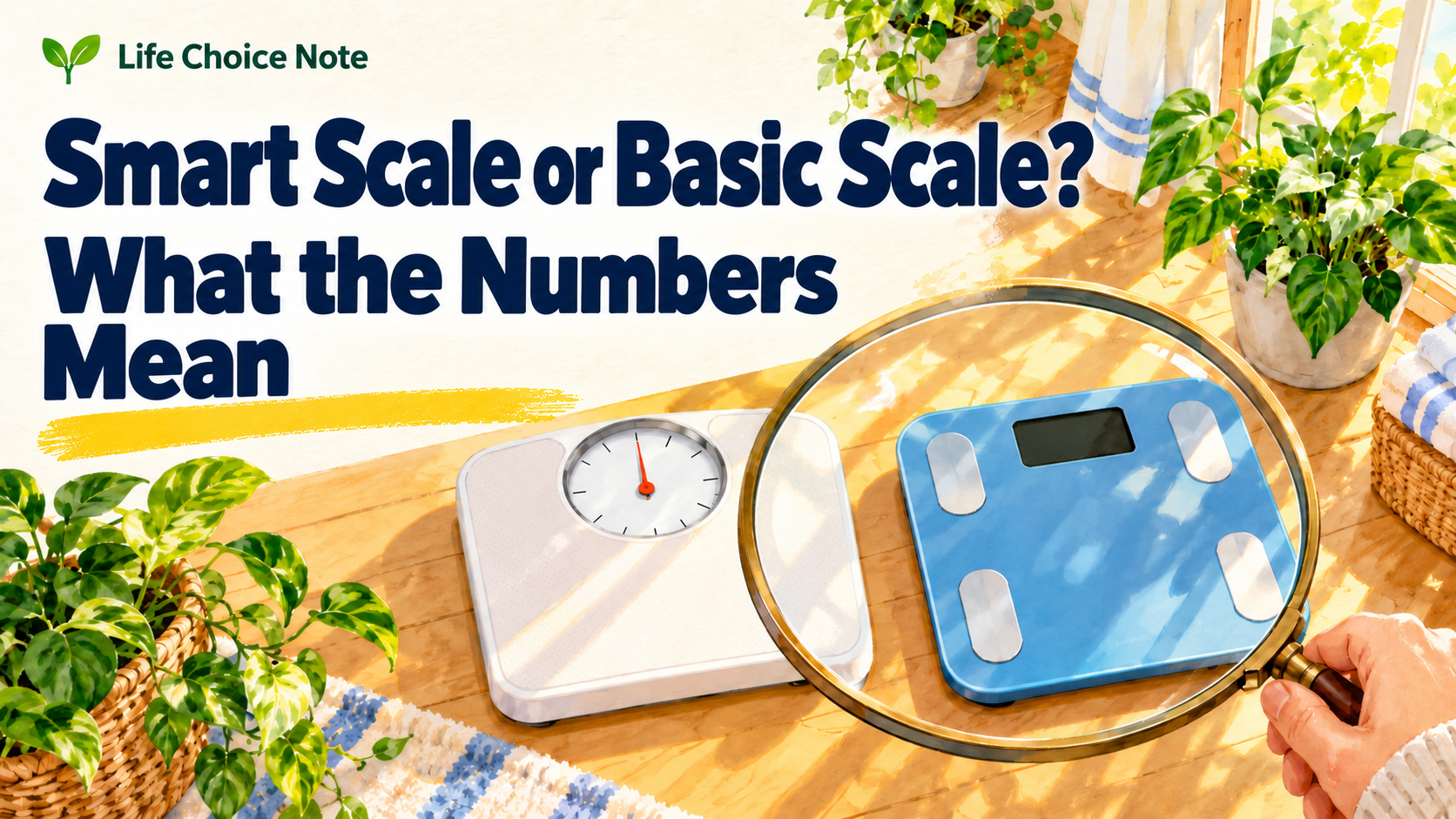
Should you choose a basic scale or a smart model that also displays fat and muscle? First decide whether you need a weight record, automatic logging or a clinical assessment of body composition.
More metrics and decimal places do not make every result more accurate. Start with whether the device helps you record consistently and comfortably at home, then consider which extra functions are worth their cost.
Separate weight logging from body-composition assessment
A basic device may be sufficient for reading and recording weight. A smart model may make logging easier, but check the specific product to learn whether app access is necessary and whether it works without an account.
If the aim is clinical assessment of muscle loss or nutrition, do not decide from home readings alone. Discuss appropriate tests and functional assessment with a clinician. Buying a scale does not automatically replace that process.
Distinguish increments, accuracy and repeatability
Three different measurement concepts
Increment
Display step size
Accuracy
Closeness to a reference
Repeatability
Consistency in the same conditions
A display increment of 0.1 kg means the screen changes in those steps. It is not a guarantee that the reading is always within 0.1 kg of true weight. Accuracy concerns closeness to a reference; repeatability concerns similar results under the same conditions.
Check maximum capacity, units, floor requirements and the manufacturer’s accuracy statement separately. An unsupported claim of hospital-grade accuracy is not validation. Several similar readings at home do not constitute formal calibration or performance testing.
Fat and muscle values are model-based estimates
Give each number an appropriate role
Weight
A record of total mass
Composition
A model-based estimate
Clinical assessment
Symptoms and appropriate tests
Many smart scales estimate composition from bioelectrical impedance plus information such as height, age and weight. They do not directly visualise fat or measure each muscle. Results depend on the model and the population for which it was developed. Frija-Masson et al. Smart Scale Accuracy Study (2021)
A 2021 study at one French hospital assessed three scales in groups of 53, 52 and 48 adult patients. Weight and body-composition performance differed; the authors concluded that composition estimates should not replace clinical DXA assessment. This is not a ranking of every device sold today. Frija-Masson et al. Smart Scale Accuracy Study (2021)
A day-to-day body-fat percentage change does not quantify exactly how much fat was lost. Do not compare different brands’ muscle scores or metabolic-age outputs as if they share a single standard. Check what each metric actually means.
Prioritise the platform, display and storage location
Look for a stable platform, a readable display and enough time to see the settled reading. If balance is difficult or falls are a concern, discuss a safe measurement method rather than forcing yourself onto an unsuitable device.
NHS England recommends a firm, level floor, the same scale and location, and comparable timing and clothing. NHS England How to Record Your Weight Do not mix carpet and hard-floor readings; follow the manual for zeroing after moving a device. Unstable readings may call for checks of the battery, floor and equipment as well as posture.
Read restrictions and intended users for bioimpedance functions. With an implanted medical device or during pregnancy, check manufacturer and clinical advice before using that function. Do not assume one model’s conditions apply to every product.
Review the app and ongoing costs before buying
Check real-world use before buying
Fit
Platform, display, capacity
Records
App, export and deletion
Long-term use
Ongoing costs and support
Write down your questions: Do you need automatic syncing? Can family records be kept distinct? Can records be exported and deleted? What happens after a phone change or if app support ends? Check the product’s official instructions and privacy information for answers.
Beyond purchase price, check paid analysis, subscription-only features, batteries or consumables, warranty and return conditions. Before storing or sharing weight information, establish who can access it. An extra function has limited value if you will not use it.
A calmer relationship with the numbers is a useful feature
If an app encourages repeated daily checks or anxiety about small changes, see whether notifications and extra metrics can be reduced. Daily weighing is not necessary for everyone; follow a clinician’s monitoring plan when one exists.
A final buying question is whether the device makes your record easier and safer to use. If readings lead to extreme food restriction or growing distress, discuss the measurement approach rather than searching for an ever more detailed device.
Common questions
Is a basic scale inadequate for weight management?
For consistent weight logging, a basic model may be sufficient. Decide which functions and costs fit your purpose, and discuss clinical composition assessment separately.
Should I replace a scale if it differs from a clinic reading?
Timing, clothing, meals and floor conditions can differ as well as devices. Review conditions and the manual first; persistent problems may need manufacturer support or advice on a suitable comparison.
Related tools and reading
Life Choice Note weight and waist log
Use this log to organise weight records, with separate notes on dates, measurement conditions and the context discussed above. A record does not diagnose a condition or determine fat change.
Sources and scope
General health information based on official guidance and the cited original sources. Scenarios and diagrams explain concepts; they do not predict individual outcomes. Country-specific rules and product conditions must be kept distinct.
Sources checked 5 October 2026 (Korea time). This does not replace individual diagnosis, treatment, nutrition or exercise advice. A separate medical professional review has not been completed.