Does Gout Increase Your Risk of Kidney Stones?
Gout and urinary stones can occur together, so a history of stones belongs in your gout review. That does not mean everyone with gout will develop a stone, or that every stone in someone with gout is made of uric acid. Composition, location, obstruction and infection all affect the next steps.[1][2]
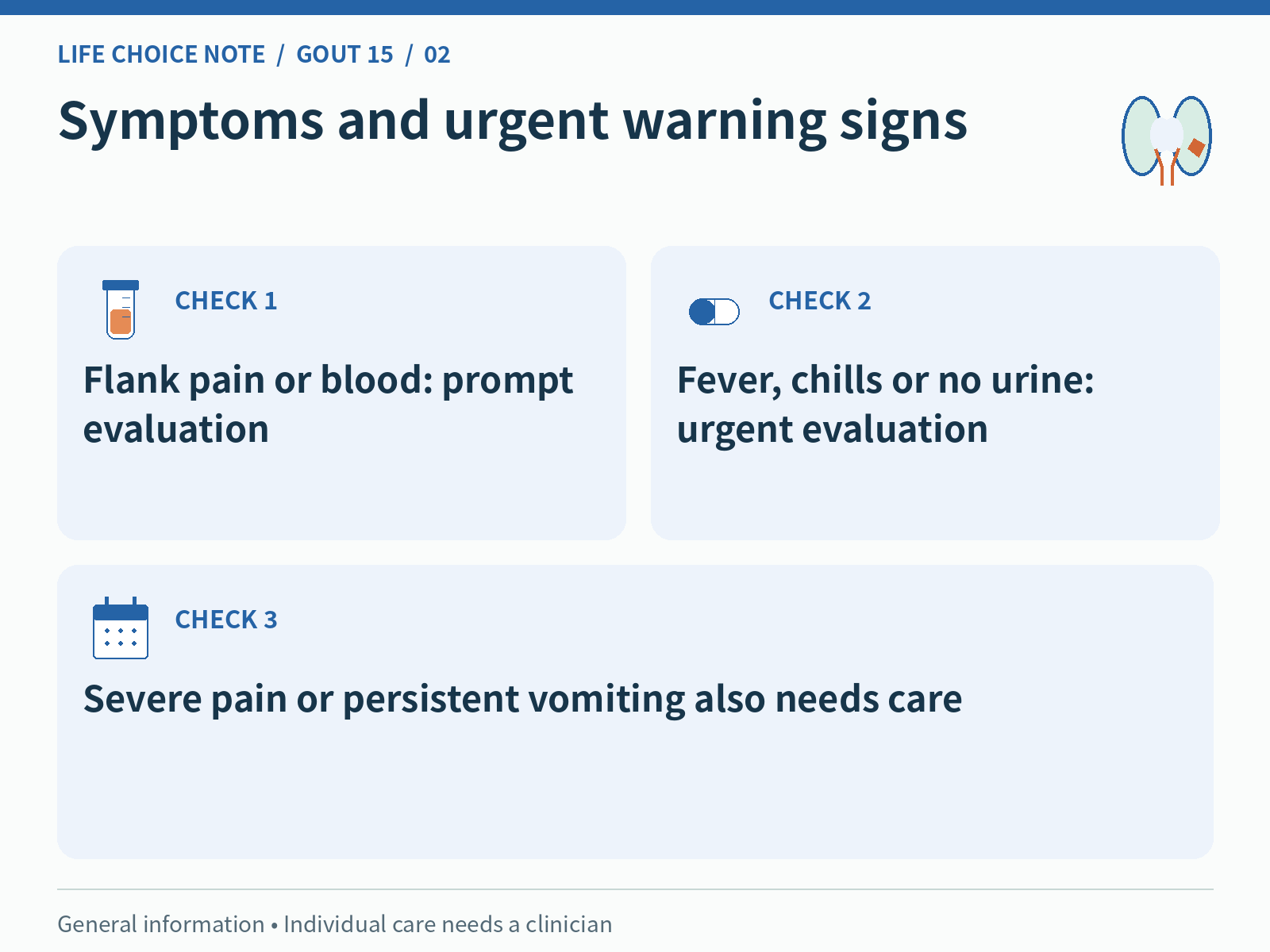
First deal with current symptoms; then discuss recurrence prevention. New flank pain or visible blood in the urine needs prompt assessment. Pain with fever or chills, inability to pass urine, or severe vomiting should not be managed by forcing water and waiting at home.[3][4]
1. Related conditions are not the same diagnosis
Gout involves urate crystals in and around joints. Urinary stones form from substances in urine and can contain calcium compounds, uric acid or other materials. NIDDK lists gout among conditions associated with stone risk, but a gout diagnosis does not establish a stone’s composition. The two problems need related but distinct assessment.[1][2]
For uric acid stones, acidic urine and urinary uric acid handling matter. A blood urate result does not describe the entire urine environment. High serum urate therefore cannot identify a stone by itself, and reaching the gout blood-urate target does not remove every stone risk. Ask what type of stone was found and what urine findings inform the prevention plan.[6]
2. Recognise symptoms that need timely care
Sharp pain in the back, side, lower abdomen or groin, visible blood in urine, painful urination or passing very little urine warrants prompt clinical assessment. These symptoms may represent a stone or another condition. Pain that comes in waves should not be assumed to have resolved simply because there is a temporary comfortable interval.[3]
Fever or chills, inability to urinate, severe pain or vomiting that prevents fluid intake calls for urgent evaluation. Clinicians need to consider obstruction and infection. Do not take extra gout medicine to treat flank pain or describe it as uric acid leaving the body. Provide symptom timing and your medicine list when possible, without delaying necessary care.[3][4]
3. Testing looks beyond whether a stone exists
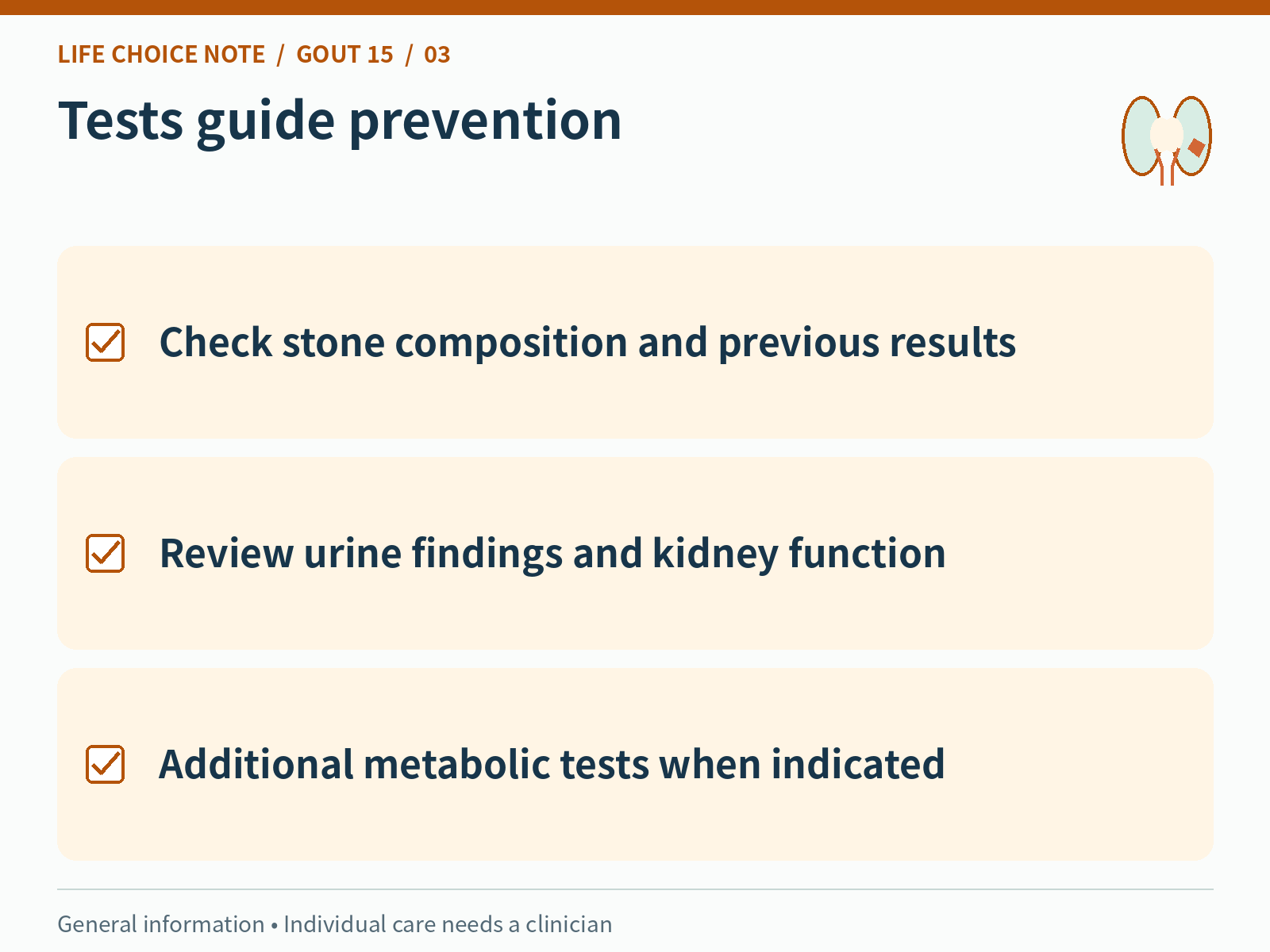
Assessment may combine history, examination, urine and blood tests and imaging. The aim includes identifying the stone’s size and location, checking for blockage or infection and assessing kidney function. The appropriate imaging method depends on the clinical situation. Having gout does not mean every person needs the same scan.[4][5]
If a stone passes, the clinician may ask you to collect it for analysis using the supplied instructions. Keep the result with previous imaging reports; colour or appearance alone is not a reliable home test. People with recurrent or higher-risk stones may need additional metabolic evaluation, including timed urine collection. Ask how to collect the sample accurately and report any missed part rather than concealing it.[4][6]
4. Plan fluids for your own medical situation
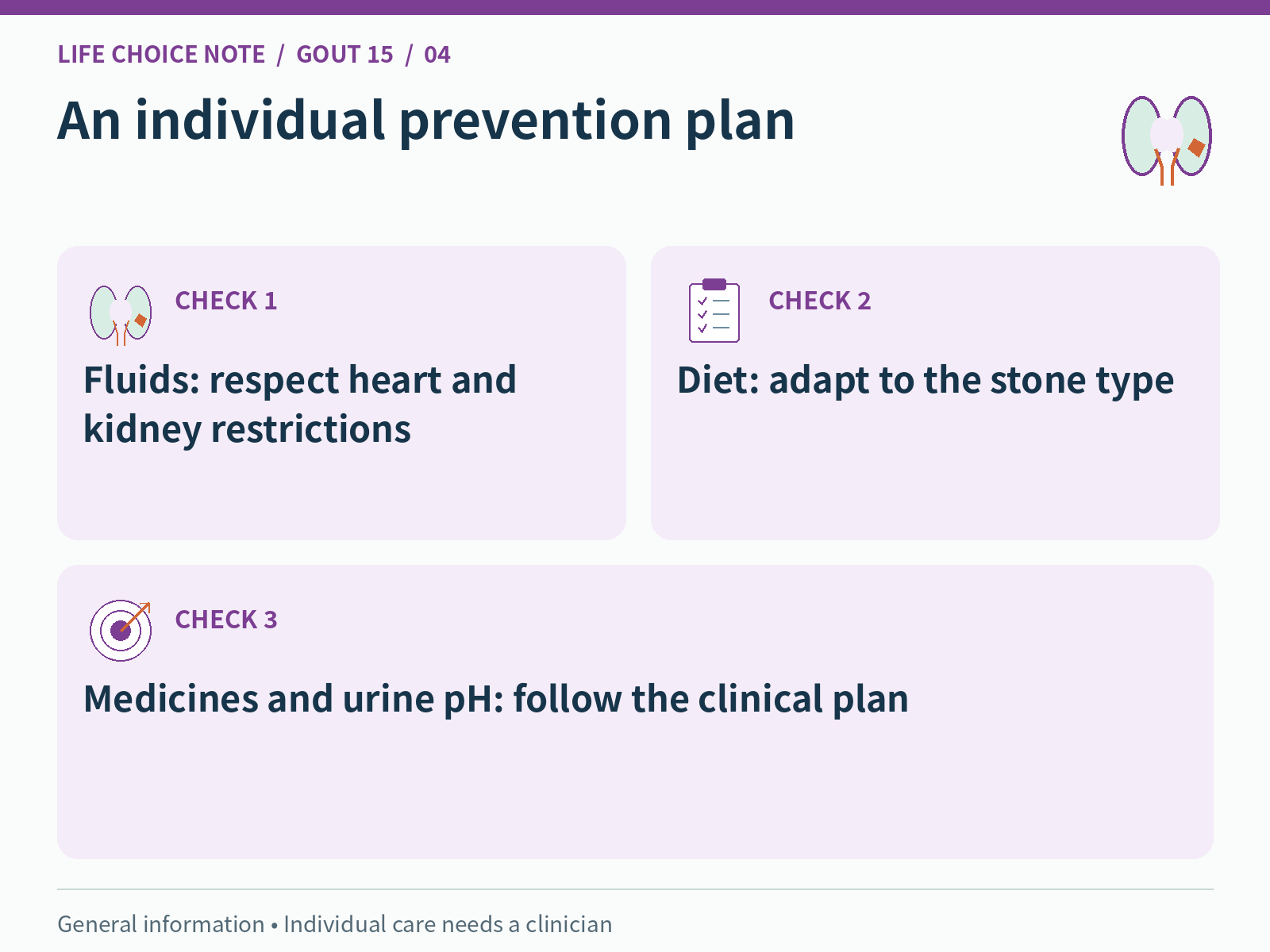
Appropriate fluid intake is important in recurrence prevention, but kidney function, heart disease and fluid losses affect the plan. NIDDK advises discussing fluid amounts with a healthcare professional, particularly with conditions such as kidney failure. This article does not prescribe one daily volume for every person with gout or stones.[7]
If you do not have a restriction, identify times when work, commuting or outdoor activity makes drinking difficult and discuss a practical routine. If heart or kidney care includes a fluid limit, do not exceed it because of general stone advice. Acute severe pain, vomiting or suspected blockage is different from routine prevention: forced drinking cannot replace assessment or necessary treatment.[3][4][7]
5. Diet and medicine depend on the stone
For uric acid stones, clinicians may review excess animal protein and urine acidity. Calcium stones can involve other dietary factors, including sodium or oxalate. NIDDK separates its advice by stone type. Do not combine every restriction into a blanket ban on meat, dairy, beans and vegetables; the plan must still meet nutritional needs.[7]
A calcium-containing stone is not a reason to remove all calcium from food. Appropriate dietary calcium may be part of calcium oxalate prevention. Supplements need a separate review of product, reason and amount. If gout and stone advice seem to conflict, ask a dietitian or clinician to create one workable plan rather than choosing between disconnected lists.[2][7]
Urine-alkalinising treatment may be used for uric acid stones under a monitoring plan. That is not an instruction to take household baking soda or another person’s citrate medicine. Stone type, kidney function and urine chemistry matter; excessive alkalinisation can create other problems. A higher urine pH is not automatically better, and self-treatment should not replace evaluation.[6]
6. Connect urology and gout follow-up
Tell the gout clinician when stones occurred, whether a procedure was required and what the analysis showed. Give the urology team your full list of urate medicines, flare treatments, diuretics and supplements. A drug used for stone prevention may have a different purpose from a gout prescription, even when both concern uric acid.[4][6]
After pain resolves, ask whether a stone remains, what follow-up imaging or tests are needed and how recurrence prevention will be reviewed. Passing one stone is not a guarantee that another will never form. Keep the reports and agreed fluid and dietary instructions available, especially when visiting different clinics in Korea or when moving between healthcare systems.[2][4]
What to bring to your appointment
- Bring the stone analysis and previous imaging.
- Report pain, blood, fever and urine changes.
- Confirm a fluid plan that respects restrictions.
- Review diet and supplements without blanket bans.
- Connect gout medicines, stone treatment and follow-up.
Common questions
If I have gout, must my stone be a uric acid stone?
No. Different stone types can occur, and serum urate alone cannot identify composition. Appropriate urine, blood and imaging tests, plus stone analysis when available, inform the diagnosis.[2][5][6]
Does gout medicine prevent every kind of stone?
No. Prevention depends on composition, urine chemistry and other risks. Clarify both the gout urate target and the separate stone-prevention plan.[6][7]
Can I wait at home and drink lots of water for flank pain?
New flank pain or blood in urine needs prompt assessment. Fever, chills, inability to pass urine, severe pain or persistent vomiting makes evaluation especially urgent. Forced fluids do not rule out obstruction or infection.[3][4]
This article provides general health information for adults, not a diagnosis or personal prescription. Discuss medicines, testing and dietary plans with your clinician, using Korean product information where you receive care. Sources were checked on 15 October 2026; this is not their publication date.
Related published reading
- CKD and Supplements: Bring the Bottle, Labs and Medicine List
- Supplements That Can Interfere With Lab Tests: Biotin and Beyond
- Previous: Can Weight Loss Help Gout, and How Should You Exercise?
- Next: What Else Should Be Checked at a Gout Follow-Up Visit?
Official and primary sources
- 통풍 · 질병관리청 국가건강정보포털 · 2025-05-19 등록; 2026-05-18 업데이트 · Checked 2026-10-15
- Definition & Facts for Kidney Stones · NIDDK, U.S. National Institutes of Health · Last reviewed 2017-05 · Checked 2026-10-15
- Symptoms & Causes of Kidney Stones · NIDDK, U.S. National Institutes of Health · Last reviewed 2017-05 · Checked 2026-10-15
- Treatment for Kidney Stones · NIDDK, U.S. National Institutes of Health · Last reviewed 2017-05 · Checked 2026-10-15
- Diagnosis of Kidney Stones · NIDDK, U.S. National Institutes of Health · Last reviewed 2017-05 · Checked 2026-10-15
- EAU Guidelines on Urolithiasis: Metabolic Evaluation and Recurrence Prevention · European Association of Urology · 현행 온라인 지침 확인; 확인일과 발행연도 구별 · Checked 2026-10-15
- Eating, Diet, & Nutrition for Kidney Stones · NIDDK, U.S. National Institutes of Health · Last reviewed 2017-05 · Checked 2026-10-15