What Should You Know About Febuxostat If You Have Heart Disease?
Headlines about febuxostat can seem contradictory. One highlights cardiovascular deaths; another reports reassuring comparative safety. The trials involved different populations and treatment situations, and regulatory wording differs between countries. Neither a claim of universal danger nor a promise of complete safety accurately represents that evidence.[1][2]
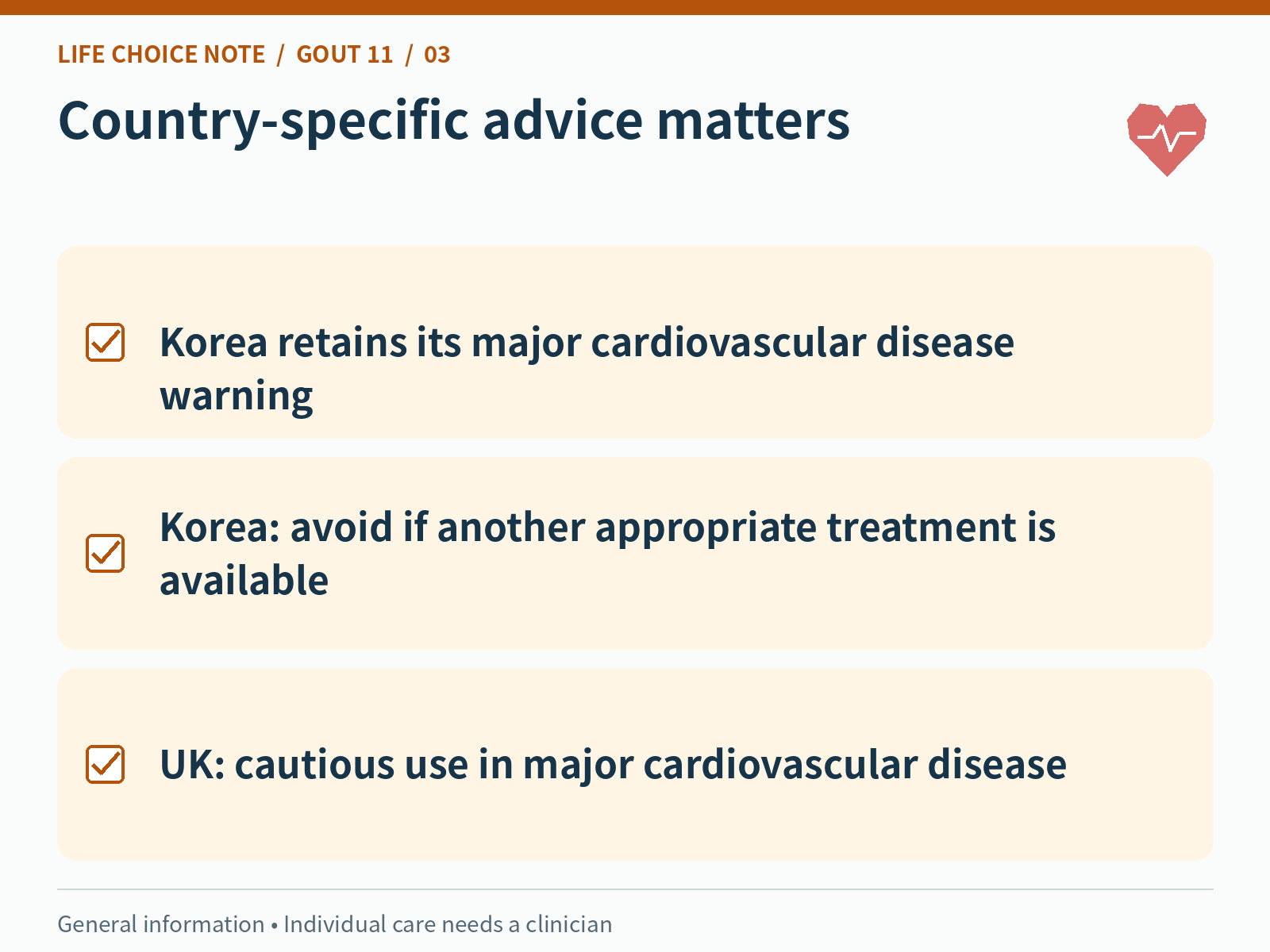
For someone receiving care in Korea, current Korean product information matters. The Feburic 40 mg label checked on 15 October 2026 still advises avoiding febuxostat in patients with major cardiovascular disease when another appropriate treatment is available. If you already take it, use this information for a focused prescription review rather than switching medicines yourself.[1]
1. Give a specific cardiovascular history
Tell the prescriber about any previous heart attack, stroke or unstable angina. Also report heart failure, other heart disease and recent cardiovascular admissions or procedures. Feeling well now does not erase a past event. If you do not know the exact diagnosis, bring the hospital name, approximate date, discharge information and current heart medicines.[1][2]
A risk factor such as high blood pressure is not the same as a previous heart attack. That distinction matters when interpreting research populations. Report a new cardiovascular event to the gout prescriber rather than assuming separate hospitals have automatically shared the records. New medicines after a hospital admission also need checking against the full gout treatment plan.[2][4]
2. What CARES found
CARES compared febuxostat and allopurinol in people with gout and established cardiovascular disease. Febuxostat met the trial’s non-inferiority criterion for its primary composite cardiovascular outcome, but cardiovascular death and death from any cause were more frequent in the febuxostat group. Reporting only that the combined event outcome was similar would omit an important finding.[1][2]
The results influenced medicine warnings and guideline recommendations. They do not predict what will happen to a particular individual. A useful clinical discussion asks whether your history and treatment circumstances resemble those studied, what alternatives are suitable and what benefits are expected. Do not interpret a relative-risk statistic as your personal absolute chance of a heart event.[2]
3. Why FAST did not erase the earlier warning
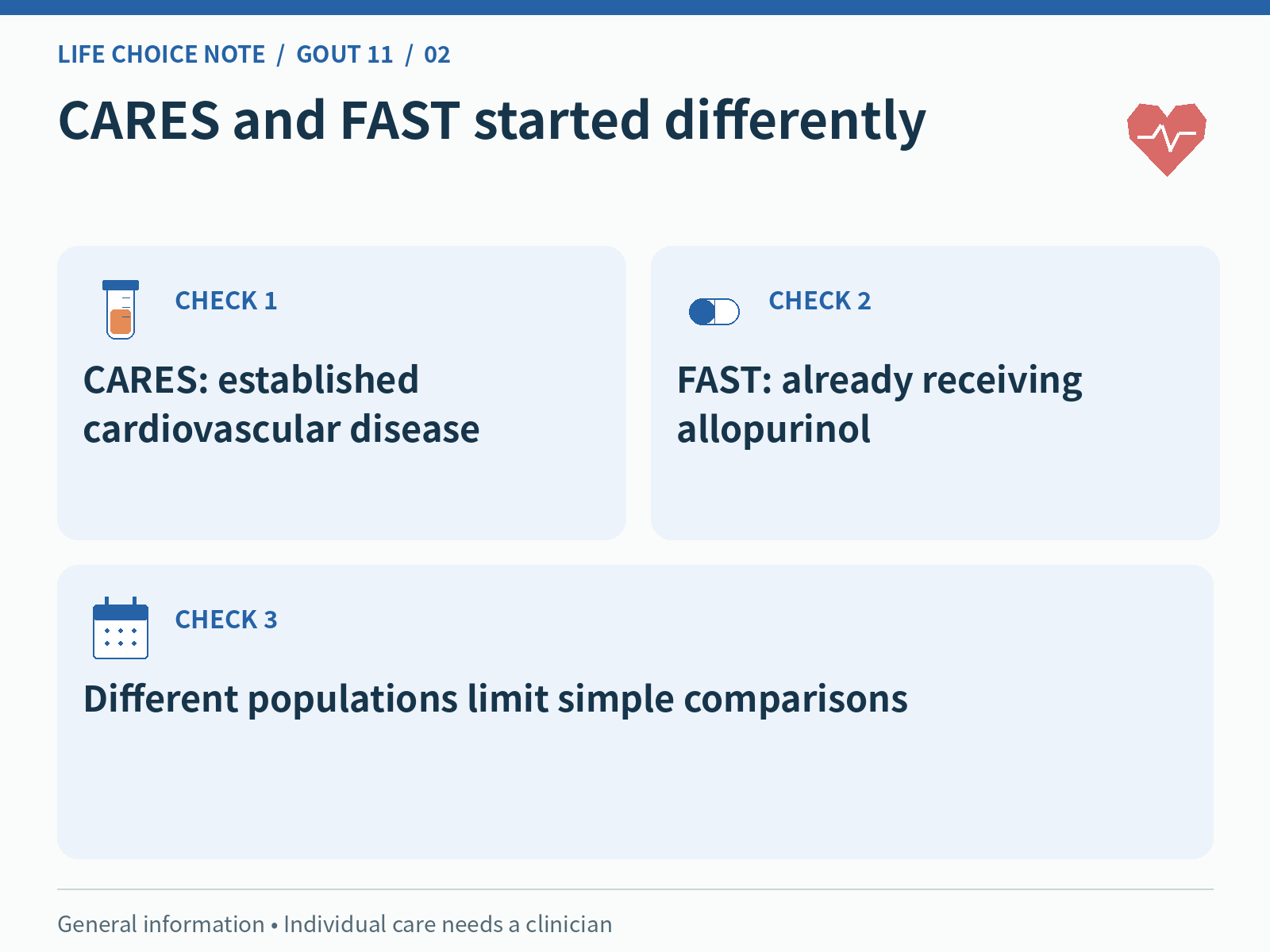
FAST studied people aged 60 or older with at least one cardiovascular risk factor who were already receiving allopurinol. Their allopurinol treatment was optimised before comparison. Febuxostat was non-inferior for the primary cardiovascular outcome, and the trial did not identify increased mortality compared with allopurinol. This added valuable evidence, but the starting situation differed from CARES.[1][2]
All CARES participants had cardiovascular disease, whereas only a proportion of FAST participants did. Some CARES participants were starting urate-lowering therapy; FAST participants were already experienced with it. Baseline urate and tophus burden also differed. Therefore, “FAST proves safety for every heart patient” is too broad, just as treating the later study as irrelevant would miss useful evidence.[2]
4. Separate Korean labeling from overseas advice
The current Korean Feburic label includes both CARES and FAST while retaining its warning to avoid use in major cardiovascular disease if another appropriate treatment is available. In 2023, the UK MHRA moved from its earlier avoidance advice to cautious use in this group. A report about that UK change should not be presented as a change to Korean prescribing information.[1][2]
UK NICE recommends allopurinol first-line for gout with major cardiovascular disease. The U.S. ACR 2020 guideline conditionally recommends switching a febuxostat user with cardiovascular disease or a new cardiovascular event to an alternative urate-lowering agent when suitable. These are clinician-led decisions. Previous allopurinol hypersensitivity and other risks still matter; “switch everyone to allopurinol” is not an adequate safety plan.[3][4]
5. What to do if you already take febuxostat
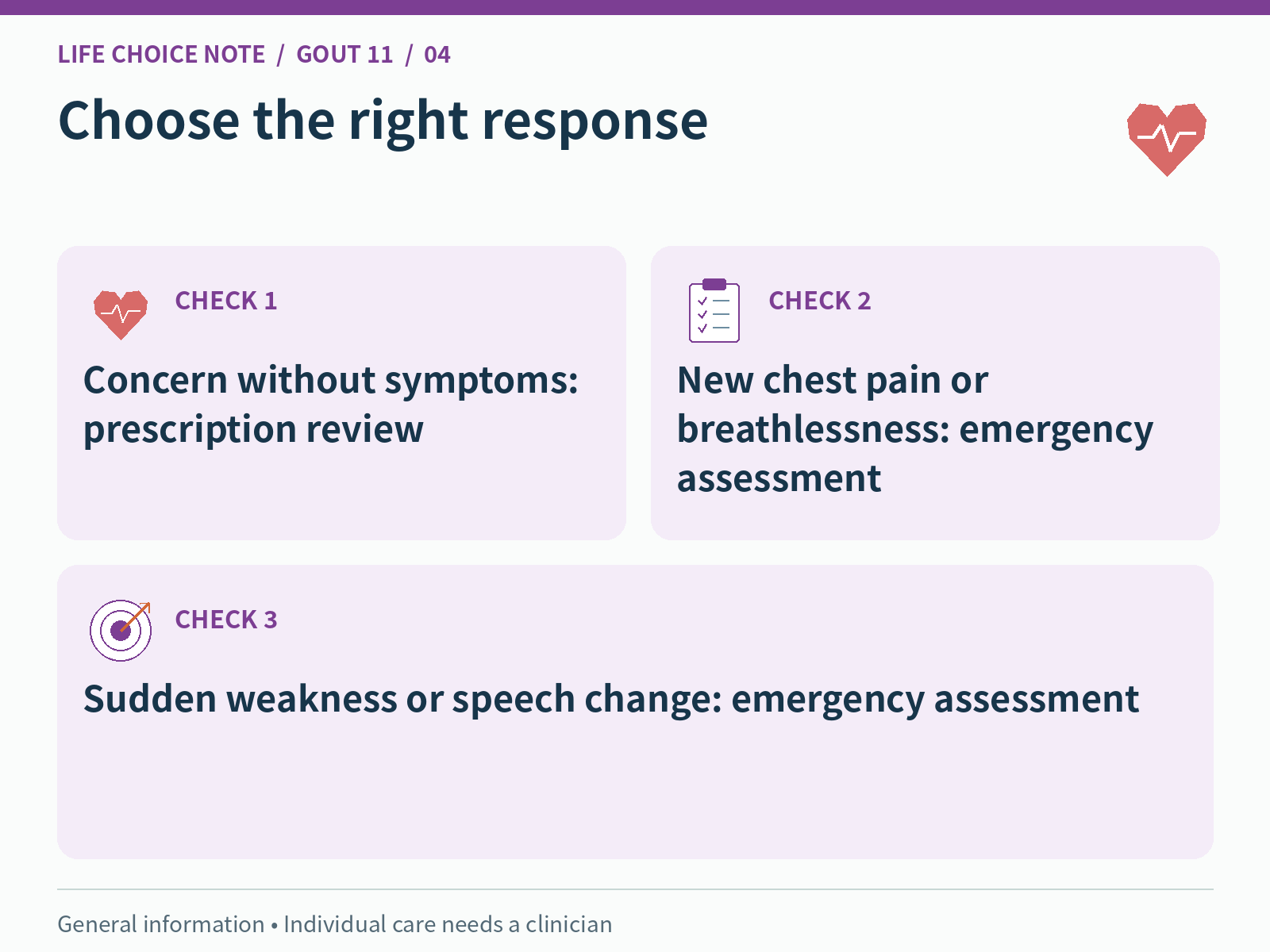
If you are well but concerned, contact the prescriber to review why febuxostat was chosen, whether allopurinol was previously tried, and how well gout is controlled. Make major cardiovascular history or any new event explicit. Do not replace the medicine with leftover tablets from a previous prescription. Reviewing alternatives is different from assuming that an abrupt, unplanned interruption is the safest option.[1][2][4]
New chest pain, shortness of breath, sudden one-sided weakness or slurred speech needs emergency assessment. Do not wait for a routine gout appointment or try to establish at home whether the medicine caused it. Record when symptoms began if possible and provide your medicine list. Gout medicine is not a treatment for those acute symptoms.[5]
6. Keep the rest of the safety plan in view
Febuxostat lowers urate over the long term; it is not an immediate pain treatment for an established flare. Early gout flares can still occur, so agree on prevention and response plans. Ask how urate will be monitored and when treatment will be reviewed. A pain-free period or one improved result is not, by itself, a reason to change the prescription.[3][5]
The Korean label contraindicates combining febuxostat with azathioprine or mercaptopurine and calls attention to liver disease and monitoring. Cardiovascular discussion does not replace that medicine review. Report a new rash to a clinician immediately. If severe hypersensitivity is suspected, such as blistering, mucosal sores, peeling skin or a rash with fever, or if signs of liver dysfunction such as jaundice develop, stop febuxostat immediately and obtain urgent assessment. Breathing difficulty or swelling of the face or throat requires emergency care.[1][5]
Bring four questions to the appointment: Why was this medicine selected? How does my heart history affect the choice? What limits the alternatives? What tests and contact plan do I need? If worry has made you miss doses, say so. A realistic agreed plan is more useful than a prescription that looks unchanged while you are actually taking it irregularly.
What to bring to your appointment
- List previous heart attack, stroke, unstable angina or heart failure.
- Clarify why febuxostat was selected.
- Report new events and medicines from other clinics.
- Know which symptoms need emergency assessment.
- Confirm urate and other monitoring appointments.
Common questions
Is febuxostat absolutely prohibited for everyone with heart disease?
The Korean warning says to avoid it in major cardiovascular disease when another appropriate treatment is available. Suitability and the benefit–risk balance require individual review. Neither a universal ban nor automatic reassurance is accurate.[1]
Can CARES be ignored now that FAST is available?
No. Their participants and treatment contexts differed. FAST adds evidence but does not guarantee safety for every high-risk patient. The current Korean warning remains relevant.[1][2]
Should I stop today because I am worried?
Discuss concern with the prescriber rather than changing treatment on your own. Acute chest symptoms, stroke-like symptoms or severe allergy are different: seek emergency assessment without waiting for routine advice.[2][5]
This article provides general health information for adults, not a diagnosis or personal prescription. Discuss medicines, testing and dietary plans with your clinician, using Korean product information where you receive care. Sources were checked on 15 October 2026; this is not their publication date.
Related published reading
- CKD and Supplements: Bring the Bottle, Labs and Medicine List
- Supplements That Can Interfere With Lab Tests: Biotin and Beyond
- Previous: How Is Gout Treated When Kidney Function Is Reduced?
- Next: Meat, Seafood, and Beans: How Should You Eat With Gout?
Official and primary sources
- 페브릭정40밀리그램(페북소스타트) 의약품 허가정보 · 식품의약품안전처 의약품안전나라 · 사용상주의사항 변경이력 2022-09-28; FAST 포함 현행 본문 확인 · Checked 2026-10-15
- Febuxostat: updated advice for patients with a history of major cardiovascular disease · UK Medicines and Healthcare products Regulatory Agency · 2023-05-25 · Checked 2026-10-15
- Gout: diagnosis and management, NG219 recommendations · UK National Institute for Health and Care Excellence · 2022-06-09 · Checked 2026-10-15
- 2020 American College of Rheumatology Guideline for the Management of Gout · American College of Rheumatology · 2020 · Checked 2026-10-15
- Febuxostat: patient medication information · MedlinePlus / American Society of Health-System Pharmacists · 2019-05-01 · Checked 2026-10-15