Late or Same-Day Vaccines in Korea: Timing Rules Explained
A missed dose usually does not erase earlier doses
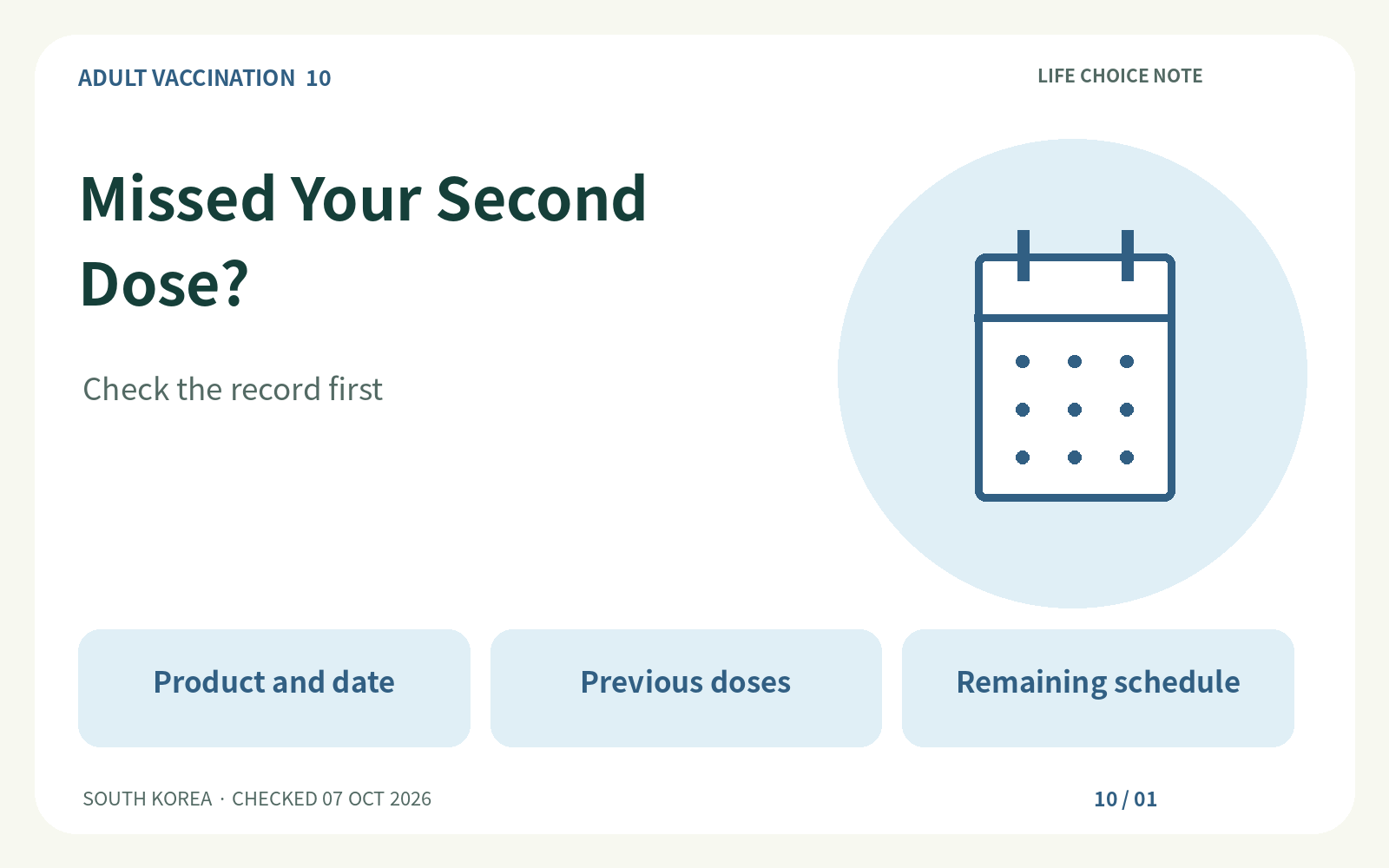
South Korea · Sources checked 7 October 2026. If your second or later vaccine dose is overdue, find the previous product and date first. KDCA’s general schedule information says a longer-than-recommended interval usually does not require restarting the series or adding extra doses. A clinician should review how to continue. [1]
Being late, being too early, and having no reliable record are different situations. Do not book a new “dose one” merely because the original appointment was missed.
Separate three timing questions
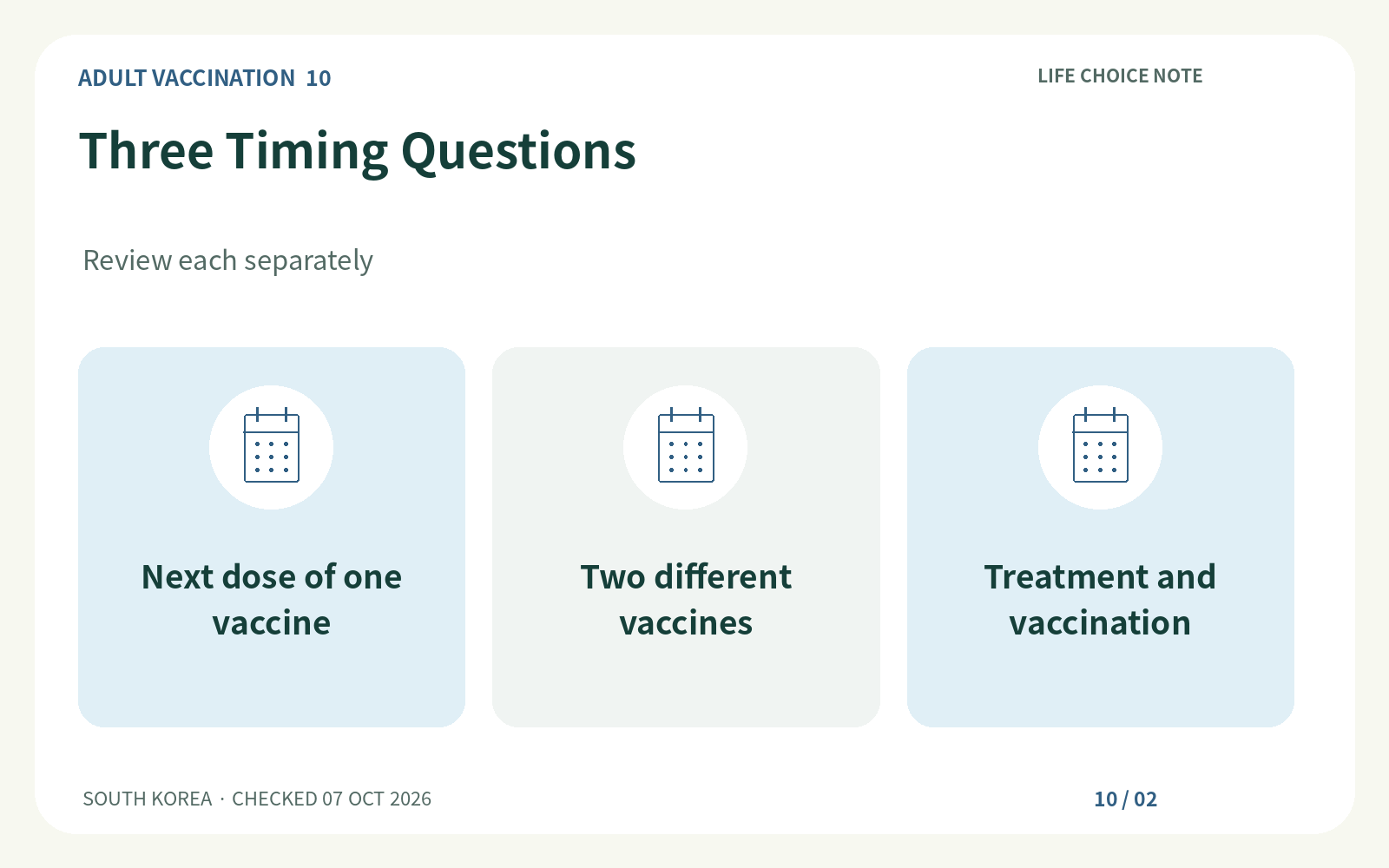
One question concerns the next dose of the same vaccine. Another concerns two different vaccines. A third concerns vaccines around treatment, transfusion or immunoglobulin. Each can involve different rules. [2][3][6][9]
Write three separate lines in your notes: “Vaccine A, dose one to dose two”; “Vaccine A to Vaccine B”; and “recent treatment to vaccination.” This makes a clinic discussion clearer than saying only that you had “an injection last month.”
Recommended intervals and minimum intervals
Recommended intervals guide routine planning. Minimum intervals help assess accelerated schedules and whether an earlier dose can count. They depend on the vaccine, dose and sometimes age, so the minimum is not automatically your best appointment date. [2][3]
For example, KDCA’s hepatitis A guidance puts the second dose at least six months after the first and notes that the usual timing window and age-related dose differ by product. Do not transfer that interval to HPV, MMR or another vaccine. [5]
If you have a flight, university deadline or new job, tell the clinician the actual date. Ask what can reasonably be completed beforehand and what documentation is available while a series remains unfinished.
What to do with an overdue dose
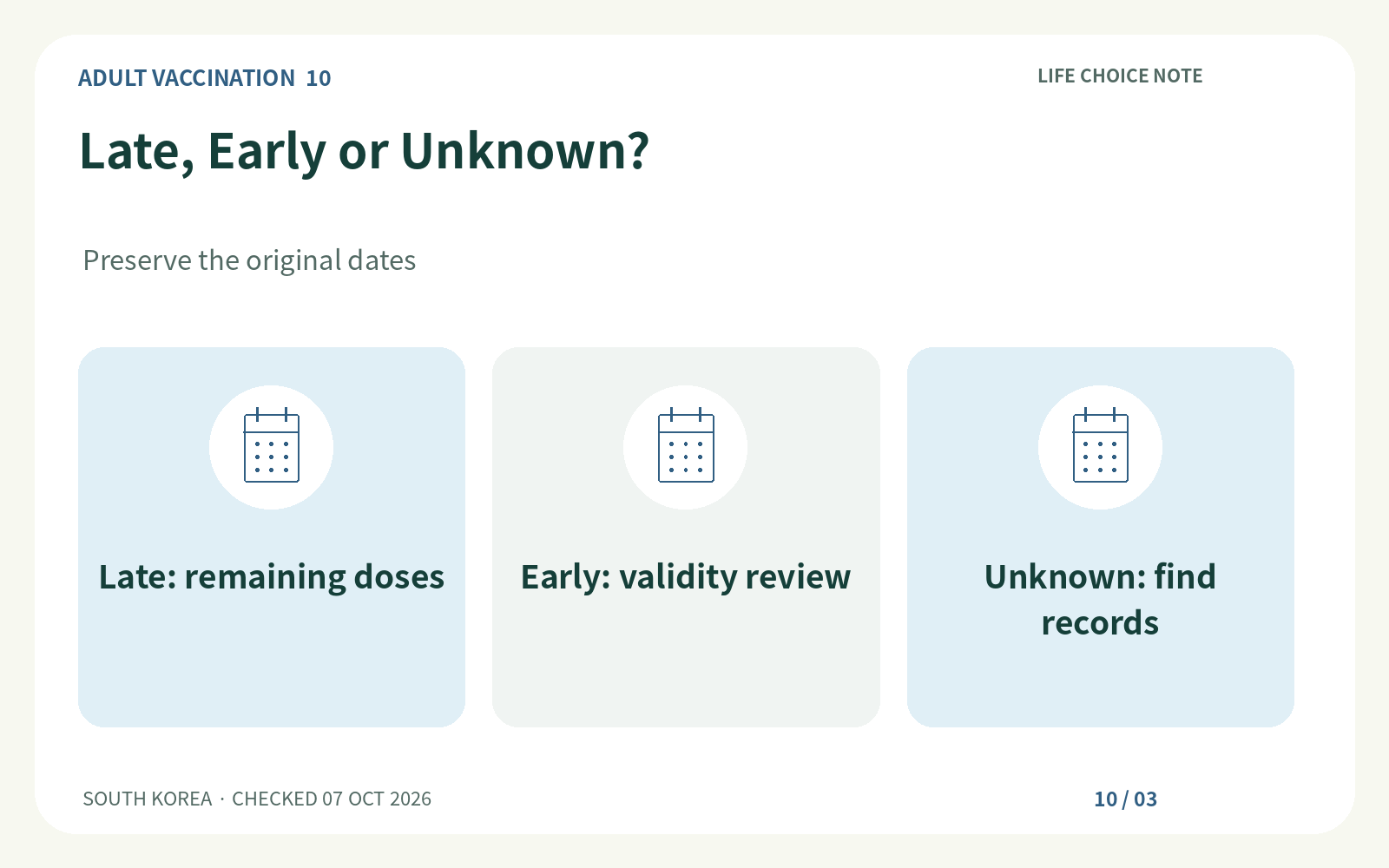
Keep each documented date rather than replacing the old schedule with a blank one. Bring a certificate or vaccine booklet if you are changing clinics, and ask which previous doses count and what remains. Ask about the product used for the next dose rather than assuming all brands are interchangeable.
As a general scientific explanation, the U.S. CDC notes that longer intervals usually preserve final antibody concentrations, but expected protection may not be reached until the required doses are completed. Exceptions exist, including oral typhoid vaccination. “No restart” therefore does not mean an indefinite delay is harmless. [3]
If the exact date is unknown, try the original clinic and existing documents. Mark unresolved entries as unknown. Guessing a date prevents the clinician from distinguishing a verified delay from an uncertain history.
An early dose needs a separate review
The 2026 Korean national guideline explains that doses given before minimum age or interval requirements may require correction. A short grace period applies to some situations, with exclusions including the four-week interval between different live vaccines. Do not decide alone that a dose counts, or repeat the whole series. [2]
Provide both dates, the product, the dose number and your age at vaccination. Ask: “Does this dose count, and if another dose is needed, which date determines the interval?” Keep the clinic’s revised plan with the original record.
Same-day vaccination has limits
Different non-live vaccines, or a non-live and live vaccine, can generally be given together or without a required interval between them, subject to specific exceptions. That does not override an individual product’s sequential schedule. [3]
Pneumococcal vaccination is a useful Korean example: the 2026 Korean Society of Infectious Diseases recommendation includes a PCV15-then-PPSV23 sequence, alongside single-dose PCV20 or PCV21 options. If using the sequential route, ask about order and spacing based on previous doses and health conditions. This is a Korean professional recommendation, not a promise of public funding. [4]
Separate vaccines given during one visit are administered separately. They should not be mixed into one syringe unless this is an approved combined product. [7]
The live-vaccine four-week rule
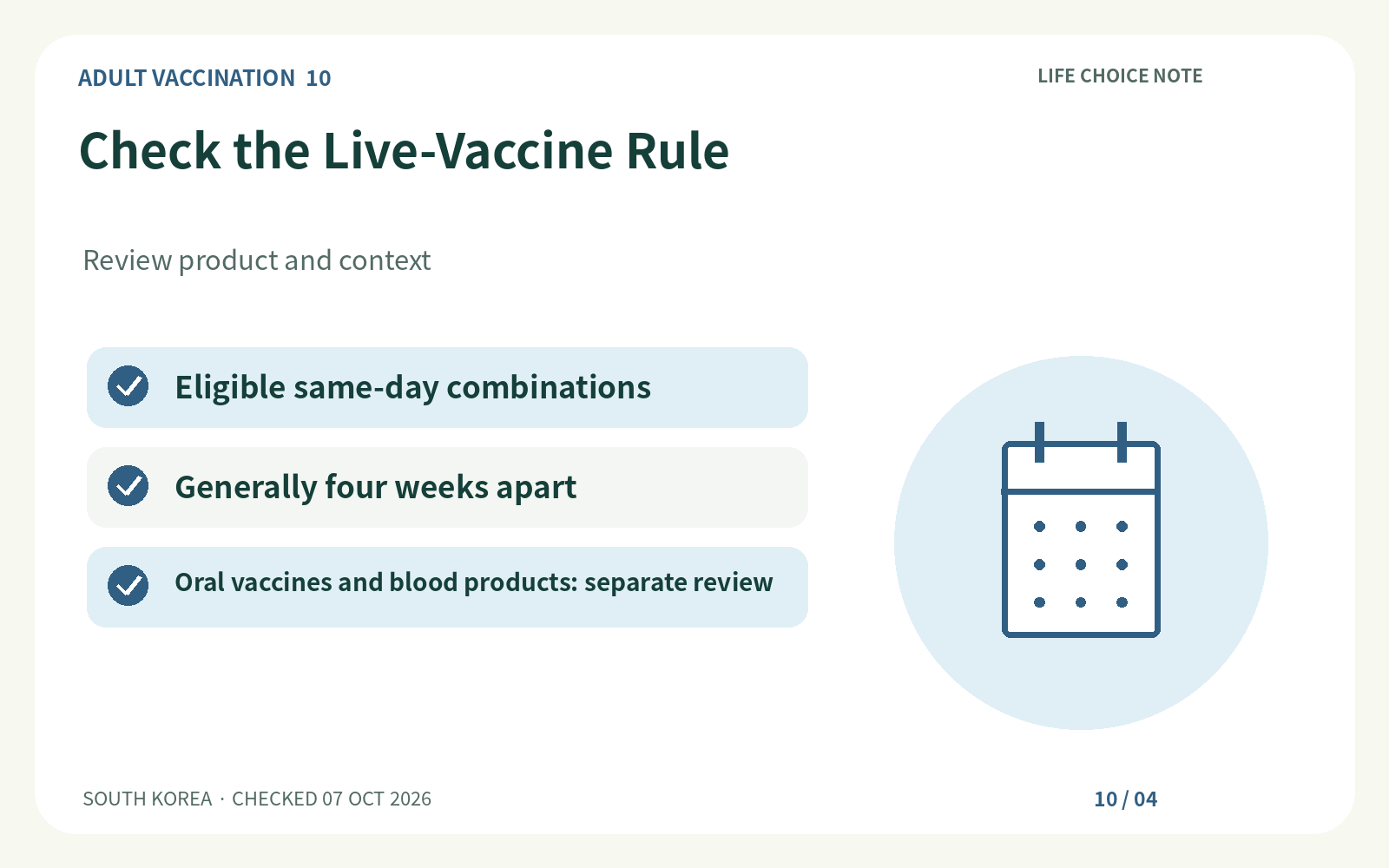
Korean guidance allows MMR and varicella on the same day. Injectable or intranasal live vaccines generally need at least four weeks between them if not given together; oral live vaccines are not all governed by that rule. Same-vaccine dose schedules still need their own check. [7][2]
Tell the clinic if you are planning MMR one week and chickenpox the next, or if that already happened. Exact dates allow the clinic to assess whether a dose needs correction.
Treatment and pregnancy can change the plan
Recent transfusion or immunoglobulin can change MMR or varicella timing according to the preparation and dose. These live vaccines are contraindicated in pregnancy, and significant immune suppression requires assessment before vaccination. Bring treatment dates and medicine details; do not stop medicines yourself. [6][9]
After stem-cell transplantation, a separate revaccination plan may be needed irrespective of earlier records. This differs from an ordinary missed appointment and should be coordinated with the transplant team. [4]
A clinic message you can use
“I received this product on this date and missed the next dose. Please review which doses count and how to continue. I also want to discuss these other vaccines.” In Korean: “다음 차수가 늦어졌습니다. 기존 접종기록을 확인하고 남은 접종 일정을 정하고 싶습니다.”
Ask for the next recommended date, any minimum interval relevant to your case, and whether the vaccines can be given together. Save the answer and the actual booking separately. Seek immediate emergency care for breathing difficulty, swelling of the face or throat, or reduced consciousness after vaccination. [8]
This article provides general information. Your clinician should determine the individual schedule, dose validity and same-day suitability using your records, health, treatment and actual vaccine products.
Related published guides
- Can You Get Flu and COVID Vaccines at the Same Time?
- South Korea Vaccination Law 2026: What Changes and When?
Sources
- 예방접종도우미: 표준 예방접종 일정표 · 질병관리청 · 최종검토 2024-01-15 · 2026-10-07 KST
- 2026년 국가예방접종 지침 의료기관용, 10월2일 수정 · 질병관리청 · 2026-10-02 수정본 · 2026-10-07 KST
- Timing and Spacing of Immunobiologics · 미국 CDC · 2024-07-24 · 2026-10-07 KST
- Recommendations for Adult Pneumococcal Vaccination in Korea: 2026 Update · 대한감염학회 성인예방접종위원회 · 온라인공개 2026-08-27 · 2026-10-07 KST
- 예방접종도우미: A형간염 · 질병관리청 · 최종검토 2025-01-20 · 2026-10-07 KST
- 예방접종도우미: 홍역과 수두의 금기·혈액제제 주의 · 질병관리청 · 최종검토 2025-01-20 · 2026-10-07 KST
- 2025년 국가예방접종사업 관리지침 의료기관용 2권 · 질병관리청 발행·대한병원협회 배포 원문 · 2025년 판 · 2026-10-07 KST
- 2026년 예방접종 후 이상반응 관리지침 · 질병관리청 · 2026-04 개정; 공개페이지최종수정 2026-04-07 · 2026-10-07 KST
- 예방접종도우미: 수두 금기와 혈액제제 · 질병관리청 · 최종검토 2025-01-20 · 2026-10-07 KST