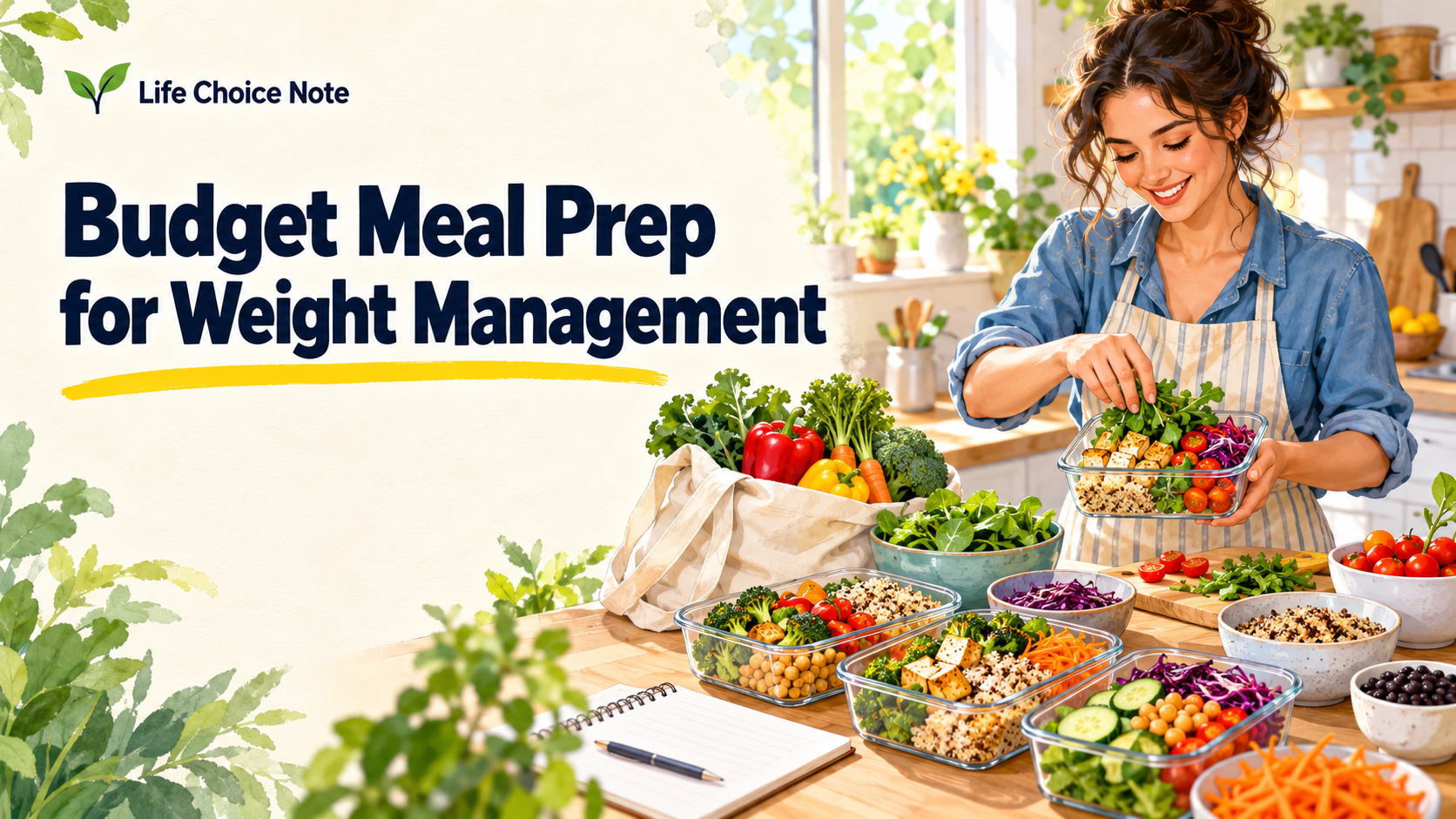
Budget Meal Prep for Weight Management
Before buying specialist diet meals, check the food already at home and how many meals you will actually eat there. A low unit price does not guarantee a low cost per meal if much of the food goes to waste.
This guide is for adults planning affordable meals while still eating adequately. It is not a promise that everyone can lose weight on a fixed grocery allowance or a prescription for a uniform daily calorie limit.
Budget meal preparation
Count real meals before shopping
Check supplies
Buy usable amounts
Store safely
Budget for the meals you will actually prepare
Start with an inventory of the fridge, freezer and cupboard, then mark meals out and other commitments. Buying seven dinners’ worth of fresh vegetables when you will only eat at home three evenings creates an avoidable mismatch. Base the list on people and meals, not an idealized week.
USDA MyPlate links checking existing food with meal planning and a shopping list. Treat cooking time and freezer space as practical constraints too. When time for preparation is scarce, a smaller prepared vegetable pack can sometimes cost less per amount eaten than a large item that spoils.
Evidence: USDA MyPlate: Healthy Eating on a Budget · USDA MyPlate: Planning for Healthy Eating and Savings
Compare the same quantity first
Compare unit prices
Invented prices for arithmetic
A: 600 g for KRW 3,600
B: 400 g for KRW 2,800
Per 100 g: A 600, B 700
Convert comparable products to the same unit. Hypothetical pack A costs KRW 3,600 for 600 g, or KRW 600 per 100 g. Pack B costs KRW 2,800 for 400 g, or KRW 700 per 100 g. A has a higher checkout price but a lower price for the same weight.
If only 300 g of A is eaten and the rest is discarded, the cost per 100 g actually eaten becomes KRW 1,200. Also consider edible yield after bones, peel or draining, discount conditions and delivery fees. These invented Korean-won prices illustrate arithmetic, not current offers; use your own currency and local prices.
Evidence: USDA MyPlate: Meeting Your Goals on a Budget
Reuse staples, protein foods and vegetables
Plan around a staple such as rice or oats, protein foods such as tofu, eggs or beans, and vegetables you can store and use. Fish or meat can vary with budget and preference. The same ingredients need not mean identical meals: use a stir-fry, rice bowl or mixed vegetable dish.
Do not reduce meals to one or two foods simply because they are inexpensive. Consider variety across the day, including vegetables and fruit, protein foods, staples and appropriate calcium sources. Frozen and canned foods can be useful; compare sauces, sodium and sugar information, and follow storage instructions after opening.
Evidence: USDA MyPlate: Healthy Eating on a Budget · USDA MyPlate: Planning for Healthy Eating and Savings
A seven-dinner example with two preparation days
Do not refrigerate a whole week of meals
Plan two preparation points
Early week: near-term meals
Midweek: cook and shop again
Later: previously frozen portions
This example shows combinations, not a complete daily menu or prescribed portions. Monday: rice, grilled tofu and cabbage. Tuesday: rice, steamed egg and carrots. Wednesday: previously frozen rice, beans and vegetables. Check fruit and dairy or suitable fortified alternatives across the rest of the day.
Prepare again on Thursday for rice, fish and vegetables. Friday can be a tofu-and-vegetable rice bowl; Saturday, a meal with eggs and vegetables; Sunday, safely stored frozen portions. This does not mean refrigerating all seven days of cooked food from Monday. Adjust with a midweek shop, a second cooking session or frozen portions.
Portion food with a storage plan
Safe portioning
Savings do not replace food safety
Divide into shallow containers
Refrigerate or freeze promptly
Label date and contents
Do not leave a large pot of cooked food at room temperature to cool for a long time. Divide it into shallow containers and refrigerate or freeze promptly. USDA advises a refrigerator temperature of 40°F, approximately 4°C, or below, with perishable food kept out no longer than two hours, or one hour above 90°F, approximately 32°C.
Most properly refrigerated cooked leftovers should be used within three to four days. Freeze portions early if they are intended for later meals, and follow stricter product-specific instructions. Rice also needs prompt safe storage. A normal smell cannot establish that food held at unsafe times or temperatures is safe.
Evidence: USDA FSIS: Leftovers and Food Safety
Include thawing and reheating in the plan
Label containers with the cooking date and contents so older portions are easy to find. Thaw the next meal in the refrigerator; if using a microwave to thaw, continue straight to thorough heating. Avoid leaving food on the counter to thaw all day.
USDA advises reheating leftovers to 165°F, or 74°C, at the center. A food thermometer helps check thick sections. Reheat the portion you intend to eat, and discard food with uncertain safe storage conditions. Reducing grocery costs is not a reason to accept a food-safety risk.
Evidence: USDA FSIS: Leftovers and Food Safety
Review cost and waste together
Add the cost of the amount used from each ingredient to estimate a meal’s ingredient cost. Include relevant oil, sauces and delivery charges. A nutrient-comparison tool converts nutrient values; it does not calculate prices or the cost of food waste.
Note one ingredient discarded and one unplanned food order this week. That may be enough to improve the next list: a smaller vegetable pack, or an easier meal for a busy day. A pattern that fits real life is more useful than a costly plan that cannot be maintained.
When money is too tight for adequate food
If the budget can only be met by skipping meals or removing protein foods and vegetables altogether, adequate nourishment takes priority over weight loss. Check official local food assistance or community nutrition services; availability and eligibility differ by location.
Do not apply this example as a weight-loss diet during pregnancy or breastfeeding, for children, with underweight or eating-disorder risk, or when conditions such as kidney disease or diabetes require an individual plan. A useful first step today is simply counting existing food and the meals you will eat at home.
Evidence: USDA Nutrition.gov: Nutrition on a Budget
Common questions
Is bulk buying always cheaper
It can help if you will use it or store portions safely. Without freezer space or a realistic schedule, a smaller pack can cost less per amount actually eaten.
Do I need special meal-prep containers
Use food-safe containers suitable for the intended storage and heating. Follow microwave and lid instructions. Safe portioning and date labeling matter more than an expensive set.
Does ordering takeout ruin the plan
No. Plans can change with appointments or fatigue. Adjust the next list, check the storage and use dates of remaining ingredients and return to your usual next meal.
Useful tools and records
Food Nutrition Comparison
Enter per-100-g nutrient values and portion weights yourself. It does not search a food database, calculate prices or assess micronutrient or meal adequacy.
Health Records and Visit Preparation
A collection of blank printable or PDF records to complete yourself. It does not automatically analyze or store food and hunger records.
Weight and Waist Log
A blank printable log without automatic averages or body-fat analysis. Discuss whether to track at all if measurement increases distress.
Related guides
- A Korean Meal Plan for Weight Management
- Korean Convenience Store Meals for Weight Management
- Protein for Weight Loss: How Much and Which Foods?
Official sources and original research
- USDA MyPlate: Healthy Eating on a Budget
- USDA MyPlate: Planning for Healthy Eating and Savings
- USDA MyPlate: Meeting Your Goals on a Budget
- USDA FSIS: Leftovers and Food Safety
- USDA Nutrition.gov: Nutrition on a Budget
Prepared from official sources and original research. General information, not individual diagnosis, treatment or nutrition advice. No separate medical-professional review was performed. Sources checked 5 October 2026 KST (4 October UTC). Diagrams are original explanatory illustrations.