What Else Should Be Checked at a Gout Follow-Up Visit?
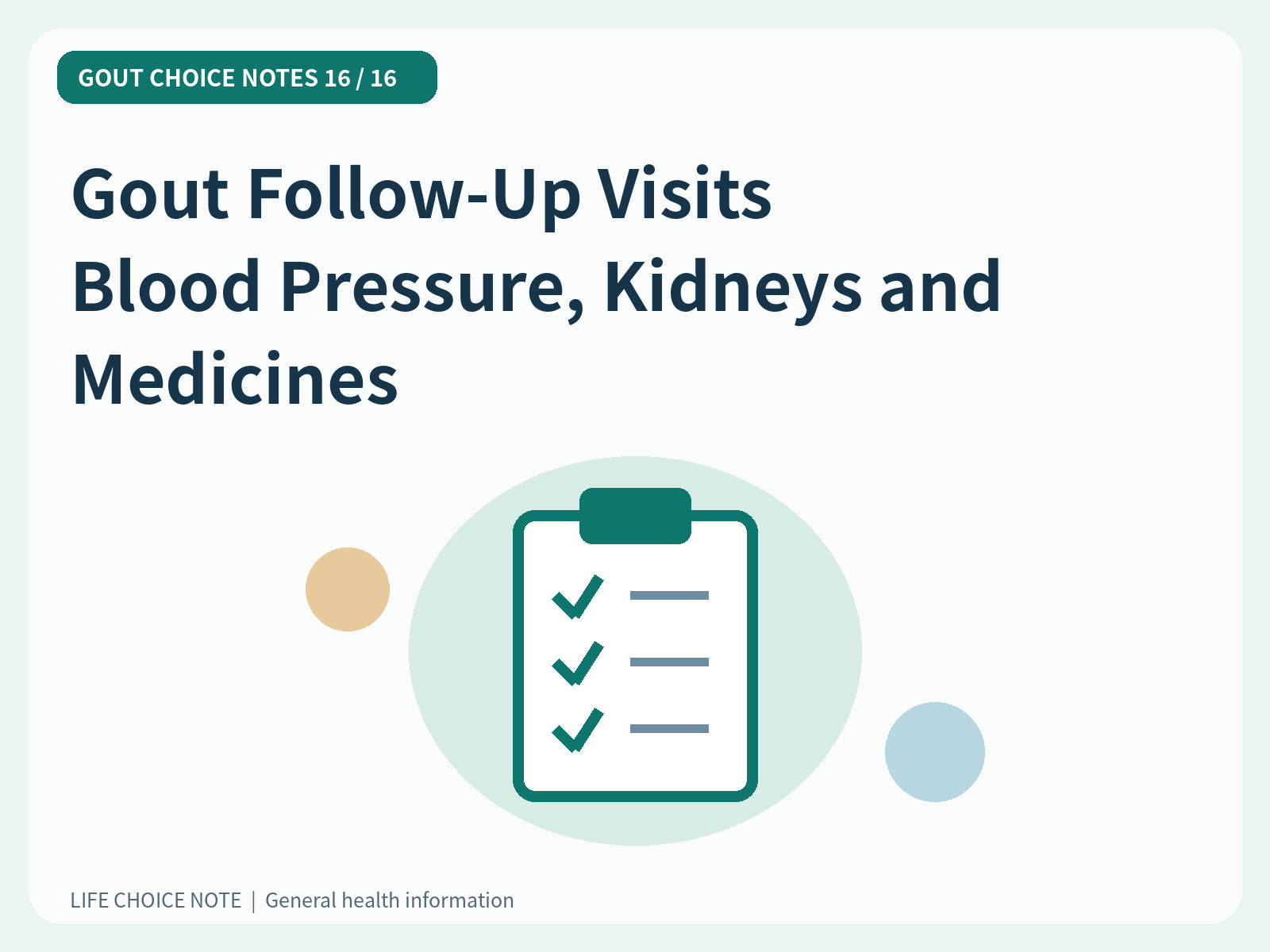
A gout review should do more than ask whether your toe hurts and read out one urate result. Kidney disease, blood pressure, metabolic health and cardiovascular history can affect treatment choices. Medicines prescribed for other conditions may also matter. A comfortable joint does not make those questions irrelevant.[1][2]
Bring recent flare dates, laboratory results and a complete medicine list. The aim is not to repeat every possible test at every visit. It is to agree on what needs monitoring at your current treatment stage, understand the next steps and know when a new symptom needs earlier attention.[2]
1. Describe flares and their real-life impact
Note when a flare began, which joint was affected and how long it lasted. Include visits to other clinics, treatment used and any adverse effects. Dated information is more useful than a vague memory of several painful episodes when discussing long-term treatment and its effectiveness.[2][3]
Also describe missed work, poor sleep, difficulty walking and symptoms between flares. Report persistent movement restriction or new lumps without diagnosing them from photographs alone. If an old flare count is uncertain, label it as an estimate. From now on, a brief calendar note can be enough; a complex symptom diary is not required to have a useful consultation.[2]
2. Compare the result with your own urate target
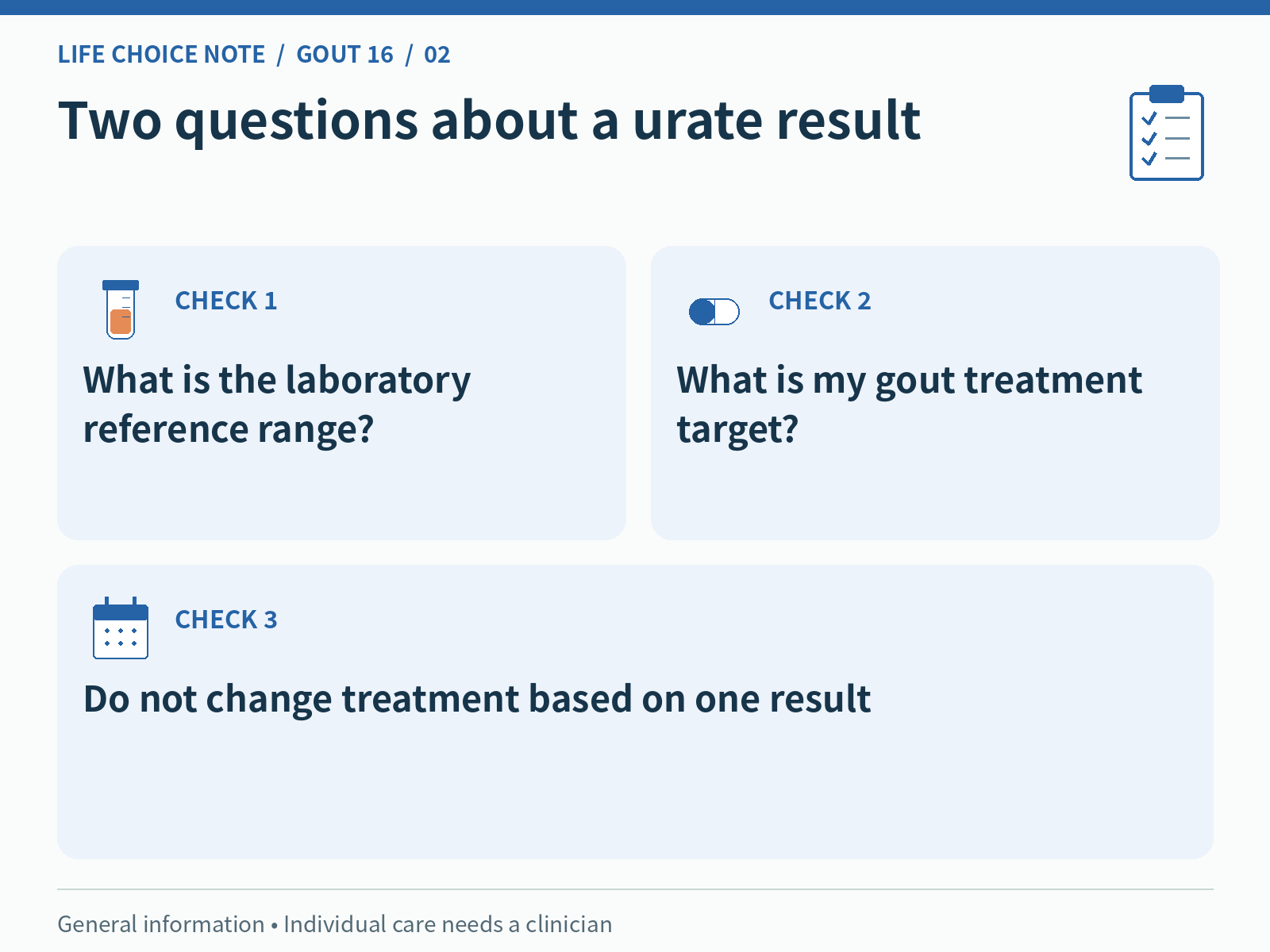
The Korean 2023 and ACR 2020 guidelines support a general serum urate target below 6 mg/dL during urate-lowering treatment. Being inside a laboratory reference range is not necessarily the same as meeting the gout treatment target. Keep the result’s date and the treatment circumstances beside the number.[3][4]
NICE considers a lower target below 5 mg/dL for tophi, chronic gouty arthritis or ongoing frequent flares despite a level below 6 mg/dL. That is not a universal target, and ACR 2020 does not specify that separate lower threshold. Ask which target applies to you and why. Do not change the dose based on one result; report missed doses and recent medicine changes honestly.[2][3]
3. Review kidney and cardiovascular health
KDCA describes the association of gout with chronic kidney disease, dyslipidaemia, obesity, diabetes and cardiovascular conditions. NICE recommends reviewing comorbidities and cardiovascular risk factors after a flare. This does not mean that every person with gout has all these conditions; it means that relevant history should be considered rather than treating the joint in isolation.[1][2]
Bring recent blood-pressure and kidney results and report heart attack, stroke or heart failure history. Tell the clinic if another doctor changed treatment. The team can decide which tests need repeating and which recent results can be used. Improved urate does not, by itself, establish that blood pressure, diabetes or kidney disease is adequately managed.[1][2][5]
4. Do not stop aspirin or diuretics yourself
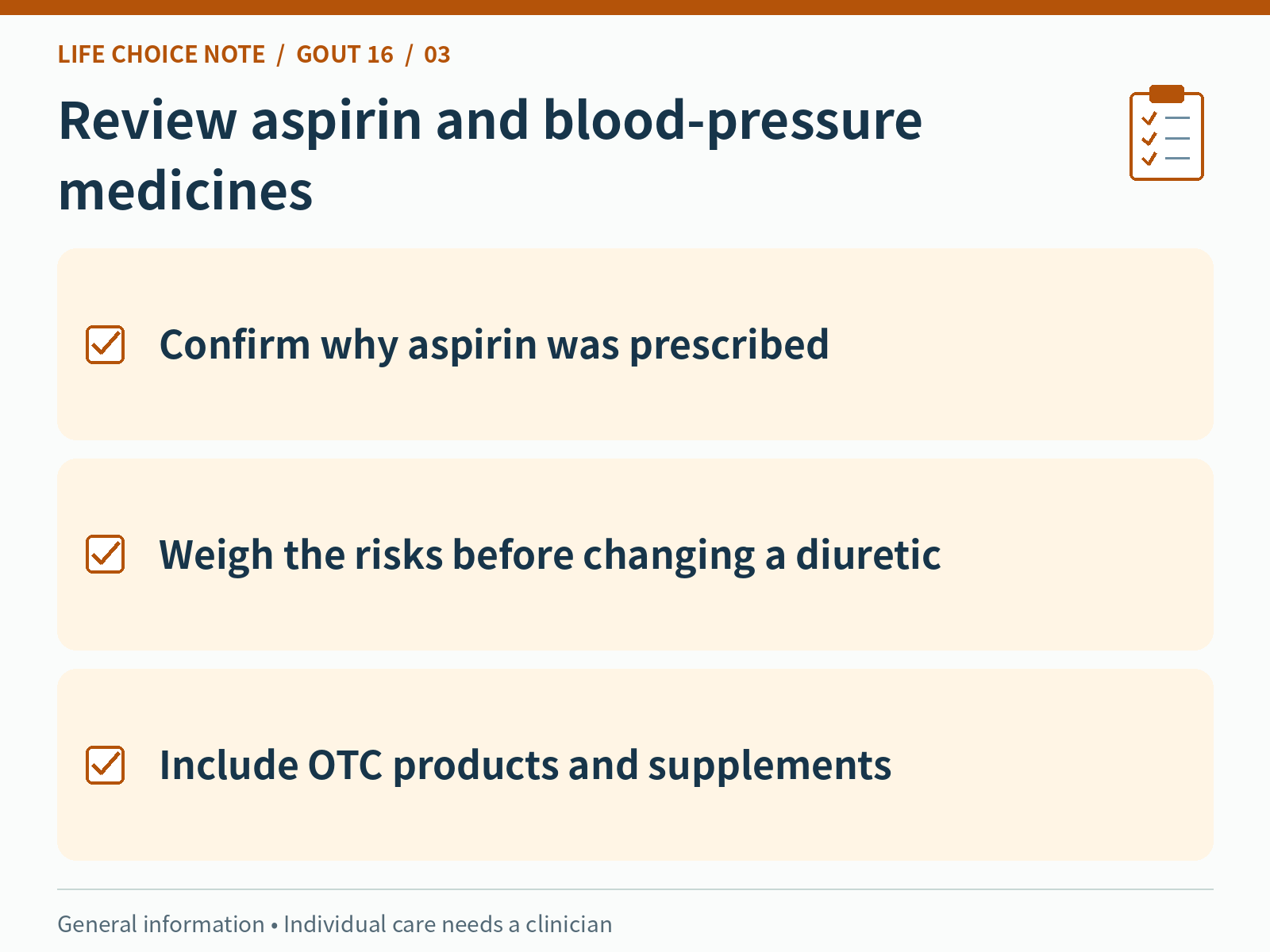
Some medicines affect urate, but their original purpose still matters. ACR conditionally recommends switching hydrochlorothiazide when feasible and preferentially considering losartan where appropriate. This is not an instruction to replace every diuretic or blood-pressure medicine. The expected gout benefit must be weighed against possible harm to the condition being treated.[3]
ACR conditionally recommends against stopping low-dose aspirin when it is being used for an appropriate indication. Do not discontinue it simply because you read that it can affect urate. Bring all prescriptions, OTC cold remedies and painkillers, supplements and herbal products. Different brands can contain overlapping ingredients, and kidney disease or dehydration can alter the safety of nonprescription medicines.[3][5]
5. Monitoring changes with the treatment stage
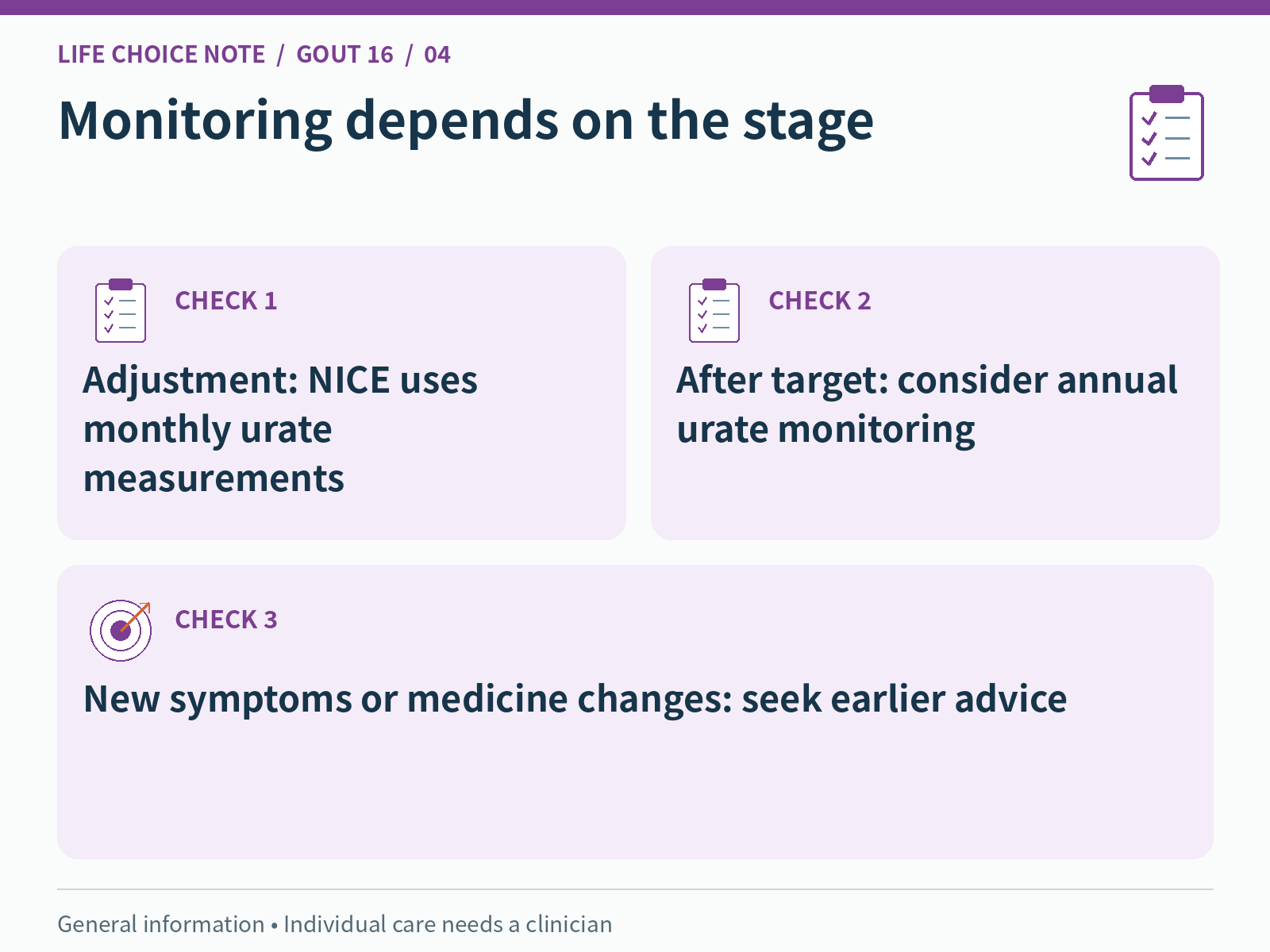
NICE uses monthly serum urate measurements to guide tolerated dose increases while working toward the target, then suggests considering annual urate monitoring after the target is reached and treatment continues. These are UK recommendations, not a rule that every person receiving care in Korea must follow the identical schedule. Product information, kidney or liver status and clinical changes may require a different plan.[2]
Considering annual monitoring does not mean waiting a year when new problems develop. More frequent flares, suspected adverse effects, a new illness or another medicine change may need earlier review. Ask what each planned test is for: urate control, medication safety or follow-up of another condition. Confirm who will explain the results and how the next appointment fits prescription supply.[2][5]
6. Leave with three clear plans
Before leaving, confirm the everyday treatment plan, the response to another flare and the route for urgent symptoms or adverse reactions. Identify each medicine’s purpose. If a prescription changed, ask which old medicine it replaces rather than assuming both should continue. A simple written list helps when several Korean clinics or pharmacies are involved.[2][4]
Serious new symptoms should not wait for a routine review. Specific medication warnings also override casual advice to keep treatment unchanged: for example, Korean allopurinol labeling requires immediate discontinuation for a new rash or hypersensitivity signs and prompt assessment. The general instruction not to stop long-term treatment on a whim does not mean tolerating a potentially serious reaction.[6]
Finally, explain what could make the plan difficult: cost, shift work, fear of adverse effects or confusion about medicine names. The useful outcome of follow-up is knowing your target, what you actually take, the next tests and what to do if something changes. That is more informative than receiving one reassuring number without a workable plan.
What to bring to your appointment
- Bring flare dates, duration and daily-life impact.
- Know the latest urate result and personal target.
- Share kidney, blood-pressure and cardiovascular information.
- List prescriptions, OTC products and supplements.
- Confirm routine review, flare response and urgent contacts.
Common questions
Can I skip follow-up if nothing hurts?
A symptom-free period can still require review of urate control, medicine safety and other conditions. Agree on an interval suited to your stage of care rather than cancelling simply because pain is absent.[2][4]
Should aspirin or a diuretic be stopped if it affects urate?
No self-directed change is recommended. In particular, low-dose aspirin with a valid indication should not be stopped because of gout. Any blood-pressure medicine switch needs review of benefits and risks.[3]
After reaching target, is testing exactly once a year?
NICE says to consider annual monitoring during continuing treatment. It is not an inflexible interval. New symptoms, medicine changes or kidney deterioration can justify earlier assessment; agree on your individual schedule.[2]
This article provides general health information for adults, not a diagnosis or personal prescription. Discuss medicines, testing and dietary plans with your clinician, using Korean product information where you receive care. Sources were checked on 15 October 2026; this is not their publication date.
Related published reading
- CKD and Supplements: Bring the Bottle, Labs and Medicine List
- eGFR calculator: estimate kidney filtration and review limits
- Previous: Does Gout Increase Your Risk of Kidney Stones?
- Continue with: Can Weight Loss Help Gout, and How Should You Exercise?
Official and primary sources
- 통풍 · 질병관리청 국가건강정보포털 · 2025-05-19 등록; 2026-05-18 업데이트 · Checked 2026-10-15
- Gout: diagnosis and management, NG219 recommendations · UK National Institute for Health and Care Excellence · 2022-06-09 · Checked 2026-10-15
- 2020 American College of Rheumatology Guideline for the Management of Gout · American College of Rheumatology · 2020 · Checked 2026-10-15
- Korean guidelines for the management of gout · Korean College of Rheumatology · 2023-07-01 · Checked 2026-10-15
- Keeping Kidneys Safe: Smart Choices about Medicines · NIDDK, U.S. National Institutes of Health · Last reviewed 2018-06 · Checked 2026-10-15
- 자이로릭정(알로푸리놀) 의약품 허가정보 · 식품의약품안전처 의약품안전나라 · 사용상주의사항 변경이력 2026-06-29; 현행 본문 확인 · Checked 2026-10-15