Creatine in Midlife: Decide What Progress Means Before Adding a Supplement
Imagine setting aside the next eight weeks to build a strength-training habit. This is a planning example, not a prescribed program or a promised deadline for results. Before buying creatine, decide what you would like to observe: attending planned sessions, performing familiar movements more consistently, or doing more work under comparable conditions.
Those observations can make the supplement question more precise. Instead of asking whether creatine is “for women,” ask what it might add to a particular training goal and how you would avoid mistaking a change on the scale for an answer.
Make the training record useful before adding another variable
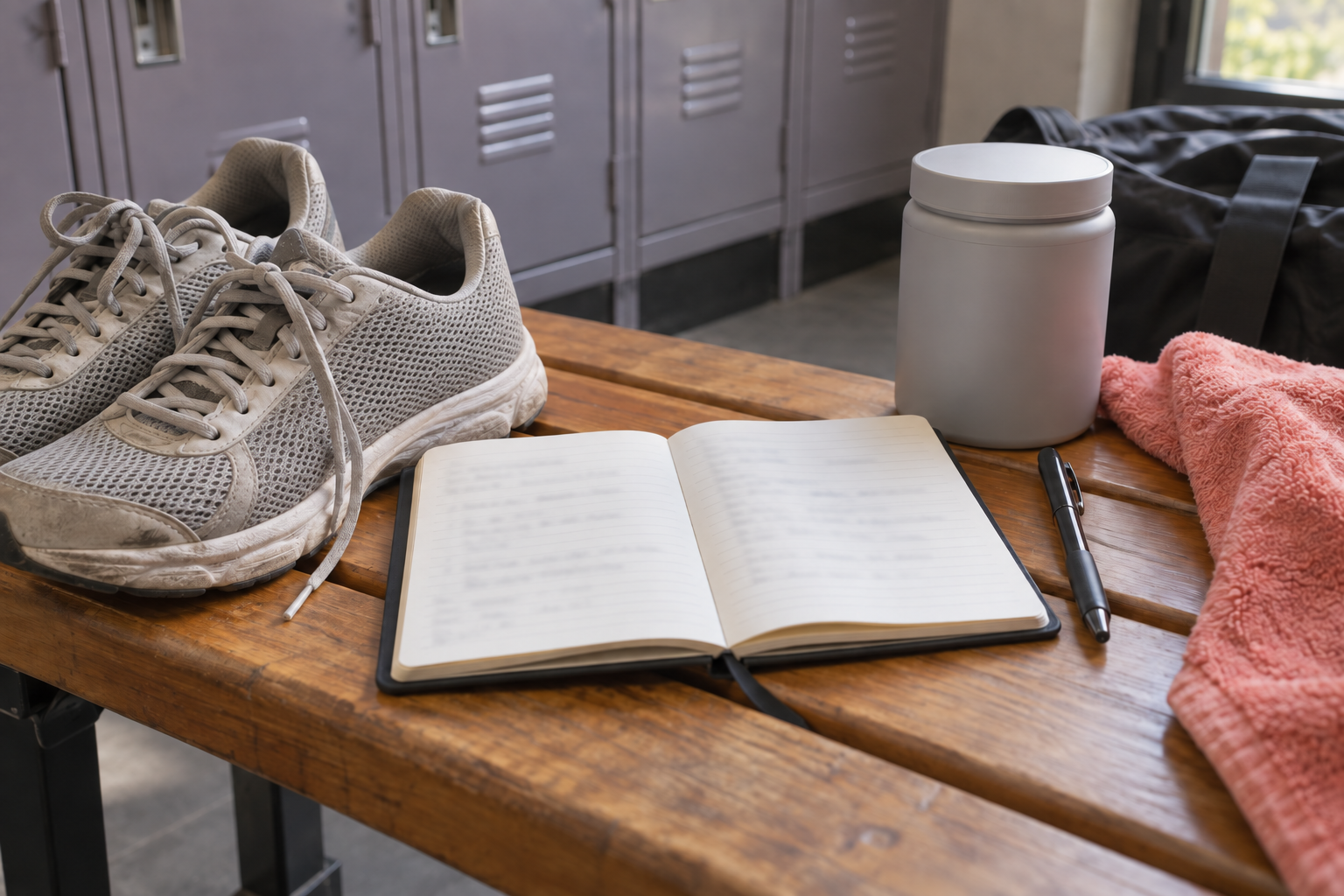
Record the movement, equipment settings, repetitions and relevant conditions. If you have a coach, agree on measures appropriate to your experience and health. Keep the date of any supplement change separate from a change in the program. This creates a record you can discuss, not an experiment that proves a product caused your progress.
An improvement may coincide with better technique, more consistent attendance or a different exercise setup. Likewise, a difficult session can occur for reasons that a supplement cannot identify. The purpose of the record is to describe what happened clearly rather than assigning every change to the newest product.
For example, imagine that your notebook shows more completed sessions, unchanged body weight and better performance on a familiar machine. Those are three separate observations worth keeping. If the machine settings changed halfway through, mark that date too. A tidy comparison is more useful than forcing the entire period into a single label such as success or failure.
Check the label before interpreting the marketing
Creatine monohydrate has the largest research base. Claims that another form works better, absorbs more effectively or avoids water retention have limited support. A more expensive name should therefore prompt a request for relevant evidence, not an automatic upgrade. OPSS product guidance
Check the actual creatine amount per serving, rather than assuming the entire scoop is creatine. A blend may also contain stimulants or other ingredients. If several products are used, keep their labels together so that a new purchase does not quietly duplicate an ingredient.
A high-dose loading phase is not compulsory; lower-dose approaches used consistently have also been studied. A research protocol is not a personalized instruction, and an unfavorable early measurement is not a reason to escalate the amount. Discuss a suitable approach if you decide to use it.
Give each measurement a separate meaning
| Observation | What it can tell you | What it cannot establish alone |
|---|---|---|
| Body weight | Total mass has changed | Whether the change is fat or muscle |
| Lean-mass-related estimate | A measured non-fat component has changed | That every added unit is new muscle tissue |
| Strength performance | Force or performance in the tested movement | The source of every improvement |
Creatine can increase water retention and body weight. Water also contributes to lean-mass-related measurements; definitions differ across methods. Do not treat all of these estimates as identical measurements of newly built muscle. NIH creatine overview
A 2025 trial illustrates the timing issue. In 63 adults, a seven-day creatine phase preceded the training program and increased the lean-body-mass estimate. During the subsequent 12 weeks of shared resistance training, additional gains did not differ between groups. Controls received neither creatine nor placebo. Participants averaged 31 years, limiting direct application to all midlife women. Desai and colleagues
Evidence for women deserves more than a yes-or-no label
NIH describes benefits for repeated short, intense efforts, including strength and power activities, with variable individual responses. This makes creatine relevant to some training goals. It does not promise a particular response because someone is female, middle-aged or starting a new routine.
In a two-year trial involving 237 postmenopausal women, creatine was added to resistance training and walking. Walking time improved, but the tested maximal-strength outcomes did not show an extra benefit over placebo. A lean-tissue benefit appeared in a valid-completer subgroup analysis. The endpoint and analysis therefore matter as much as the headline. Chilibeck and colleagues
That finding should not be compressed into either “women do not benefit” or “all women gain strength.” The age, health, training background and outcome being considered need to match the question you are trying to answer.
Read the newer no-exercise claim with its study design attached
A 2026 study reported gains in lean tissue and strength even without a structured exercise program. Its 12-week analysis included 64 completers aged 45–65: 40 women and 24 men. Participants chose exercise/diet participation before supplement or placebo randomization. This small, short study is not evidence that supplementation can replace exercise, and its findings should not be promised to every midlife woman. Chun and colleagues
Research can identify possibilities without settling every practical question. Keep any proposed benefit tied to its measured outcome and population. Neither this trial nor a change in your own scale reading establishes a treatment for fatigue, a way to reverse aging, or a dementia-prevention strategy.
Revisit the decision when health information changes
Safety findings in healthy adults do not automatically apply to someone with kidney disease. If kidney care is already part of your medical history, discuss use before starting. Bring the product and its amount, rather than simply describing it as a gym supplement.
Tell the clinician before blood testing if you use creatine. It and recent intense exercise can influence creatinine and a creatinine-based eGFR estimate. A changed result should not be diagnosed as kidney injury from one number, nor dismissed as “just the creatine.” Interpretation depends on the broader clinical picture. National Kidney Foundation
When you review the training period, bring the exercise record and supplement dates together. You can then discuss whether the routine is sustainable, what has improved and whether the optional supplement still has a clear purpose. The record remains valuable even if you decide not to use creatine.
General health information, not individual diagnosis, treatment or an exercise prescription. The eight-week example illustrates planning only. Sources checked September 23, 2026 (KST).
Related guides
- Do You Need Supplements? Start With the Problem You Want to Solve
- How to Read a Supplement Facts Label Without Misreading the Dose
- Is This Supplement Actually Verified? How to Check Quality Claims Before Buying
- eGFR Calculator: Understand a Creatinine-Based Estimate and Its Limits
References
- NIH ODS — Exercise and athletic performance supplements
- OPSS — Creatine monohydrate, 2025
- Chilibeck et al. — Two-year trial in postmenopausal women, 2023
- Desai et al. — Creatine wash-in and resistance-training trial, 2025
- Chun et al. — Exercise/diet participation and creatine trial, 2026
- National Kidney Foundation — Creatinine