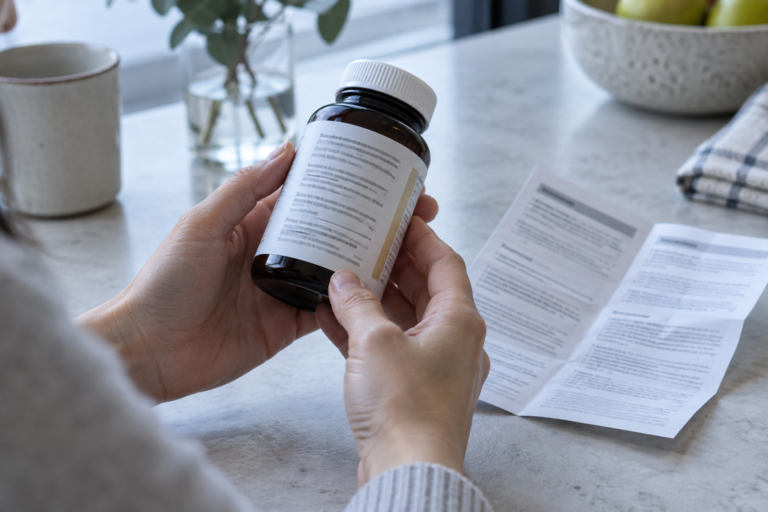
When Supplement Instructions Don’t Fit Your Day
One bottle says to take it with food. Another mentions an empty stomach. Your prescription has its own instructions, and none of them seems to fit the morning you actually have. Where should you start?
Treat the mismatch as a specific problem to resolve. Keep prescription instructions in place, collect the exact product labels, and identify what is making the routine difficult. The four situations below help you prepare useful questions without inventing a universal timetable. They concern products you already have a reason to take; they are not a shopping list.
You keep skipping the meal your plan depends on
Suppose a breakfast reminder goes off every day, but breakfast rarely happens. Before moving the reminder, check whether the instruction is tied to food, a medicine, or simply a time you chose for convenience. That distinction tells you what needs to stay fixed.
Calcium provides a useful example. Calcium carbonate is best taken with food, while calcium citrate can be taken without it. NIH also notes that calcium absorption is highest at elemental doses of 500 mg or less. That describes absorption, not the amount everyone should add. Confirm your appropriate total and whether it should be divided. NIH: calcium
For vitamin D, dietary fat can improve absorption, but some is absorbed without fat. A regular meal may therefore be worth discussing when rebuilding the routine. This does not make lunchtime universally better than evening, or justify an extra dose after taking one without food. NIH: vitamin D
Bring your real meal pattern to the conversation: “Lunch is reliable; breakfast is not.” Once medication constraints and product directions are checked, that is more useful for planning than choosing an hour because a social-media chart recommends it.
The instructions are clear, but your stomach is unhappy
A schedule can look sensible on paper and still become difficult to follow. If discomfort makes you delay or miss doses, explain that directly. Record the product, when you took it, what you ate or drank, and the symptoms. You do not need to identify the cause before asking for help.
Iron is generally absorbed better on an empty stomach, yet gastrointestinal discomfort can occur. MedlinePlus explains that a small amount of food may be needed to reduce that problem. It also cautions against taking iron simultaneously with milk, calcium, or antacids. MedlinePlus: taking iron supplements
Tea and coffee deserve a place in the record too: the NHS ferrous sulfate guidance identifies them, along with dairy products, as relevant to absorption. Ask about the instructions for your actual preparation rather than applying one rule to every iron product. NHS: taking ferrous sulfate
For prescribed iron, discuss whether food conditions, formulation, or the treatment schedule need review. Do not independently lower the dose or change the days you take it. Persistent or severe symptoms need assessment; repeatedly moving an alarm does not address every possible reason for discomfort.
A new prescription has made the old arrangement uncertain
Bring the supplement list when a medicine is added, even if the routine previously felt straightforward. A comfortable schedule is not proof that every new combination fits. Include product names, strengths, formulations, and the actual times you have been taking them.
Iron can interact with certain antibiotics, levothyroxine, and some osteoporosis medicines. The NHS advises asking a doctor or pharmacist how much separation is needed. A blanket two-hour gap is not a substitute for checking the named medicine and its formulation. NHS: iron and other medicines
Show the prescription instructions before asking where a supplement could fit. If the directions conflict or seem impossible alongside meals and work, leave that question open for the pharmacist rather than rearranging prescribed treatment yourself.
After the advice is clear, write the reason beside the chosen slot. “Interval confirmed for these products” is more useful than an unexplained “take later.” Keep the relevant instructions with the record so that a future medicine change prompts another check instead of quietly inheriting the old timetable.
You replaced the bottle but kept its predecessor’s instructions
A similar product name can conceal a different formulation or set of directions. Read the replacement label before transferring the old reminders. Compare the complete ingredients, serving instructions, and storage conditions, including anything that changes how you can carry it through the day.
Probiotics are one example: their evidence depends on the strain, product, and intended use. NIH discusses strain-specific guidance and checking storage instructions. The before-meal directions from one probiotic should not automatically become a rule for all the products that follow it. NIH: probiotics
Combination supplements deserve the same attention. Marketing words such as “energy” or “relaxation” do not provide enough information to assign an hour. If something feels different after a switch, keep the old and new product details available and describe the change. A personal observation can guide a discussion without proving that timing caused the difference.
Leave a record you can update
Use three columns to connect each instruction with everyday life. The sample entries below are prompts for organizing a discussion, not a completed dosing schedule. Replace them with the directions confirmed for your products.
| Condition to honor | Routine to check | Question still open |
|---|---|---|
| Current label says with food | Usual lunch | Does the new prescription affect this choice? |
| Prescription-specific separation | Slot to confirm with pharmacist | What interval applies to these exact products? |
| My product and instruction: ___ | My usual meal or event: ___ | I need to confirm: ___ |
Once those questions are answered, choose reminders that match the confirmed plan. Revisit the record when a medicine, product, or daily routine changes. You should be able to tell why each slot exists, what it depends on, and which instructions need checking again.
This article provides general health information, not individual diagnosis or treatment. US and UK sources are identified; your product directions and personal prescribing advice take priority. Sources checked September 23, 2026 (KST).
Related reading
- Supplements and Medicines: What to Check Before a New Bottle, Blood Test, or Procedure
- Do You Need Vitamin D? Separate the Supplement Decision From the Blood Test
- Taking Several Supplements? Check What the Ingredients Add Up To