Td vs Tdap in Korea: Adult Boosters and Pertussis
Find the name behind a tetanus shot
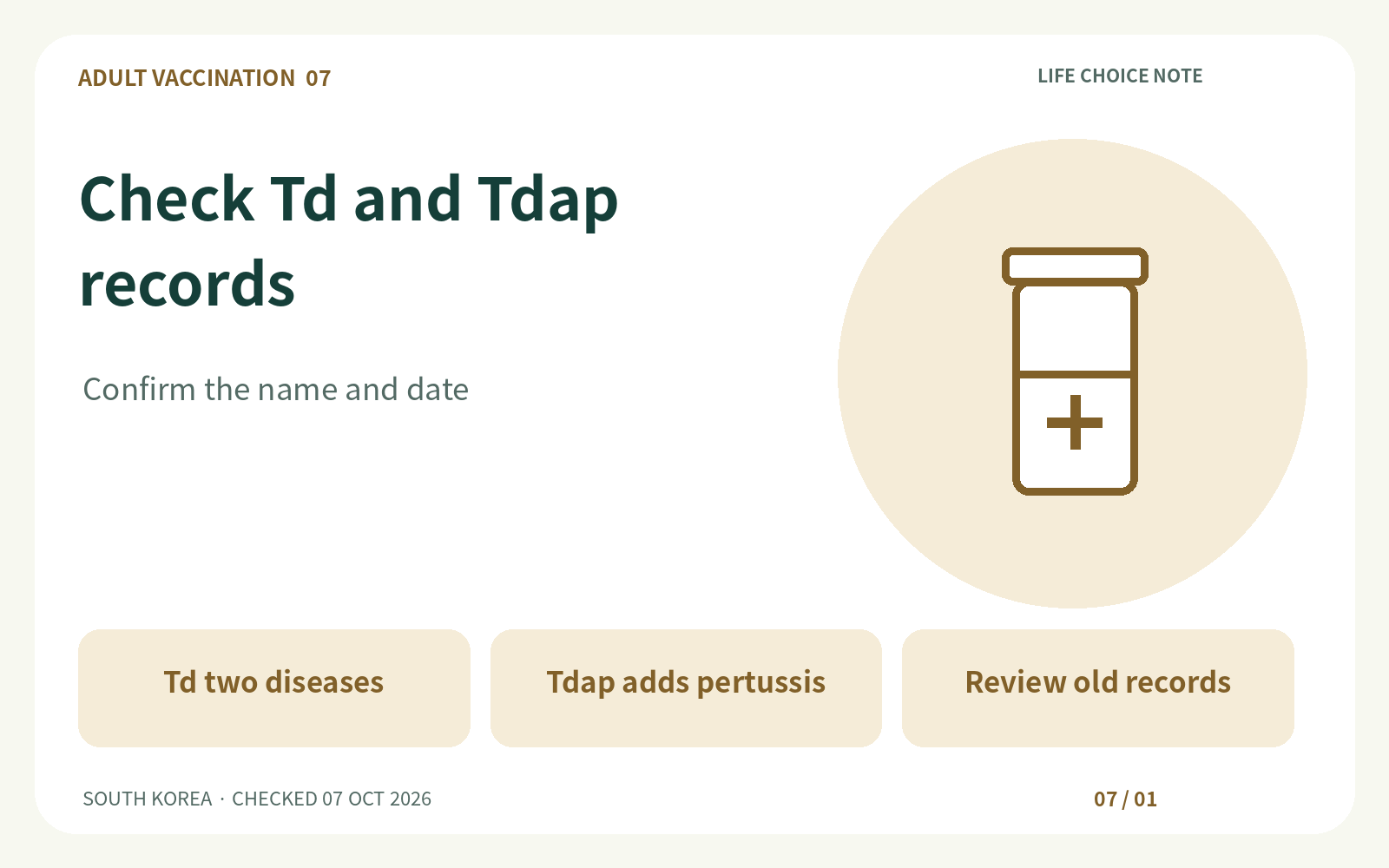
This guide concerns adults receiving care in South Korea, with sources checked on 7 October 2026. Td protects against tetanus and diphtheria; Tdap also includes pertussis, or whooping cough. A recollection of having a “tetanus shot” therefore does not establish whether you received the pertussis component. [1][2]
Locate the product and date before making a second booking. The important questions are whether your primary course is complete, when you last received a tetanus-containing vaccine, and whether Tdap appears in the record. Pregnancy, infant contact and a recent wound add different considerations.
Primary vaccination and routine boosters
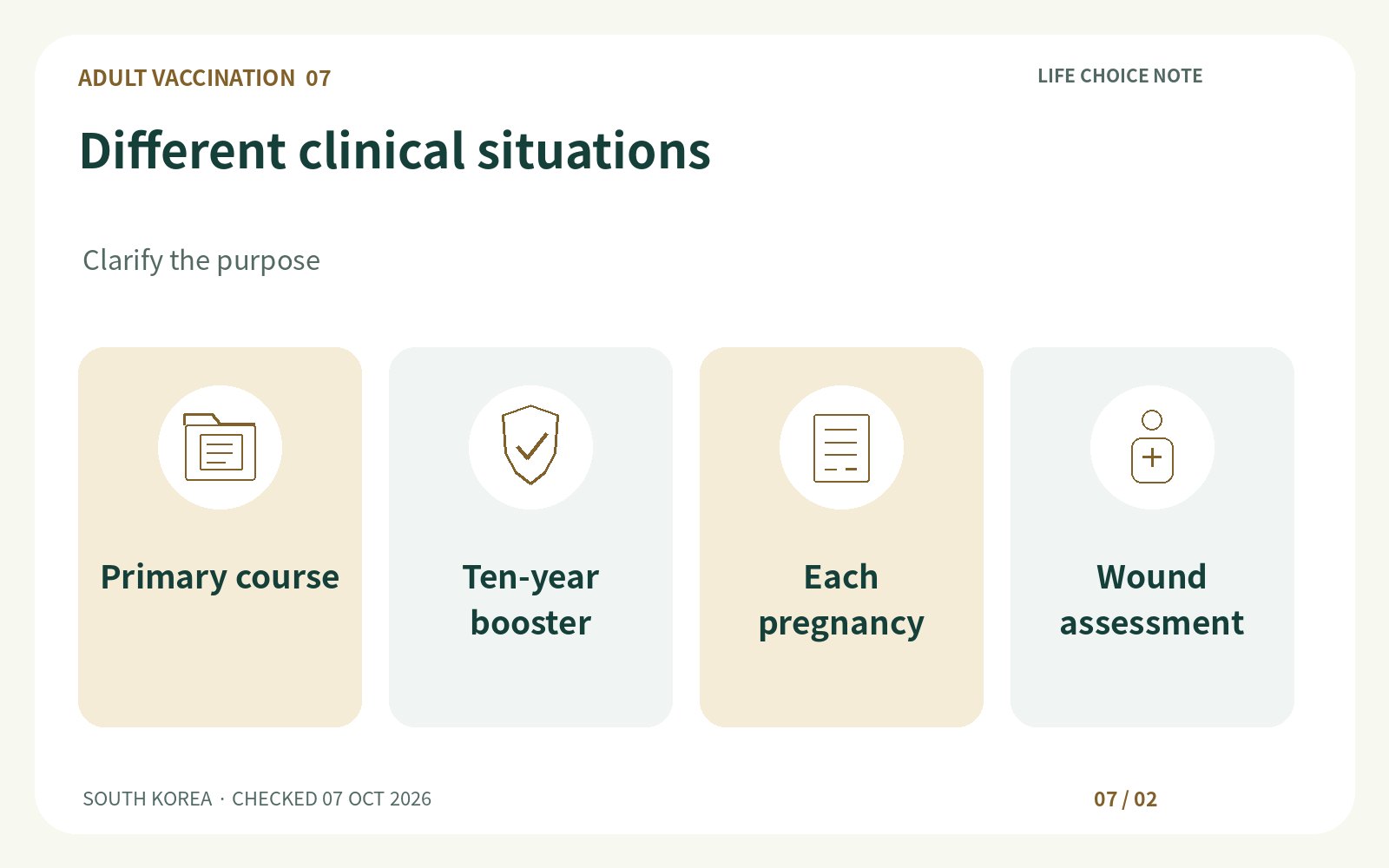
Korean guidance generally describes Td or Tdap boosters every ten years after a completed primary course. A Tdap history matters because Td does not cover pertussis. An explanation that adults should have at least one Tdap dose should not be read as permission to forget later tetanus and diphtheria boosters. [1][2][3]
Adults with no primary vaccination or unclear records may need a three-dose primary plan containing at least one Tdap dose. A single injection given during an emergency visit does not necessarily complete that plan. The clinic should determine which documented doses can be counted. [1][3]
Ask for actual appointment dates rather than copying isolated interval numbers into your calendar. A description measured from dose one can be confused with an interval measured from dose two. Your existing dates and the chosen product are more useful than a generic timetable.
A wound-treatment injection may have another name
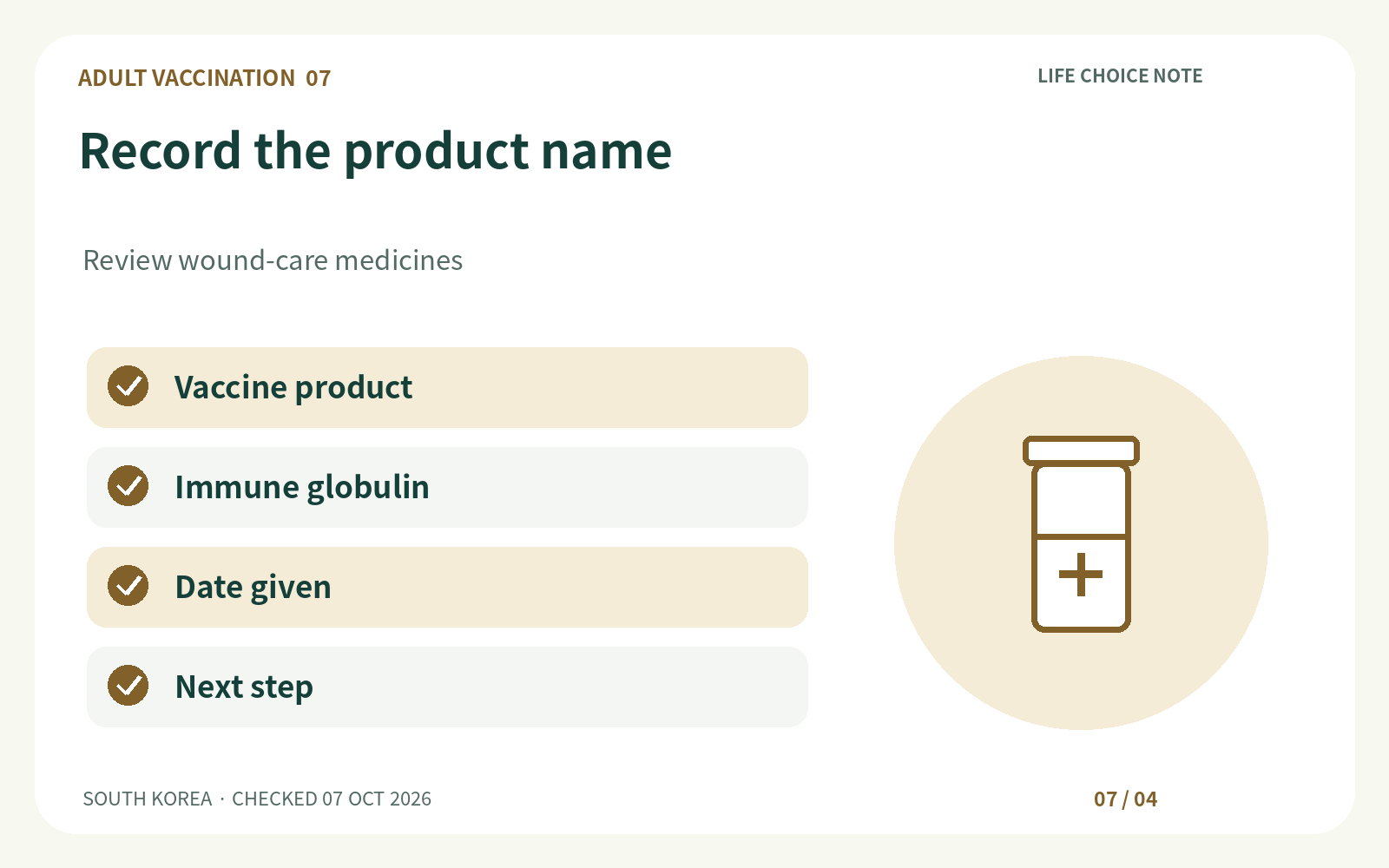
Tetanus immune globulin and a tetanus vaccine can both appear in wound-care records, but they have different roles. Immune globulin provides antibodies for particular circumstances and should not be counted as a vaccine dose. Ask the previous provider for the medication record if the invoice only says “tetanus treatment.” [4]
If a recent record says Td, ask how any missing Tdap history should be handled. Do not automatically book a duplicate injection or assume you must wait ten years in every circumstance. The reason for vaccination and any previous serious reaction need review. [1][5]
Pregnancy has its own recommendation
The Korean Society of Infectious Diseases recommends Tdap during weeks 27–36 of every pregnancy. KDCA’s health information also describes vaccination in each pregnancy, intended to help protect the infant before the baby’s own vaccinations begin. A dose during an earlier pregnancy does not remove the need to discuss the current pregnancy. [1][2]
Tell your obstetric clinician your current gestational age, due date and previous Tdap dates. Include any dose already given during this pregnancy at another clinic. If the recommended window has passed or dates are uncertain, ask the clinician to resolve the next step rather than scheduling another dose yourself.
Relatives and carers should check individual records
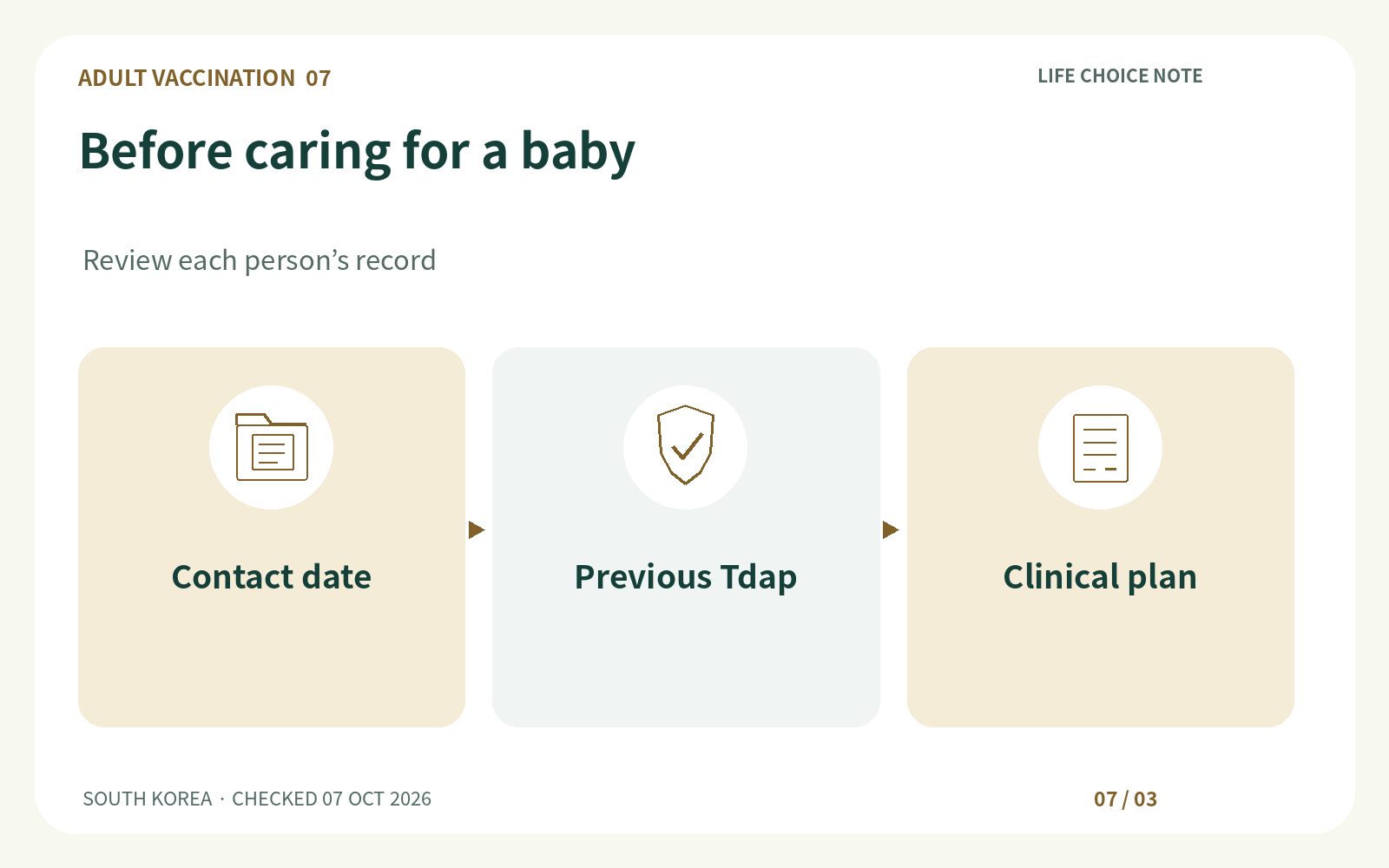
Korean society guidance recommends Tdap at least two weeks before close contact with an infant younger than twelve months for adults who have not previously received Tdap. This can include parents, grandparents, childcare providers and healthcare personnel. It is not an instruction for every family member to repeat a dose whenever a new baby arrives. [1]
Bring your expected contact date and personal record. If you have already started caring for the baby, say so. Each adult’s plan should follow their own history rather than a family-wide assumption.
Vaccination is not a reason to ignore a persistent cough or a known pertussis exposure. Clinical assessment and exposure management may still be needed. Seek urgent help for an infant with breathing difficulty or other serious symptoms. [2][3]
Wounds require more than a ten-year calculation
The routine booster interval is not a complete wound-management rule. A clinician considers the wound’s contamination, depth and type alongside vaccination history. Punctures, burns, bites and other contaminated injuries may need a different assessment, including whether immune globulin is appropriate. [4]
Give the time and cause of the injury and any available vaccine record. Do not postpone necessary wound care while searching for an old certificate. Continued bleeding or a deep wound needs prompt assessment; jaw stiffness, difficulty swallowing or breathing problems require urgent care. [3][4]
The CDC wound page is a United States clinical reference. It supports the distinction between routine boosting and wound assessment here, rather than serving as a self-treatment algorithm for a Korean reader.
Mention important previous reactions
Tell the clinic about severe allergy, neurological events or unusually extensive swelling after an earlier vaccination. Some reactions require special consideration of product choice or timing. Describe what happened and when, and bring the original record if available, instead of assigning yourself a diagnosis from photographs online. [5]
Routine soreness and a documented serious reaction are not the same history. The clinician needs enough detail to interpret the event and agree on a safe plan.
A useful booking question
You can ask: “I received a tetanus-containing injection on this date. Can you confirm whether I need routine boosting, a primary-course dose or Tdap? I will also be caring for a newborn.” In Korean, tetanus is 파상풍 and pertussis is 백일해. State pregnancy or recent injury separately if applicable.
Confirm stock, adult availability and the total consultation and vaccination charge. If a local support programme is mentioned, check its current eligibility rather than assuming a recommendation means nationwide funding. After the visit, keep the product, date, reason for vaccination and next step together.
This is general health information. Individual vaccine choice, timing and wound prevention should be agreed with a clinician who can review your records and current condition.
Related published guides
- Can You Get Flu and COVID Vaccines at the Same Time?
- South Korea Vaccination Law 2026: What Changes and When?
Sources
- Recommendations for Adult Immunization by the Korean Society of Infectious Diseases 2023 Minor Revisions · 대한감염학회 · 2024-06-12 공개 · 2026-10-07 KST
- 국가건강정보포털 백일해 · 질병관리청 · 현행 본문 확인 · 2026-10-07 KST
- 예방접종도우미 파상풍 · 질병관리청 · 최종검토 2025-01-20 · 2026-10-07 KST
- Clinical Guidance for Wound Management to Prevent Tetanus · CDC 미국 · 현행 본문 확인 · 2026-10-07 KST
- 예방접종도우미 이상반응 바로알기 · 질병관리청 · 최종검토 2026-01-05 · 2026-10-07 KST