Hepatitis B Antibody Results: What to Ask a Clinic in Korea
A negative antibody result is not a complete vaccination decision
For adults seeking care in South Korea, a negative anti-HBs result should be reviewed alongside vaccination records, earlier antibody results and current health. It does not automatically mean that everyone needs another three-dose series. Sources were checked on 7 October 2026. [1][2]
Start by obtaining the full laboratory report and the dates of previous injections. A recollection that you were vaccinated is useful background, but it is different from a documented completed course. The purpose of this guide is to help you ask a clinic the right questions, not to diagnose yourself from a result combination.
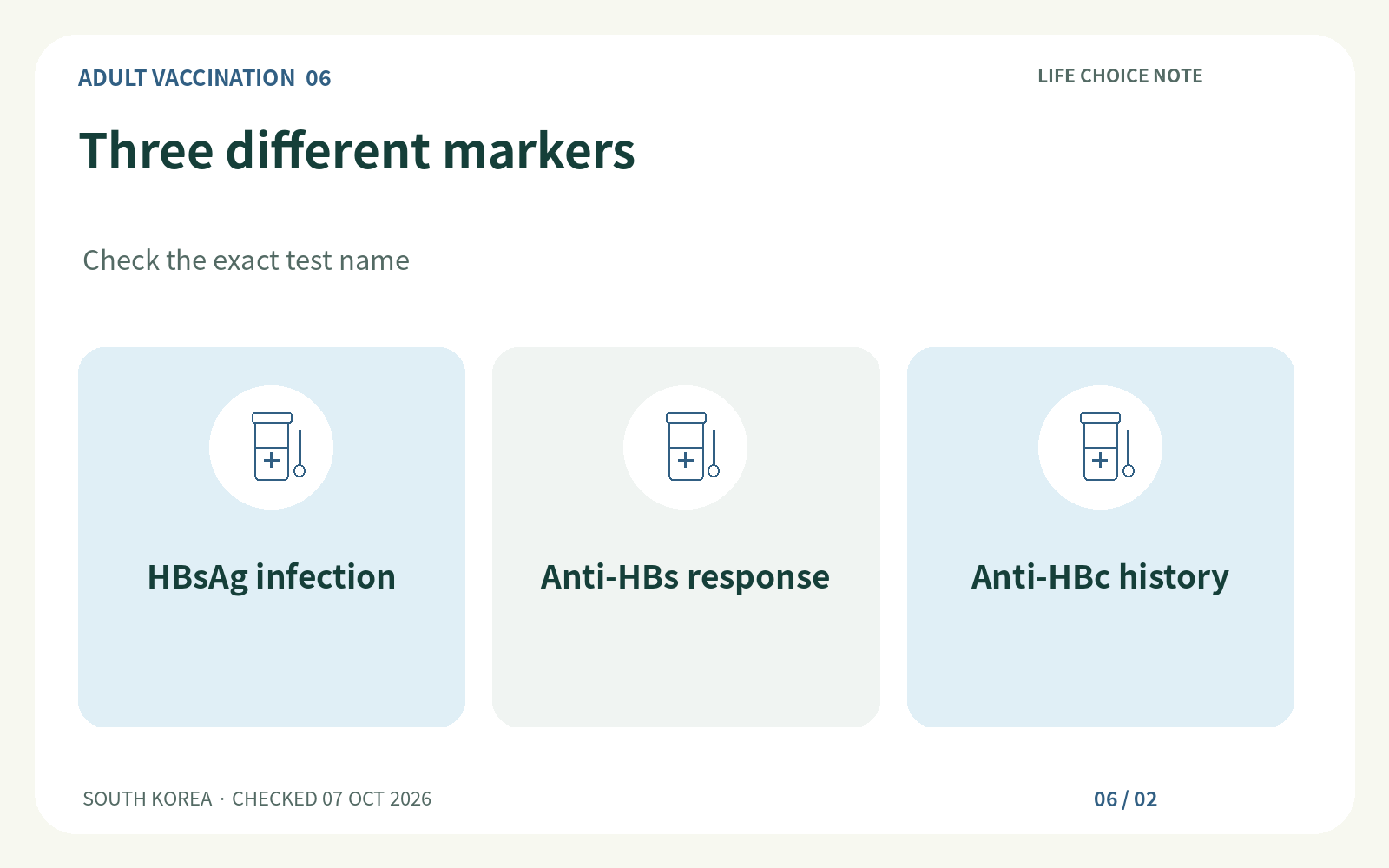
Three names with different meanings
HBsAg is hepatitis B surface antigen. A positive result needs medical assessment for possible current infection; simply booking more vaccine does not resolve it. Tell the clinician about any recent hepatitis B vaccination, which can matter when interpreting a result. [2]
Anti-HBs is surface antibody and can develop after vaccination or recovery from infection. Total anti-HBc is antibody to the core antigen and indicates previous or ongoing infection. Vaccination alone does not produce anti-HBc. If only core antibody is positive, several explanations are possible and additional clinical assessment may be needed. [2]
A result that was not measured should not be entered as negative. CDC recommends a three-test screening panel in the United States, but this does not establish what every Korean national health examination must include. Ask your clinician whether another test is relevant to your circumstances. [2]
Why antibodies can decline after successful vaccination
Measured surface antibody can fall over time in people who originally responded to a complete series. Immune memory can persist in people with normal immune function, so routine boosters are not generally recommended solely because a later titre is low. A Korean public health FAQ and CDC guidance explain this distinction. [1][3]
This principle should not be used to assume immunity when no vaccination record can be found. KDCA identifies adults without previous infection or a completed course as candidates for vaccination. Record uncertainty needs to be discussed rather than resolved by guessing. [4]
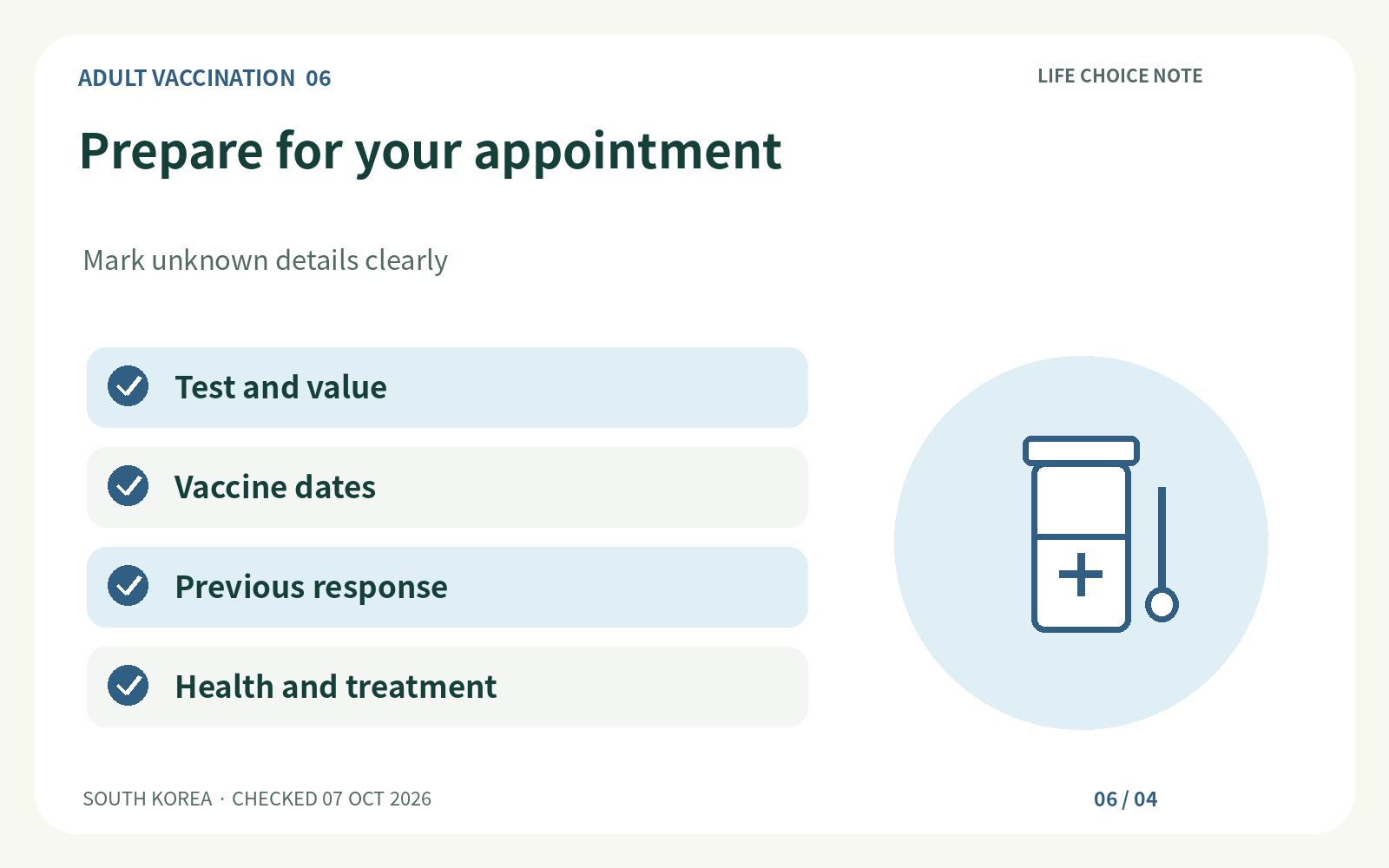
If possible, locate the antibody result obtained after your original course. Label missing information clearly: “three doses documented; original response not tested” is more useful than either “definitely protected” or “vaccine failed.”
The timing behind the 10 mIU/mL threshold
When post-vaccination response testing is indicated, anti-HBs is generally measured one to two months after the final dose. A concentration of at least 10 mIU/mL is used to assess an adequate response. That framework is not an automatic instruction to repeat three doses whenever a routine test years later is below 10. [3]
Keep the value, unit, reference range and collection date together. Do not round a result or remove a less-than sign when copying it into a note. Ask what the proposed follow-up test would change: confirmation of an initial response, occupational documentation or a treatment-related plan.
Some groups need a separate pathway
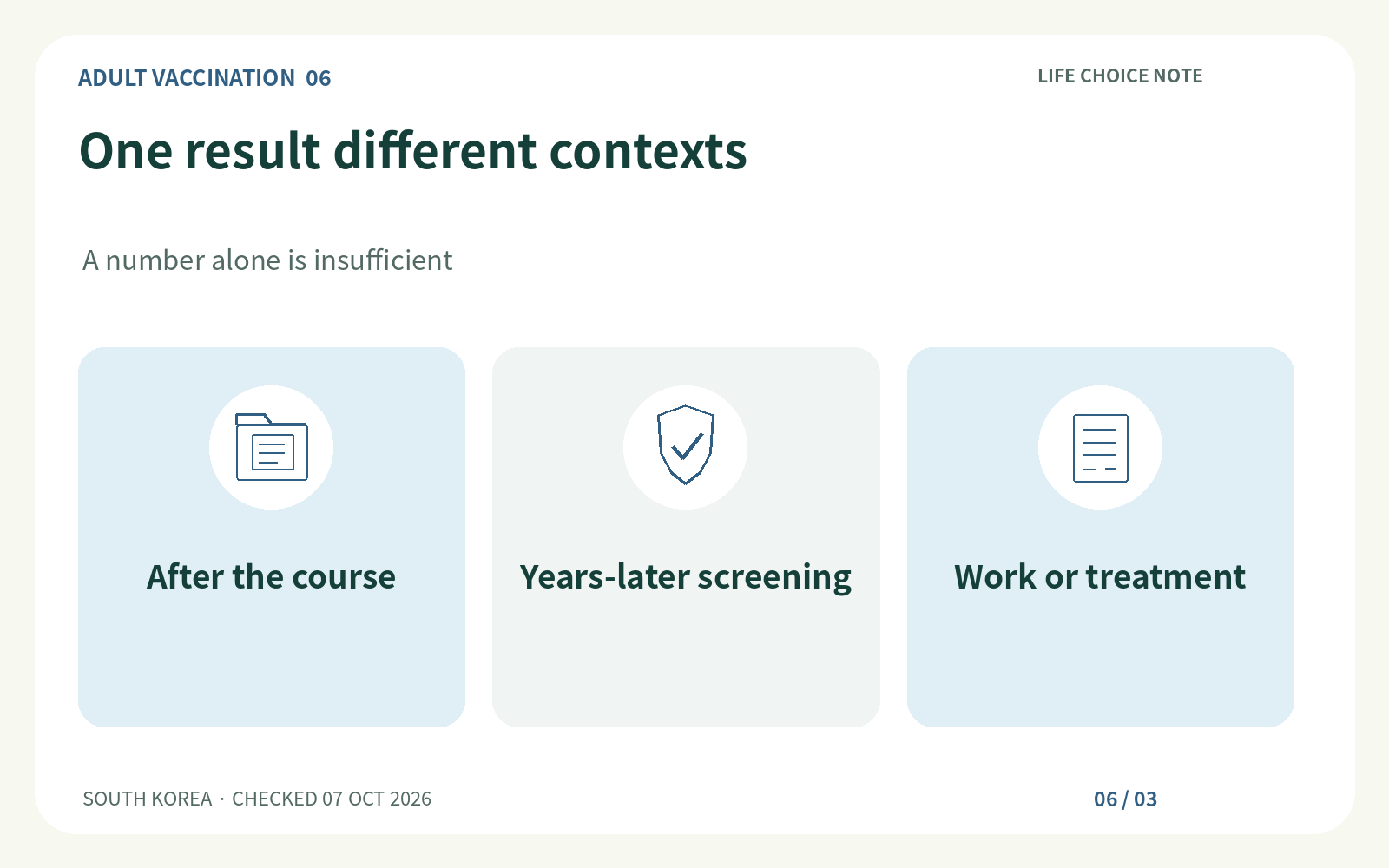
Healthcare workers with potential blood exposure may need documented response information for occupational protection and exposure management. Ask your Korean employer’s infection-control team which records and assessment it requires. A United States occupational algorithm is not a substitute for your institution’s procedure. [6]
Dialysis care is another important exception. The Korean Society of Nephrology’s 2024 infection-control guideline includes specific vaccination and antibody follow-up arrangements. The treating team should select the dose and monitoring plan rather than applying a healthy-adult summary. [5]
Before chemotherapy, transplantation or immune-suppressing treatment, show the team any HBsAg or total anti-HBc positive result. Previous infection can be relevant to reactivation risk. Vaccination does not replace management of existing infection, and you should not stop prescribed treatment to improve a vaccine response. [2]
If the course was never completed
KDCA’s usual adult hepatitis B schedule is 0, 1 and 6 months, with zero meaning the first dose date. An overseas product or a specialist treatment situation may require a different assessment. Bring the actual brand and dates rather than translating them into a familiar Korean schedule yourself. [4]
A delayed series generally continues from valid doses rather than restarting. A dose given too early, however, raises a separate minimum-interval issue. Ask the clinic to distinguish a missing dose from an invalid or undocumented one before it writes the next appointment. [7]
Positive antigen or recent exposure needs prompt attention
If HBsAg is positive, arrange medical review even if you feel well. Symptoms such as jaundice, severe vomiting or altered awareness warrant prompt or urgent care according to severity. Normal liver enzymes alone do not settle the meaning of a hepatitis B result. [2][4]
After a needlestick or relevant blood exposure, contact the appropriate clinical service immediately. The exposure time, source assessment and your documented vaccine response can affect whether vaccine or hepatitis B immune globulin is needed. Do not wait for a routine vaccination appointment. [6]
A practical clinic enquiry
You can say: “My anti-HBs result is negative. Here are my full results and vaccination dates. Do I need assessment for infection, additional vaccination, or a post-vaccination antibody test? If testing is needed, when should it be done?” The Korean terms are B형간염 표면항원 for surface antigen and 표면항체 for surface antibody.
Leave with the next action, its date and the responsible clinic written down. This is general health information. Your clinician should determine your individual vaccination and follow-up plan from the complete records and clinical context.
Related published guides
- Blood Test Results Explained | Lab Values, Units & Reference Ranges
- South Korea Vaccination Law 2026: What Changes and When?
Sources
- 건강검진시 B형간염 항체가 양성이었는데 재검사에서 음성으로 나올 수 있나요 · 인천광역시 미추홀구 보건소 · 2014-05-29 · 2026-10-07 KST
- Clinical Testing and Diagnosis for Hepatitis B · CDC 미국 · 갱신 2026-08-14 · 2026-10-07 KST
- Pink Book Chapter 10 Hepatitis B · CDC 미국 · 공식 현행 페이지 확인 · 2026-10-07 KST
- 질병관리청 예방접종도우미 B형간염 · 질병관리청 · 최종검토 2025-01-20 · 2026-10-07 KST
- 2024 인공신장실 감염관리지침 제7장 예방접종 · 대한신장학회 · 2024판 · 2026-10-07 KST
- Responding to HBV Exposures in Health Care Settings · CDC 미국 · 공식 현행 페이지 확인 · 2026-10-07 KST
- Timing and Spacing of Immunobiologics · CDC 미국 · 페이지 표기 2024-07-24 · 2026-10-07 KST