Adult Vaccine Costs in Korea: Public Funding and Private Fees
Start with the vaccination plan, then compare costs
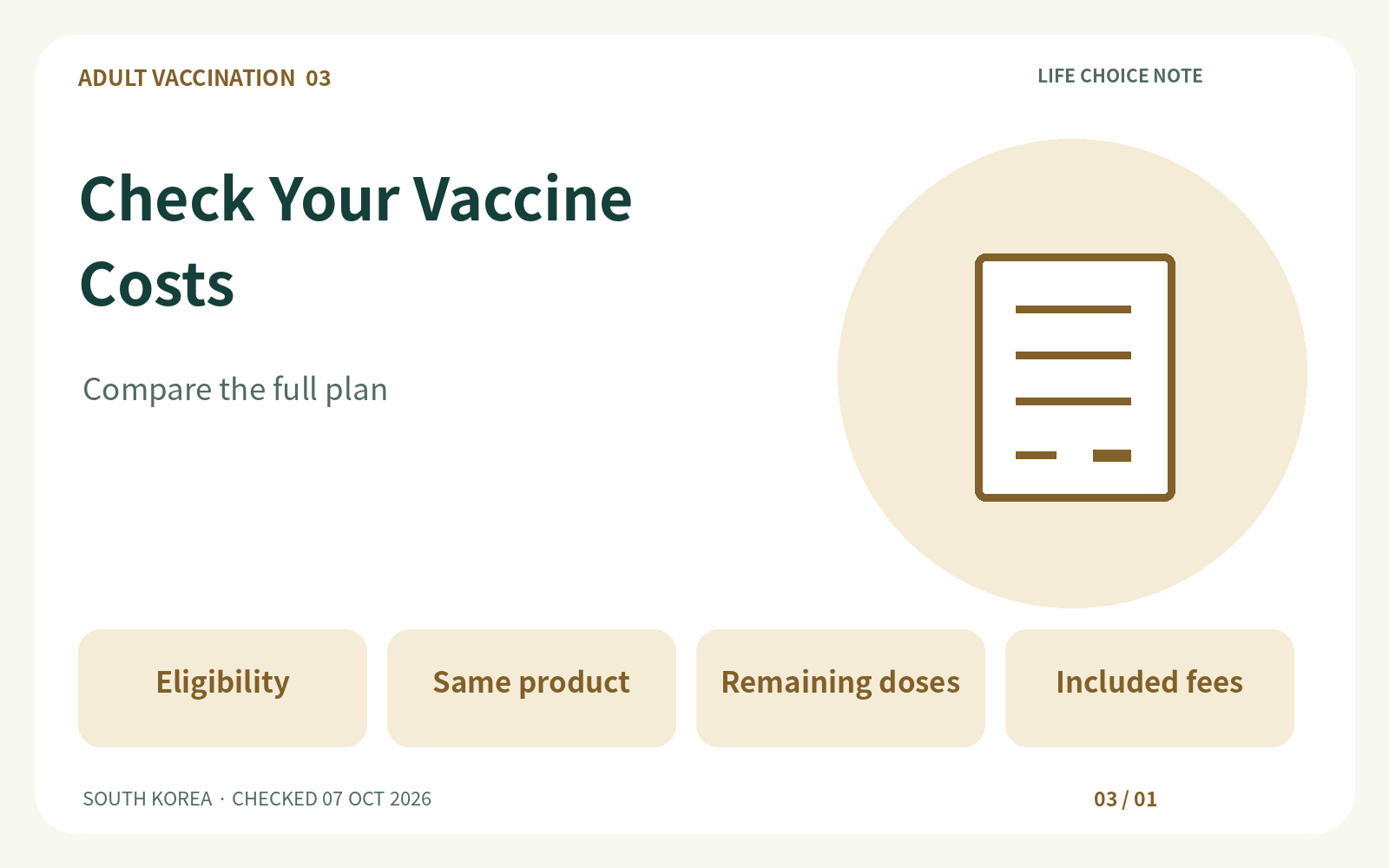
Adult vaccine costs in South Korea depend on the product, remaining doses, eligibility for public funding and the provider’s charges. A visit to a public health center does not by itself make every vaccine free. This guide was checked on October 7, 2026 and explains how to make a useful comparison without relying on a national average or an advertised starting price. [1][2]
First ask a clinician which vaccination plan is appropriate for your records and health. A single-dose option and a sequential course can have different follow-up needs. Compare the cost of the plan you are actually considering, rather than treating every product for the same disease as interchangeable.
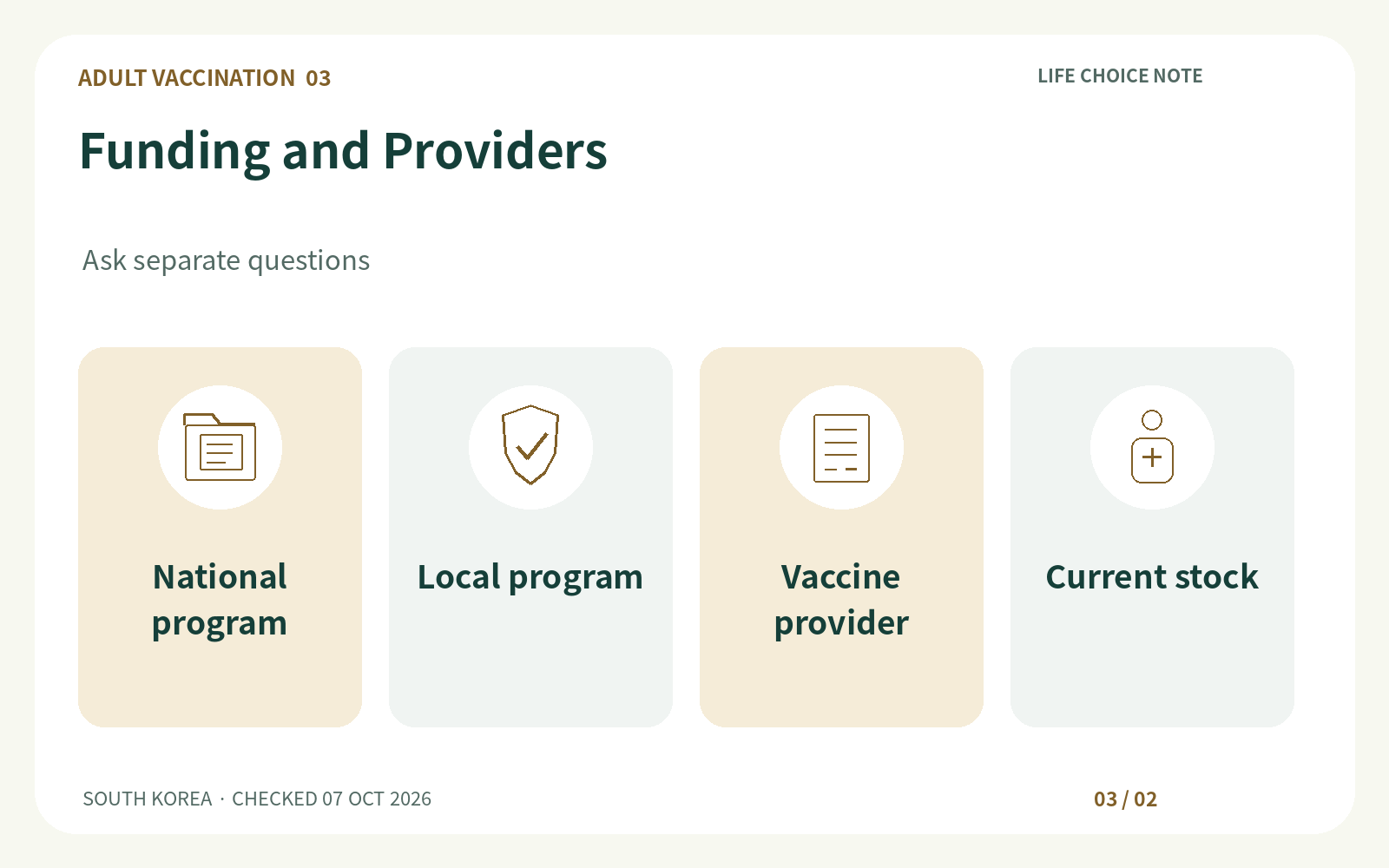
1. Check the exact national program
Korea’s older-adult pneumococcal program supports one PPSV23 dose for eligible adults aged 65 or older. The 2026 page lists people born on or before December 31, 1961, and previous vaccination history must be checked. It identifies public health centers and participating providers as the vaccination sites. [1]
This funding rule is distinct from the Korean Society of Infectious Diseases’ 2026 clinical recommendations, which also include conjugate-vaccine options. Do not assume that every pneumococcal product is funded under the ordinary older-adult PPSV23 program. Ask which product and which program the quoted price refers to. [1][6]
For adult HPV vaccination, the national program includes eligible low-income women aged 18–26 under its 2026 birth-year and qualification rules. HPV4 is the funded product; HPV9 is excluded from this program. The addition of 12-year-old boys does not extend that funding to adult men. [2]
2. Special support may have narrow conditions
On July 27, 2026, Korea expanded vaccination support after hematopoietic stem cell transplantation to recipients of all ages, for new transplants performed from January 1, 2026. The announcement describes support for qualifying vaccines for up to three years from transplantation. It does not establish free vaccination for every immunocompromised adult or every past transplant recipient. [3]
If this may apply, bring the transplant date and your treating team’s proposed vaccination plan. The clinical timing still depends on your condition. Ask the participating provider which doses and documents are covered before making a cost comparison. A funding window is not an instruction to receive every vaccine immediately. [3]
3. Ask your local public health center the right questions
For a local subsidy, check the current notice from the city, district or public health center responsible for your address. Questions worth asking include whether there are residency, age or income conditions; whether approval is required before vaccination; and which clinics participate. These are points to check, not identical rules across every municipality.
Also ask whether the center itself gives the vaccine. KDCA’s HPV program page warns that local circumstances can prevent vaccination at a public health center. Eligibility, the vaccination location and product availability need separate confirmation. [2]
If you are a foreign resident, ask what identification and eligibility documents the specific program requires. Do not assume either eligibility or exclusion based on nationality alone. Use the administrative terms 지원 대상, eligible recipient; 위탁의료기관, participating provider; and 준비서류, required documents.
4. Use HIRA to compare like with like
The Health Insurance Review and Assessment Service, HIRA, publishes provider-level information on non-covered medical fees. Its 2026 fee disclosure was announced for September 3 through its website and the 건강e음 app. Vaccine-fee information also links to relevant vaccination resources. [4]
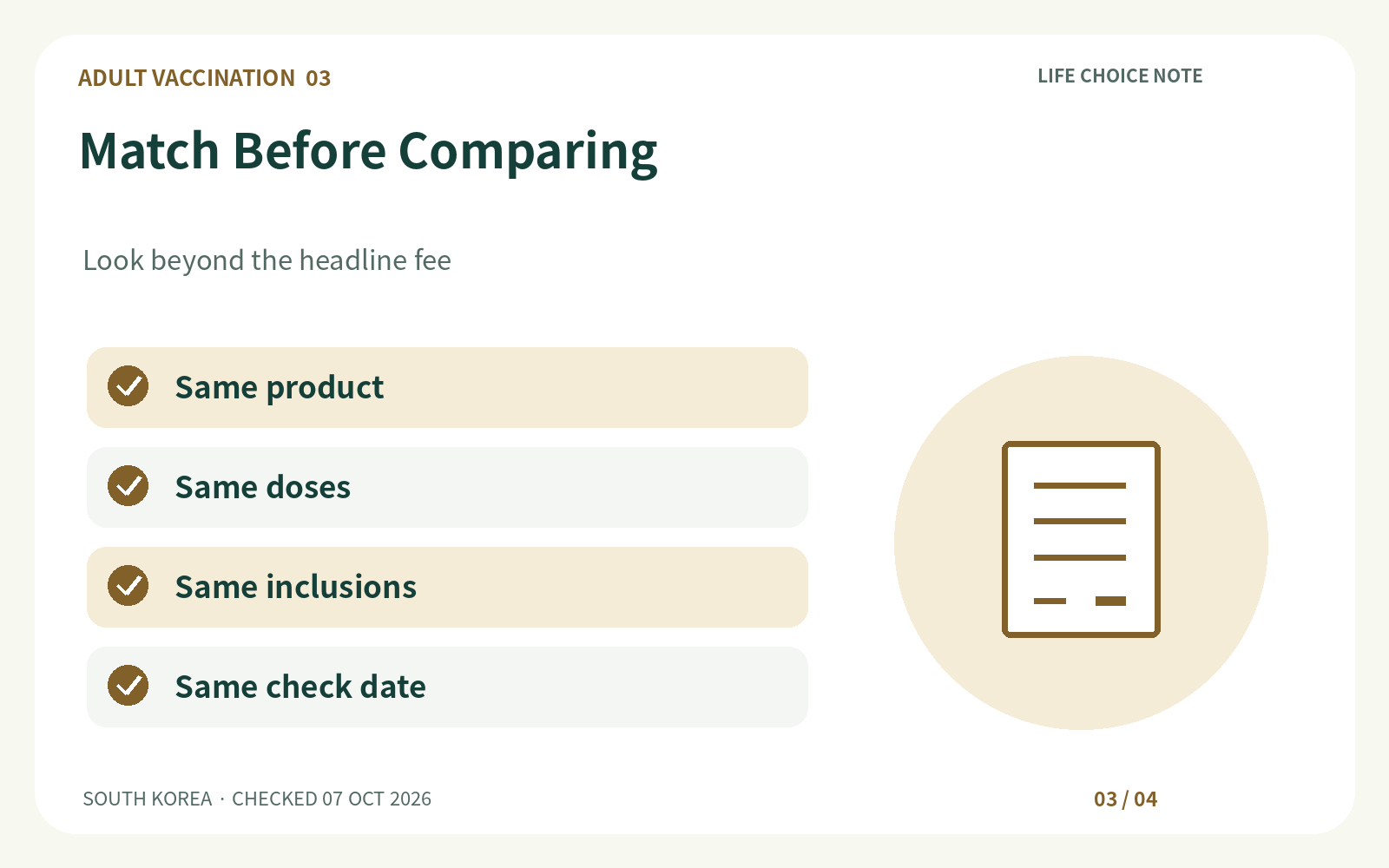
Use 비급여 진료비 정보, non-covered medical fee information, and compare the same product in the area you can reasonably visit. Open the item’s detailed information where available; HIRA’s FAQ explains that detail matters when interpreting prices. [5]
A listed charge should be the beginning of your inquiry, not proof of stock, a reserved appointment or the exact amount you will pay. Tell the clinic which product and listing you found. Ask whether it is currently offered and whether consultation, administration or any required tests are charged separately.
5. Write down the whole expected bill
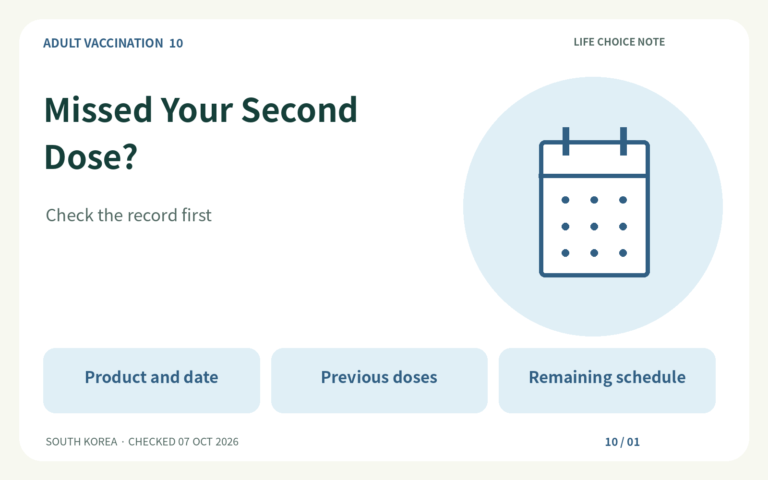
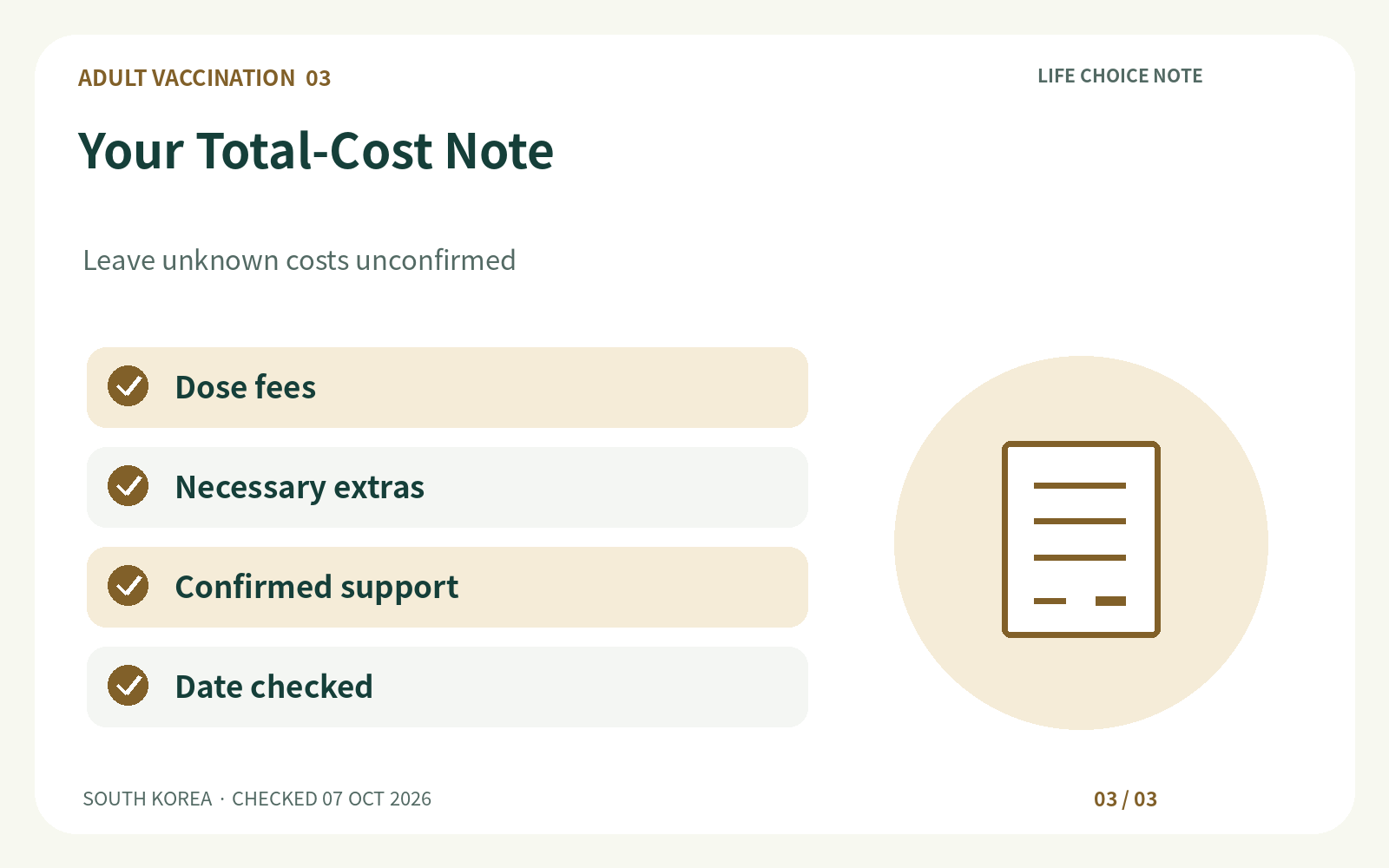
For each clinic, record the product, number of remaining doses, charge per dose, additional fees, confirmed funding, appointment requirements and the date of confirmation. Leave unknown items marked “not confirmed.” Do not subtract a subsidy simply because you might qualify.
Imagine that clinic A has confirmed only a one-dose price, while clinic B has explained a complete two-dose plan and whether other fees apply. You cannot yet establish which is cheaper. First obtain comparable information from A. This example is a comparison method, not a recommended vaccine course.
If a package requires advance payment, ask about its included doses, validity period and the handling of postponed or unused doses. Consider travel time and the practical ability to return as well as the fee. Do not add unnecessary antibody tests simply to make a package look complete.
A short request you can show a clinic
“Please confirm the vaccine product, the cost for my remaining doses, any additional consultation or test charges, and whether public funding applies. What documents should I bring?” In Korean: “제품명, 남은 접종의 총비용, 별도 진찰·검사료, 지원 여부와 준비서류를 확인하고 싶습니다.”
This article provides general health information and a cost-checking method. Agree on your vaccination and testing plan with a qualified clinician. The relevant program office and provider must confirm your eligibility, current availability and final charges.
Related published guides
- Flu Shots in Korea 2026–2027: Dates and Eligibility
- COVID-19 Vaccination in Korea 2026–2027: Who Is Eligible?
Sources
- 65세 이상 성인 폐렴구균 국가예방접종 · 질병관리청 · 2026-01-05 최종검토 · 2026-10-07 KST
- HPV 국가예방접종 사업 · 질병관리청 · 2026-04-14 최종검토; 남아 확대 2026-05-06 시행 · 2026-10-07 KST
- 조혈모세포이식 환자 국가예방접종 지원, 전 연령으로 전면 확대 · 질병관리청 · 2026-07-26 작성; 2026-09-16 수정; 2026-07-27 시행 · 2026-10-07 KST
- 2026년 비급여 진료비용 공개 안내 · 건강보험심사평가원·보건복지부 · 2026년 9월 3일 공개 · 2026-10-07 KST
- 동일병원 동일항목의 비급여 진료비용 가격차이 · 건강보험심사평가원 · 2026-03-16 · 2026-10-07 KST
- Recommendations for Adult Pneumococcal Vaccination in Korea: 2026 Update Incorporating the 21-Valent Pneumococcal Conjugate Vaccine · 대한감염학회, Infection & Chemotherapy · 2026-08-27 온라인 공개; 2026년 9월호 · 2026-10-07 KST