Fruit, Nuts or Yogurt: Choosing a Filling Snack
A useful snack choice starts with why you are eating and how much you plan to eat. Fruit, nuts and yogurt have different nutritional profiles. A comparison per 100g also answers a different question from a comparison of your actual portions.
Snacking is not a compulsory weight-loss strategy. If a snack fits your needs, include it within your overall eating plan. Adding a food simply because it looks healthy does not guarantee weight loss.
First compare the same weight
The table uses three specific USDA FoodData Central SR Legacy records. The apple is raw with skin; the yogurt is plain, nonfat Greek yogurt. The almond record is named “Nuts, almonds,” without an explicit raw or unsalted description.[1]
| Food record | Energy | Protein | Fibre |
|---|---|---|---|
| Apple, raw, with skin | 52kcal | 0.26g | 2.4g |
| Almonds | 579kcal | 21.15g | 12.5g |
| Greek yogurt, plain, nonfat | 59kcal | 10.19g | 0.0g |
The common 100g basis is a comparison unit, not a recommendation to eat that amount of each food. Nor does the table establish which snack will keep you full longest. Higher energy per gram does not automatically make a food unsuitable.
These are reference records, not laboratory measurements of your purchase. Do not substitute them for coated nuts, dried fruit, sweetened yogurt or a different fat level. Check the actual product and preparation.
Selected USDA SR Legacy records • Per 100 g edible portion
| Food record | Energy | Protein | Fibre |
|---|---|---|---|
| Apple, raw, with skin | 52 kcal | 0.26 g | 2.4 g |
| Almonds | 579 kcal | 21.15 g | 12.5 g |
| Greek yogurt, plain, nonfat | 59 kcal | 10.19 g | 0.0 g |
100 g is a comparison unit, not a recommended portion. Your product may differ.
Specific reference records, not measurements of a purchase. The almond record does not explicitly identify raw or unsalted almonds.
Source: USDA FoodData Central, SR Legacy • FDC 171688 / 170567 / 170894
Then calculate the portion you might eat
Use value per 100g × edible weight ÷ 100. Here are examples using 150g apple, 15g almonds and 150g yogurt. The apple weight excludes its core and other uneaten parts. These amounts are chosen for arithmetic, not as personal targets.
| Example | Multiplier | Energy, approx. | Protein, approx. | Fibre, approx. |
|---|---|---|---|---|
| Apple, 150g | 1.5 | 78kcal | 0.4g | 3.6g |
| Almonds, 15g | 0.15 | 87kcal | 3.2g | 1.9g |
| Plain nonfat Greek yogurt, 150g | 1.5 | 89kcal | 15.3g | 0.0g |
The calories happen to be similar in these examples, while protein and fibre differ. That does not make the portions nutritionally interchangeable or equally filling. Your experience also depends on the eating situation.
For comparison, 30g of the same almond record gives about 174kcal. A “handful” can vary, so checking package weight or setting aside a portion can make the amount clearer. NIDDK distinguishes actual portions from label servings and suggests portioning snacks rather than eating directly from a package.[2]
Arithmetic examples • Rounded energy and nutrient values
| Example food | Portion | Energy | Protein |
|---|---|---|---|
| Apple, raw, with skin | 150 g | 78 kcal | 0.4 g |
| Almonds | 15 g | About 87 kcal | 3.2 g |
| Greek yogurt, plain, nonfat | 150 g | About 89 kcal | 15.3 g |
Value per 100 g × portion (g) ÷ 100. Example amounts do not imply equal fullness.
These portions are chosen for arithmetic, not personal recommendations or nutritionally interchangeable servings. Use the edible apple weight.
Source: USDA FoodData Central, SR Legacy • Calculated before rounding
Whole fruit, juice and dried fruit are different choices
KDCA recommends fresh fruit over juice as a way to obtain fibre.[3] Do not apply the apple record to apple juice. WHO notes that even juice without added sugar can contain free sugars.[4] “No added sugar” does not mean “no sugars.”
Dried fruit also needs its own product information and portion. Check ingredients, including any added sweeteners, rather than transferring a fresh-fruit value to it. This guide does not prescribe equal weights of fresh and dried fruit.
Total sugar alone cannot rank these foods for your needs. At the same time, naturally occurring sugar is not a reason to ignore the amount eaten.
For nuts, distinguish a portion from a bag
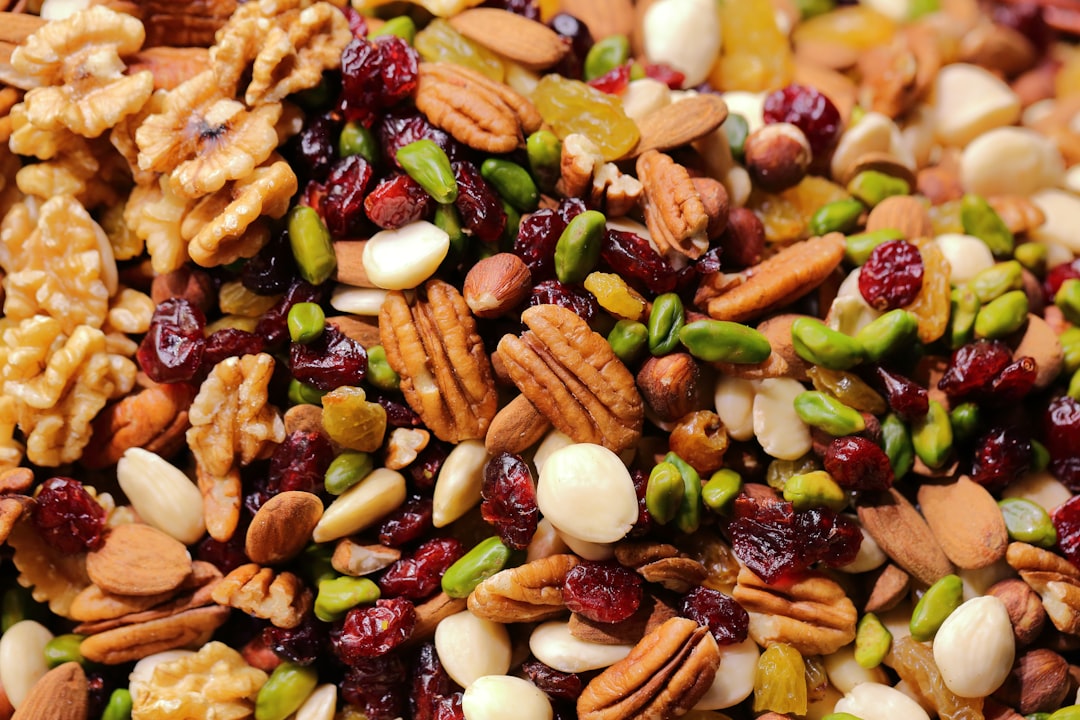
The almond example shows how a relatively small weight can supply substantial energy. If you tend to keep reaching into a bag, putting a portion in a bowl can make the amount easier to notice.[2] There is no fixed number of almonds that everyone must eat daily.
A mixture containing nuts, dried fruit or coatings needs the mixture’s own information. The word “nuts” does not make the plain almond record a suitable stand-in for every packaged snack.
Yogurt’s total sugar is not necessarily added sugar
NHS explains that naturally occurring milk sugars can appear in yogurt’s total-sugar information.[5] A sugar entry therefore does not prove that sugar was added. The selected USDA yogurt record contains about 3.2g total sugars per 100g; that is not a measurement of added sugars.
Korean MFDS guidance distinguishes sugar-free from no-added-sugar claims and advises checking ingredients and nutrition.[6] Likewise, “plain” and “Greek” are not enough to establish the calorie or protein content. A consumer-group product test reported by the Korea Consumer Agency found differences among the Greek yogurts tested.[7]
Read your own label, then add any honey, syrup, granola or nuts separately. The yogurt’s original values do not include toppings you add yourself.
Labels and preparation differ even when product names look similar.
Label basis
and portion
Is the information per 100 g, per cup or another amount?
Protein and
total sugars
Total sugars are not the same as added sugars.
Ingredients
and toppings
Include any honey, syrup, granola or nuts you add.
“Plain” or “Greek” alone does not establish no added sugar or low calories.
Check the actual product. Naturally occurring milk sugars may appear in total sugars, and separately added toppings change the complete snack.
Life Choice Note • Editorial example
Choose for the situation
If you are hungry before the next meal: choose an available option and an amount that fits your plan. Notice how it works for you. You do not have to eat all three foods together.
If replacing a habitual snack: distinguish replacing something from adding another food on top. Compare the overall amount and the effect on your meals.
If opening the package is mostly routine: note the time, place and situation. The aim is to understand its role, not to make snacking mandatory or forbidden.
Follow personal allergy or medical dietary guidance. Milk allergy and difficulty digesting lactose are different issues. Pregnancy, breastfeeding and growth also require appropriate advice; the example portions are not a weight-loss prescription.
Frequently asked questions
Which of the three is best for weight loss?
The table cannot identify a universal winner. Consider portion, nutritional needs, allergies and the eating situation.
Why can no-added-sugar yogurt contain sugar?
Milk-derived sugars may remain. Check ingredients and the full label instead of treating total sugars as added sugars.
Must I snack every day?
No. Choose according to your overall eating plan and needs. Follow a prescribed snack plan if you have one.
Compare your own food and portion
The food nutrition comparison tool scales verified per-100g values that you enter manually. It does not look up products or select the best snack for you. Match the food record to your product, and do not replace missing data with zero.
Sources
Checked October 1, 2026. General information; calculated portions are examples, not recommendations.
- USDA FoodData Central datasets — SR Legacy final release, April 2018. FDC IDs: apple 171688, almonds 170567, plain nonfat Greek yogurt 170894.
- NIDDK: Food Portions.
- KDCA: Diet and nutrition (Korean).
- WHO: Healthy diet.
- NHS: Sugar, the facts.
- MFDS: Sugar-free and no-added-sugar claims, September 11, 2026 (Korean).
- Korea Consumer Agency: Greek yogurt product comparison — consumer-group testing, March 4, 2026 (Korean).