Hair, Skin and Nails Supplements: Why Your Lab Team Needs the Label
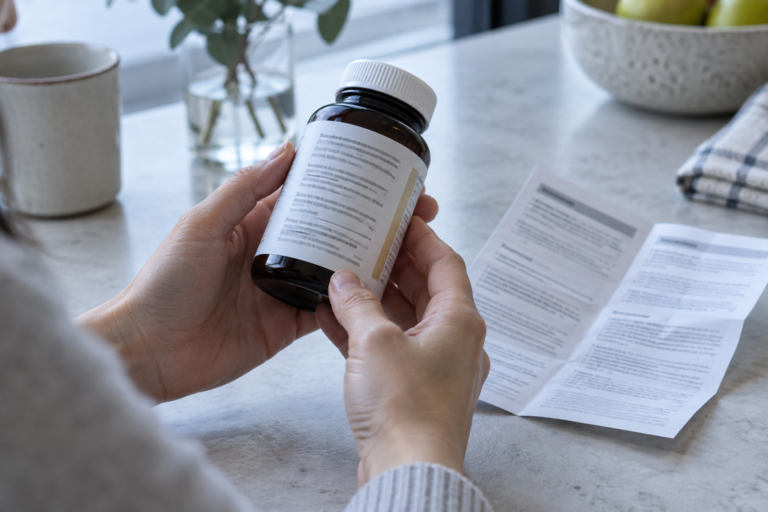
Your clinician orders blood tests while investigating increased hair shedding. You list your prescriptions but leave out the beauty gummies on the bathroom shelf: they feel more like part of your skincare routine than something relevant to an appointment. That omission can matter. Before deciding whether a hair, skin and nails product is working, make sure the people interpreting your tests know what it contains.
Bring the gummy label to the blood-test conversation
Biotin can interfere with certain laboratory methods, producing falsely high or low results. Some thyroid tests are susceptible. The FDA also warns about falsely low troponin results in some assays used to assess heart injury. This is interference with measurement; it is not evidence that a supplement improved the condition being investigated. Not every testing platform is affected in the same way. FDA troponin guidance
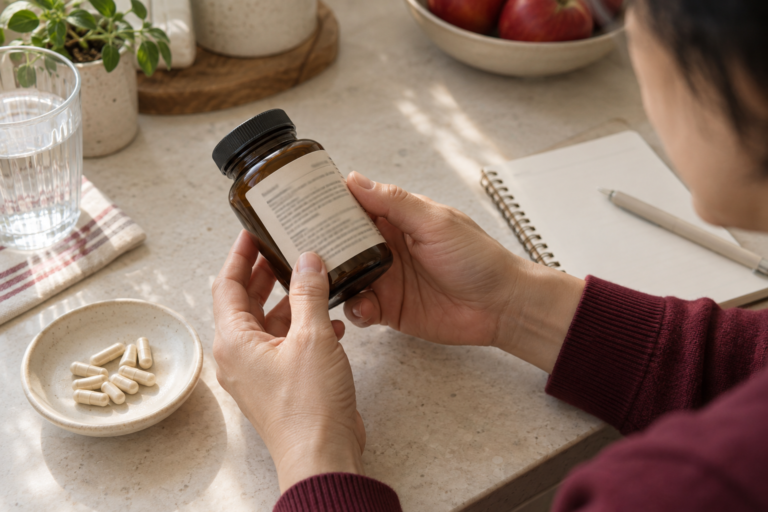
For planned testing, report every supplement, the actual daily amount and when you last took it. Let the clinician and laboratory determine whether a pause is needed. Dose, timing and the assay matter, so a universal stop-for-a-few-days rule is unreliable. If you need urgent medical attention, do not wait for biotin to clear before seeking care. Disclose its use when you arrive.
One label can hide three different expectations
Imagine buying a combination product because your nails keep splitting. Later, a wider-looking part makes you hope the same bottle will address hair loss. Those are different goals, even when a label puts them next to skin radiance. A change in one area cannot serve as the outcome measure for another.
| Your goal | Evidence that would answer it |
|---|---|
| Less hair loss | Hair-specific outcomes in an applicable patient group |
| Fewer broken nails | Nail outcomes, with relevant care changes considered |
| Less dry-looking skin | The particular skin measure tested, not a hair-growth claim |
Also check whether the research tested the complete formulation or just one ingredient. A positive study of a particular collagen preparation does not validate every blend that adds it to biotin and minerals. The ingredient list tells you what you would take; it does not establish that all the advertised benefits were tested together.
If a study summary gives no comparator, participants or measured outcome, its headline is not enough to judge whether it answers your concern. Ask for the study details rather than treating an ingredient name as evidence.
What skin research can—and cannot—contribute
A 2025 meta-analysis of 23 randomized trials found overall improvements in hydration, elasticity and wrinkles. Benefits were not statistically significant in studies without pharmaceutical-company funding or in the high-quality subgroup. That weakens confidence in a reliable effect; it does not prove that every possible preparation has zero effect. Myung and colleagues
A review published in 2026 also described possible skin benefits while finding high risk of bias in most included trials. Its search ended in April 2023, illustrating why a publication date alone does not establish how current its underlying evidence is. Bassila and colleagues
Even a convincing hydration result would leave the hair and nail questions unanswered. If your main concern is scalp coverage, evidence from skin instruments cannot substitute for evidence about hair growth. Treat the outcome named in a study as a boundary on the claim, rather than an invitation to extend it across the product’s entire front label.
A changing hair pattern needs its own explanation
A suddenly appearing bald patch, or loss accompanied by marked scalp redness, pain or itching, deserves assessment rather than waiting to finish a supplement bottle. These patterns can have different causes. Their appearance does not identify a nutrient deficiency. AAD signs and symptoms
A dermatologist considers the history and examination, with tests selected when indicated. Recent illness, restrictive eating, medication changes and the timeline are useful information to bring. There is no need to turn every episode of shedding into a self-ordered panel of every vitamin and mineral. AAD diagnosis and treatment
Replace a missing nutrient for a reason
Documented iron or zinc deficiency may warrant clinician-directed replacement. That is different from taking either nutrient simply because hair is thinning. Establishing why a deficiency occurred and how it will be reassessed matters as much as choosing a product. Do not replace prescribed treatment with a beauty blend or add duplicate ingredients without reviewing the full list.
Excess supplemental iron can cause gastrointestinal problems, including constipation. High zinc intake over time can impair copper absorption. An attractive combination label does not remove these risks. The point is to match intake to an identified need, not to keep increasing amounts until a cosmetic change appears. NIH iron guidance · NIH zinc guidance
Biotin deficiency is rare, and evidence for improving ordinary hair, nail or skin concerns without deficiency is limited. Small uncontrolled nail studies cannot establish dependable benefit for the wider population, much less prove hair regrowth. Its popularity and its laboratory relevance should not be mistaken for strong cosmetic efficacy evidence. NIH biotin guidance
Take a more useful record than a before-and-after impression
Write down the change that prompted the purchase, when it began, the product and any care changes made at the same time. Bring the list to the appropriate appointment. Separate a cosmetic preference, an identified deficiency and an unexplained symptom: each leads to a different decision. The next useful step may be targeted replacement, assessment of the scalp, or deciding that an uncertain skin benefit is not worth the purchase. None requires pretending that one bottle answers all three questions.
General health information, not individual diagnosis or treatment. Sources checked September 23, 2026 (KST).
Related guides
- Is Your Collagen Subscription Worth Renewing? Skin and Joint Claims
- Before You Buy Iron: Confirm the Need and Understand the Elemental Amount
- Buying Zinc Again? Lozenges, Multivitamins and Daily Tablets
- Taking Several Supplements? Check What the Ingredients Add Up To
References
- American Academy of Dermatology — Hair loss: Diagnosis and treatment
- American Academy of Dermatology — Hair loss: Signs and symptoms
- NIH ODS — Biotin: Health Professional Fact Sheet
- NIH ODS — Iron: Health Professional Fact Sheet
- NIH ODS — Zinc: Health Professional Fact Sheet
- FDA — Biotin Interference with Troponin Lab Tests
- Myung et al. — Effects of Collagen Supplements on Skin Aging, 2025
- Bassila et al. — Hydrolyzed Collagen and Skin Health Outcomes, 2026