Why Is the Gout Treatment Target Below 6 mg/dL?
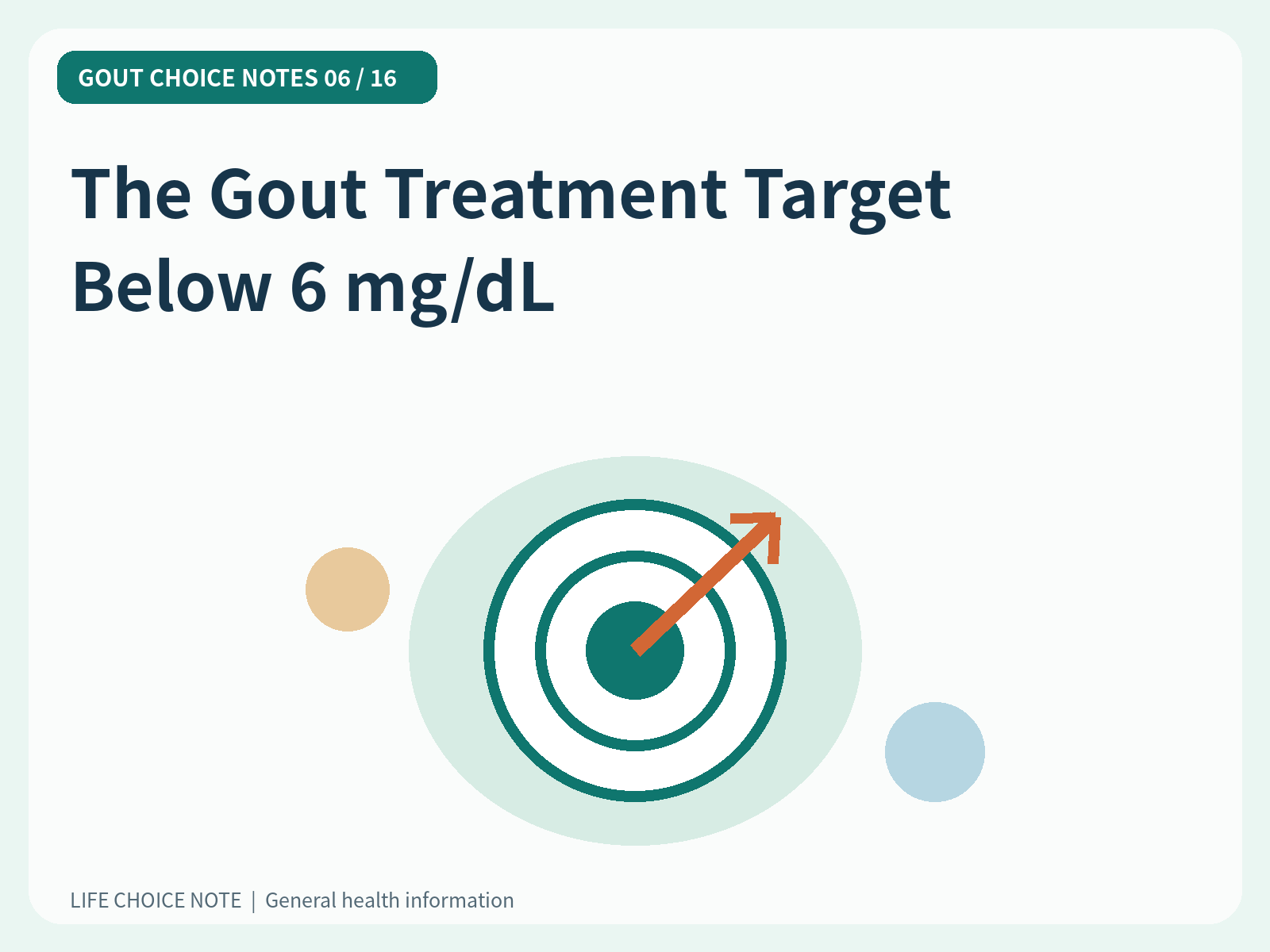
A urate result can appear within a laboratory’s reference range while still being above your gout treatment target. Korean, American College of Rheumatology and UK NICE guidance use a serum urate target below 6 mg/dL for urate-lowering treatment. The aim is to reach and maintain the agreed target, rather than pass a blood test once.[1][2][3]
This number is a treatment goal for people with gout. It is not, on its own, a diagnosis or a rule that everyone above it should start medication. Knowing the distinction helps you ask better questions without turning a blood result into a self-prescribing instruction.[2][3]
1. A reference range and a treatment target have different jobs
Consider a hypothetical result of 6.5 mg/dL. Even if a laboratory does not flag it, the value is above a gout target of less than 6 mg/dL. That numerical comparison does not tell you to increase your medicine today. Your clinician still considers the treatment you are taking, its tolerability and your clinical course.[1][2][3] Ask for your personal target to be written separately from the laboratory range so the two do not become interchangeable in your notes.
Keep the units with every result. NICE also expresses its general target as below 360 micromol/L.[3] A number copied without its unit can look dramatically different from a result reported in mg/dL. When comparing tests from different clinics in Korea or abroad, bring the reports rather than only a remembered number. A useful question is, “Is this within my treatment target?” If the target changes, record when and why, instead of replacing the old value without explanation.
2. Maintaining the target supports crystal reduction
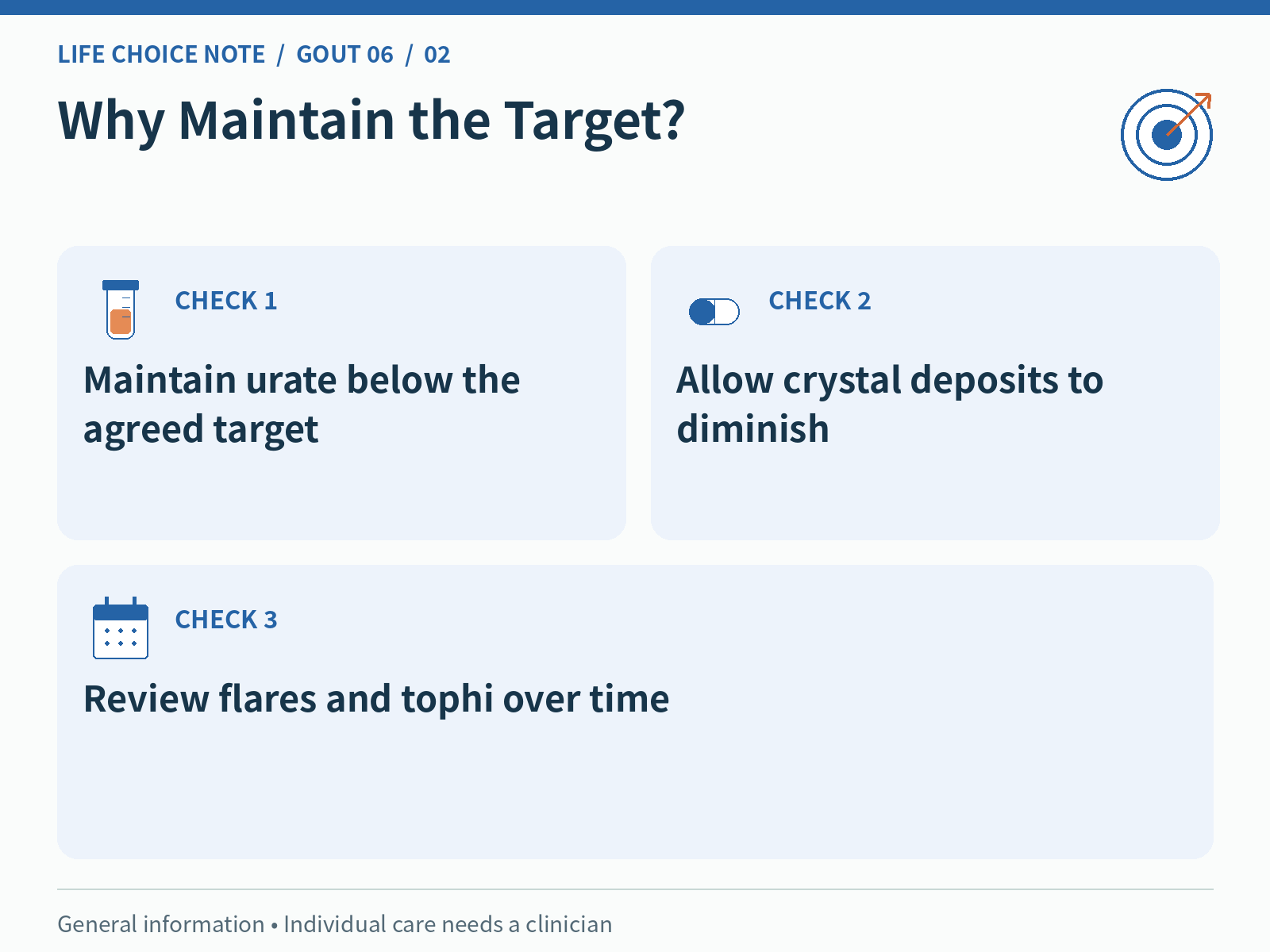
Gout involves deposits of urate crystals. Sustained urate lowering helps prevent new deposits and allows existing deposits to diminish, supporting long-term control of flares, tophi and joint damage.[3][4] This is why care continues between painful attacks. If treatment is understood only as a way to improve a laboratory flag, it can be difficult to see the purpose of taking medicine on days when walking feels normal.
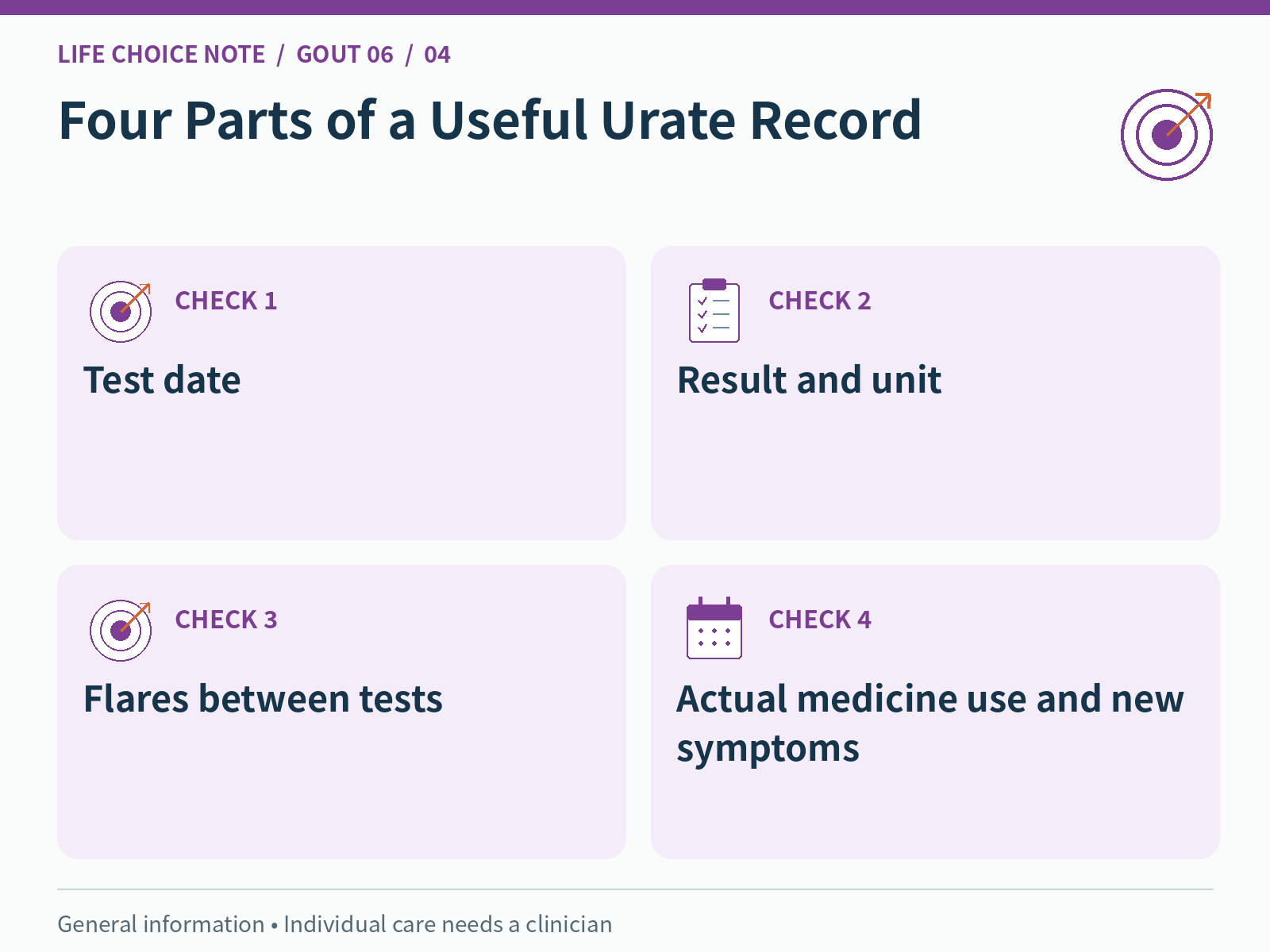
Blood urate and the amount of deposited crystal are different measures. One result below target does not show that every crystal has disappeared. Symptoms, tophi and the pattern over time still matter.[3][4] In your record, place test dates beside any intervening flare dates. This helps a clinician understand the sequence. It is not a way to calculate your own crystal burden or declare that treatment has failed because a painful episode occurred after one encouraging result.
3. Some people discuss a target below 5 mg/dL
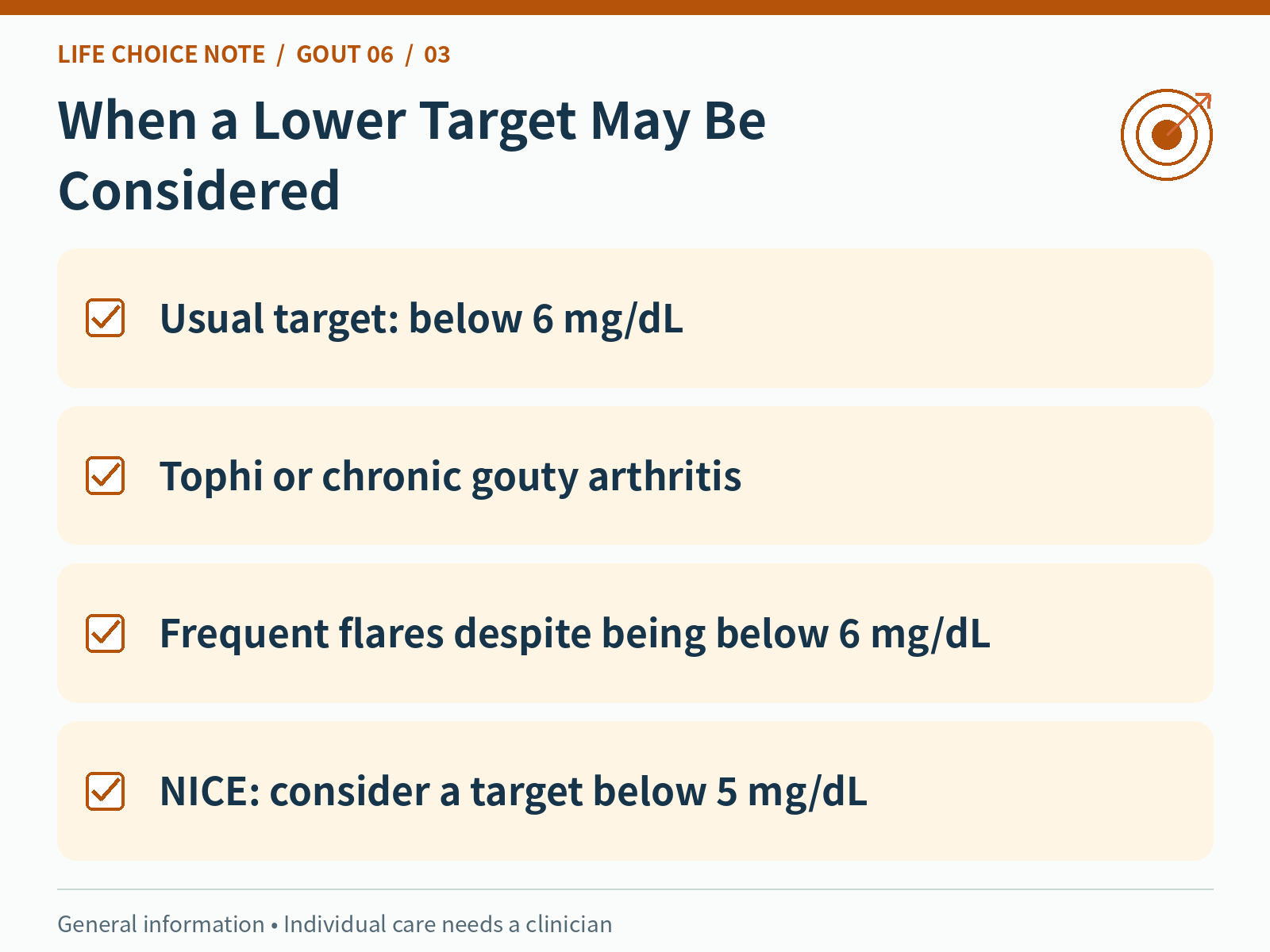
NICE recommends considering a lower target, below 5 mg/dL, for tophi, chronic gouty arthritis, or frequent ongoing flares despite being below 6 mg/dL. EULAR also supports a lower target in severe gout. ACR’s 2020 guideline does not specify a separate numerical target below 6 mg/dL for these groups.[2][3][4] The recommendations should therefore not be presented as a single identical rule shared by every organization.
A friend’s lower target does not establish that yours is inadequate. Ask whether your joint findings or treatment course justify a different goal, and when it will be reassessed. Lower is not automatically better without limits; EULAR cautions against excessively low urate over the long term.[4] Do not compete for the lowest laboratory result or change the dose yourself. An unexpectedly low reading belongs in a clinical review, with the unit and date confirmed first.
4. Treatment is adjusted through tests and tolerability
A treat-to-target approach uses repeat urate measurements to guide clinical treatment adjustments. NICE describes starting low and using monthly urate tests during titration; ACR recommends adjustment guided by serial results. Korean guidance supports maintaining urate below 6 mg/dL.[1][2][3] Your actual schedule in Korea depends on your medicine and health circumstances. These principles explain the follow-up process; they are not a personal dose-escalation chart.
Tell your clinician what you have actually taken, including missed doses, changes made elsewhere and new discomfort. If taking the prescription consistently has been difficult, explain why rather than trying to create a “perfect” history. Bring the current medicine packets or a clear list. Before leaving, confirm where testing happens, who reviews the result and how to contact the clinic if you miss the appointment. Do not bridge a gap by doubling doses or following an old prescription without advice.
5. A flare can occur while the numbers improve
Flares may occur early after starting or adjusting ULT, which is why preventive anti-inflammatory treatment is considered. The plan for a painful episode and the plan for long-term urate control need to be understood separately.[1][2][3] Ask what to do if pain appears between appointments and which instructions apply to each medicine. A photograph of swelling can support the history, but it cannot determine the cause of pain or whether the long-term treatment is working.
If attacks continue, bring their timing in relation to test results. Persistent frequent flares despite achieving the usual target can prompt a reassessment, while other causes of joint pain may also need consideration.[3] Do not assume every episode is an expected treatment-related flare. A suddenly swollen, painful joint with fever or feeling very unwell needs prompt medical evaluation, including consideration of infection.[5] That assessment should not be delayed until your next routine urate test.
6. Reaching the target starts the maintenance conversation
NICE explains that ULT usually continues after the target is reached and suggests considering annual urate monitoring during stable ongoing treatment. This is not an instruction to ignore changes for a year.[3] Ask for your own schedule and which symptoms or medication changes should trigger earlier contact. The end of dose adjustment does not necessarily mean the end of treatment, or that every other medicine in your gout plan continues for the same duration.
Keep a one-page summary: your agreed target, latest result and date, flares since the previous visit, current medicines and any practical difficulties. Three closing questions can make the plan clearer: “Have I reached my target?”, “When will we check it again?”, and “What should make me contact you sooner?” Your record supports the consultation. It should not become an automated rule for starting, increasing or stopping treatment whenever a number crosses a line.
What to bring to your appointment
- Write down your personal target and its unit.
- Keep original results with their dates.
- Ask why a target below 5 mg/dL is being considered, if applicable.
- Record attacks and actual medicine use between tests.
- Confirm your next test and reasons to seek earlier advice.
Common questions
Does exactly 6.0 mg/dL meet a target below 6?
Numerically, no. However, your clinician interprets rounding, trends and your circumstances together. Do not change a dose because of one result alone.[1][2][3]
Why continue treatment after a good result?
The aim is to maintain control while managing crystals and recurrence over time. NICE says ULT usually continues after the target is reached.[3][4]
Does variation between tests mean treatment has failed?
Not by itself. Serial measurements, actual medicine use, symptoms and tolerability guide assessment and any adjustment.[2][3]
General adult health information, not personal diagnosis, test interpretation or prescribing advice. Do not adjust medication from a target number alone. Seek prompt medical care for an acutely painful joint with fever or marked illness.[5]
Related published reading
- CKD and Supplements: Bring the Bottle, Labs and Medicine List
- Supplements That Can Interfere With Lab Tests: Biotin and Beyond
- Previous: Do You Need Long-Term Treatment After Your First Gout Flare?
- Next: Can Urate-Lowering Treatment Start During a Gout Flare?
Official and primary sources
- Korean guidelines for the management of gout · Korean College of Rheumatology · Published 2023-07-01 · Checked 2026-10-15
- 2020 American College of Rheumatology Guideline for the Management of Gout · American College of Rheumatology · Published June 2020 · Checked 2026-10-15
- Gout: diagnosis and management (NG219), Recommendations · National Institute for Health and Care Excellence (NICE) · Published 2022-06-09 · Checked 2026-10-15
- Managing gout: lay version of the 2016 updated EULAR recommendations · European Alliance of Associations for Rheumatology (EULAR) · 2016 guideline update; original journal publication 2017 · Checked 2026-10-15
- Gout · NHS · Page last reviewed 2023-08-24 · Checked 2026-10-15