Berberine Is Not ‘Nature’s Ozempic’: What to Check Before Buying

Berberine is not a natural version of semaglutide, and current evidence does not establish it as a replacement for prescription weight-management or diabetes treatment. The useful question is not whether a bottle looks more natural. It is whether its claimed benefit has been demonstrated in people like you—and whether adding it creates a medication risk.
This guide focuses on evaluating a purchase, not choosing a dose. Regulatory examples below refer to the United States; rules and approved uses differ elsewhere.
27-second Short: Is Berberine Really “Nature’s Ozempic”?
Berberine is not semaglutide. Weight-loss evidence remains uncertain, and supplements should not replace prescribed treatment.
The visuals and burned-in captions are in Korean. For English narration, open the YouTube player settings and choose Audio track → English (United States), when available.
General health information, not individual treatment advice. Avoid berberine during pregnancy or breastfeeding. Ask a clinician or pharmacist about interactions; do not reduce prescribed medicines on your own. Watch on YouTube
Start with the promise on the front of the bottle
| The marketing claim | The missing question |
|---|---|
| Supports blood sugar | Was sustained weight loss actually measured? |
| Clinically studied ingredient | Was this exact formulation tested in a comparable population? |
| Participants lost weight | How much more did they lose than the control group? |
| Natural alternative | Has replacement of prescribed treatment been established? |
| Sold as a supplement | What does that establish about efficacy? Not drug approval. |
A statement about an ingredient is not automatically evidence about the product in your cart. A customer’s before-and-after photograph cannot separate the effects of the supplement from changes in meals, activity, illness or other treatment. Those limitations matter even when the customer’s experience is genuine.

A newer trial did not find a weight-loss advantage
In a 2026 six-month trial of 337 Chinese adults with obesity and MASLD but no diabetes, berberine showed no advantage over placebo for weight, visceral fat or liver fat. Both groups received lifestyle support. Participants unable to tolerate a preliminary berberine phase were excluded, limiting generalization of safety findings.
References
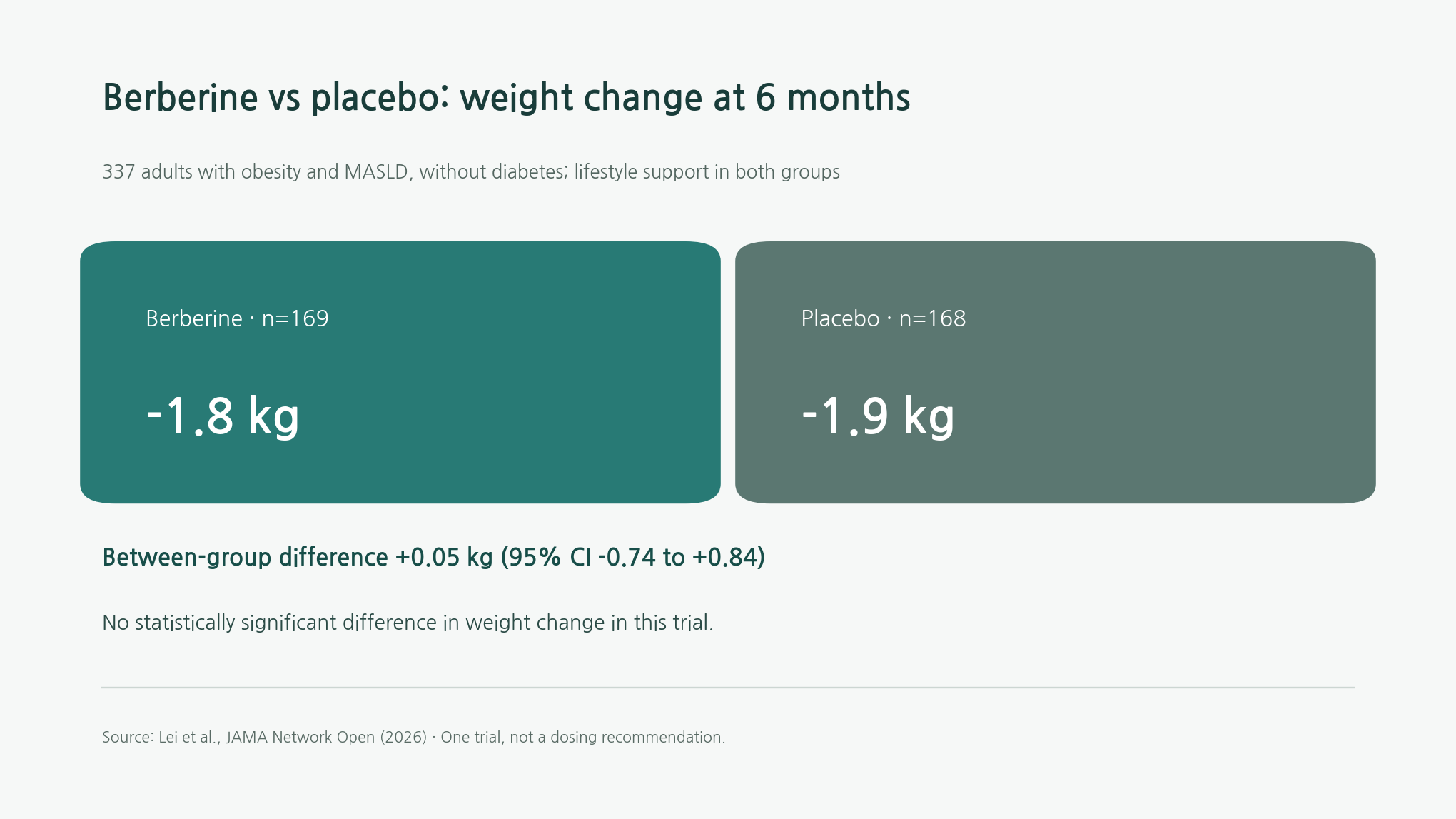
That result is not a verdict on every possible formulation or patient group. It is a reason to reject confident, universal promises. A seller should not use the existence of research as a substitute for explaining what the research found.
Why older studies can sound more positive
A 2022 meta-analysis estimated an average weight difference of about 0.84 kg—1.9 lb—in favor of berberine. Differences among studies and substantial risk of bias limit what that average means for an individual buyer. Subgroup findings do not establish that taking more will work better.
References
An average across studies is neither a personal forecast nor a promise that weight loss will be maintained. Look for the comparator, follow-up duration and population before accepting a headline. Also ask whether the seller acknowledges studies that did not support the claim.
Glucose research answers a different question
A small 2008 pilot included a three-month randomized comparison in 36 adults with newly diagnosed type 2 diabetes and reported improved glucose measures. It did not establish long-term treatment equivalence to metformin or prove benefit for healthy people seeking weight loss.
References
A laboratory result can be important without answering every clinical question. It cannot, by itself, show fewer heart attacks, a durable change in weight or that a prescribed medicine can be stopped. Possible glucose effects are also a reason to review combinations, not simply another selling point.
Read Supplement Facts—not just a certification claim
In the United States, FDA regulates dietary supplements but does not approve their safety and effectiveness before sale as it does with drugs. The Supplement Facts panel identifies serving size and ingredient amounts. Compare the serving size with the number of capsules, and note every active ingredient in a blend.
References
Treat product identity, manufacturing claims and evidence of benefit as separate checks. If a page says a product is tested, ask what was tested, by whom, and whether the report matches the exact product. A quality claim is not a clinical trial. A more expensive or ‘enhanced’ formulation should not inherit results from a different formulation without evidence.
Pause the purchase if any of these apply
Avoid berberine during pregnancy or breastfeeding, and do not give it to infants. NCCIH identifies infant bilirubin-related safety concerns and a documented interaction with cyclosporine. Nausea, abdominal discomfort, diarrhea and constipation are also reported. Transplant recipients should consult their transplant team before adding supplements.
References
If you use insulin or medicines that increase insulin release, have a clinician or pharmacist review the possibility of overlapping glucose-lowering effects. Do not lower your prescribed dose to make room for berberine. A fixed gap between doses is not proof that an interaction has been avoided.
Shakiness, sweating and a racing heartbeat can occur with low blood glucose. Follow your established diabetes action plan if applicable. Confusion, a seizure or loss of consciousness needs urgent emergency help; do not force food or drink into someone who cannot safely swallow.
References

Two distinctions the nickname leaves out
Ozempic and Wegovy are not interchangeable labels
Both contain semaglutide. Under US prescribing information, Ozempic has type 2 diabetes-related indications, while Wegovy includes long-term weight-management indications for eligible patients. Berberine is neither semaglutide nor an equivalent substitute. Neither prescription product is suitable for everyone; treatment requires an individual assessment.
References
A research dose is not a personal recommendation
Matching a dose quoted online does not match the trial population, formulation, monitoring or other treatments. This guide does not recommend a self-treatment dose or a brand. The first decision is whether there is a sufficiently supported reason to add the product at all.
For a useful medication review, bring the full label, all medicines and supplements you use, and the outcome you want to improve. Ask: ‘What benefit is realistic for me, what interaction could matter, and what would we monitor?’ That conversation is more useful than choosing between ‘natural’ and ‘prescription’ as marketing categories.
General health information, not individual diagnosis or prescribing advice. Evidence checked September 23, 2026 (KST).