Pneumococcal Vaccines in Korea: Age 65 Funding and PCV Options
Two different questions at age 65
If you are arranging a pneumococcal vaccination in South Korea, first separate public funding from the clinical vaccination plan. The national older-adult program supports PPSV23. The Korean Society of Infectious Diseases’ 2026 recommendation also includes conjugate-vaccine pathways. Bring the products and dates of any earlier doses so your clinician can consider both questions. Information was checked on October 7, 2026. [1][2]
These vaccines target disease caused by particular pneumococcal serotypes. They do not prevent every cause of pneumonia, and a larger number in a product name is not a universal measure of better protection. [2][3]
1. What the Korean public program funds
KDCA’s 2026 program page lists adults aged 65 or older, corresponding to birth on or before December 31, 1961, for one supported PPSV23 dose. Vaccination is provided through public health centers and participating medical institutions. Previous doses must be checked, and a nonparticipating clinic is outside this program’s funding route. [1]
If you already received PPSV23 at or after age 65, do not arrange another annual dose simply because the program is advertised again. However, that administrative guidance should not be interpreted as ruling out every future discussion of conjugate vaccines. The complete clinical plan depends on your history and health. [1][2]
For foreign residents, ask the provider to verify program eligibility and required identification rather than assuming that the age criterion is the only administrative requirement. Also confirm the product and availability before visiting.
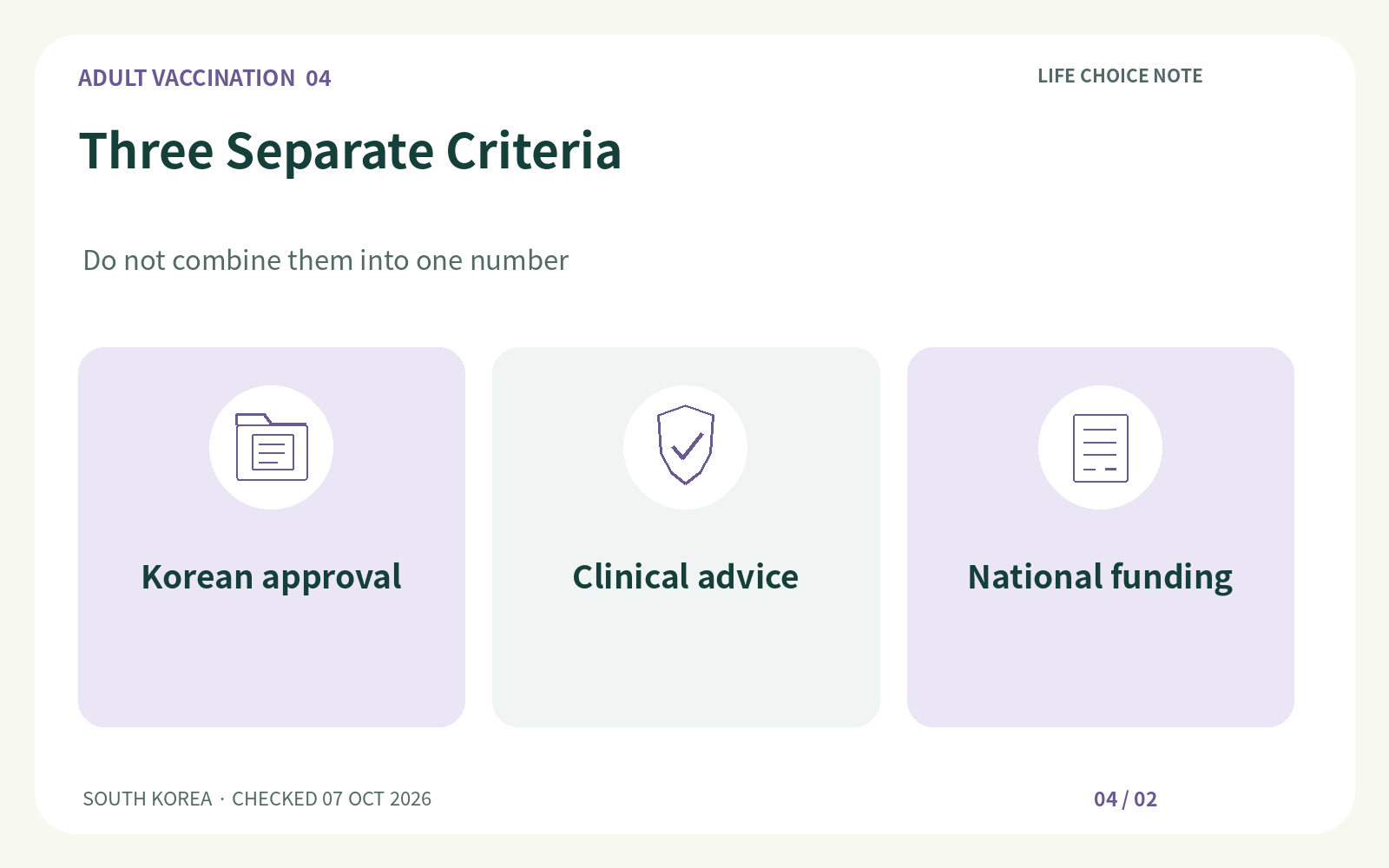
2. Understand the product names
PCV means pneumococcal conjugate vaccine, known in Korean as 폐렴구균 단백결합백신. PPSV23 is a pneumococcal polysaccharide vaccine, or 폐렴구균 다당백신. The numbers identify vaccine formulations with different serotype coverage; they are not scores for quality or effectiveness. [2]
PCV21 is not simply PCV20 with one extra serotype. Their compositions differ. Korea’s approved indication for the PCV21 product Capvaxive includes adults aged 18 or older, but this product-approval age is distinct from routine clinical recommendations and funding eligibility. [2][3]
If a clinic asks which vaccine you received abroad, use the exact name on the original document. A phrase such as “pneumonia shot” or a price on a receipt may not establish whether you had a conjugate or polysaccharide vaccine.
3. The 2026 Korean clinical recommendation
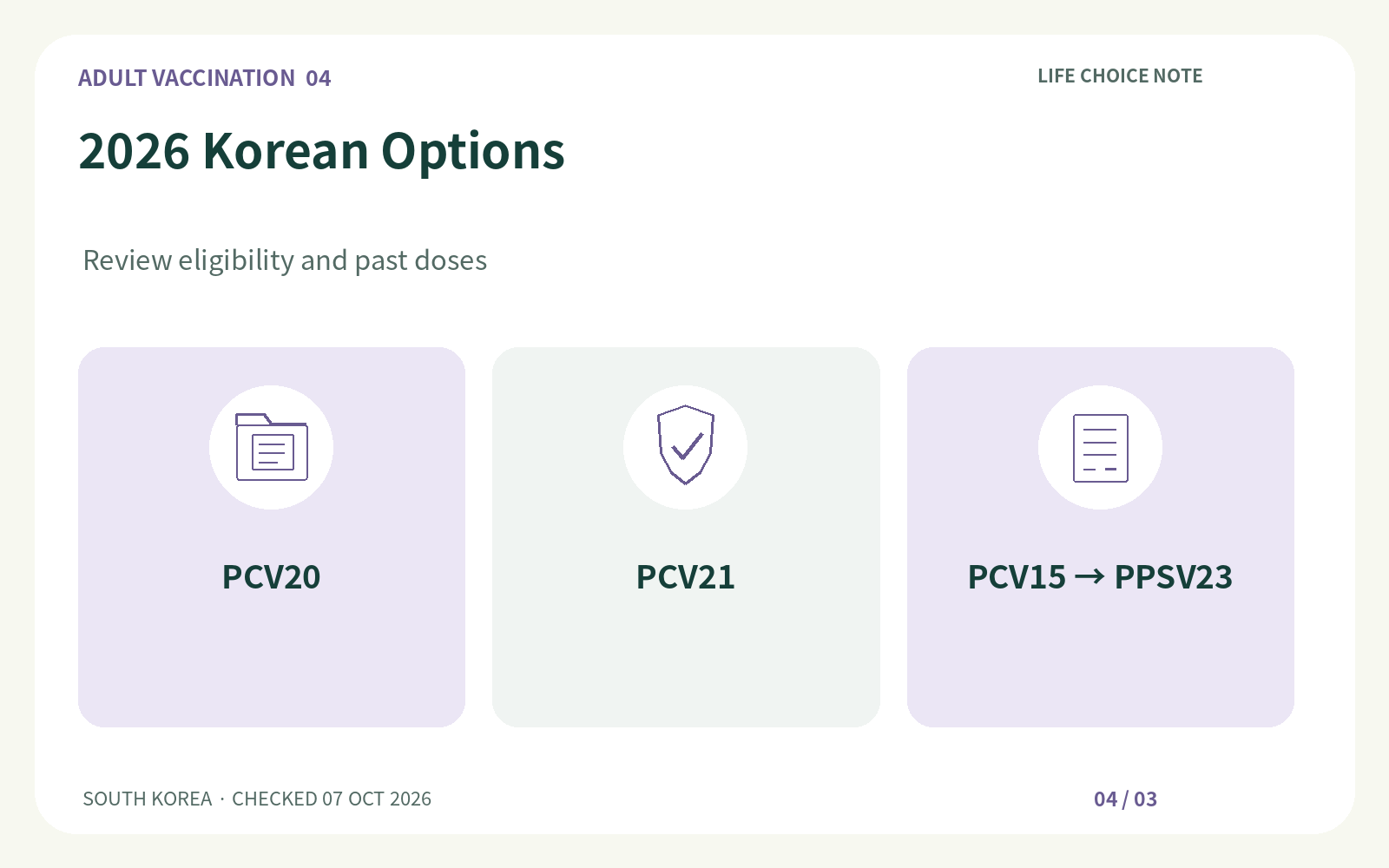
The Korean Society of Infectious Diseases recommends pneumococcal vaccination for all adults aged 65 or older and adults aged 19–64 with increased risk. Its options include one PCV21 dose, one PCV20 dose, or PCV15 followed by PPSV23. Previous vaccination and underlying conditions determine how the recommendation applies to an individual. [2]
The guideline does not rank one of these pathways as universally preferred. Differences in immune-response measurements do not necessarily establish a corresponding difference in real-world clinical protection. Ask about the relevance of each option to your circumstances, rather than treating a higher serotype number as a prescription. [2]
Risk information includes diagnosed chronic conditions, immune compromise, cerebrospinal fluid leak, a cochlear implant or absence of a functioning spleen. Tell the clinician about conditions such as diabetes and chronic lung, heart or liver disease, as well as smoking and current treatments. [2][5]
For ordinary adult pathways, PCV20 or PCV21 generally completes pneumococcal vaccination under the recommendation. Hematopoietic stem cell transplantation is a separate situation with a specific revaccination approach. Do not apply the ordinary one-dose description to a transplant plan. Solid-organ transplant recipients also need their immune status and previous doses reviewed with the transplant team. [2]
4. Match your question to your previous record
If you received PPSV23 only, ask whether a conjugate-vaccine option should now be considered, showing the date and your age at that dose. If you received PCV13 or PCV15, ask which next step, if any, follows from the current Korean recommendation. If you received both a PCV and PPSV23, bring every date in order. [2]
If you already received PCV20 or PCV21, ask whether any special circumstance changes the usual completed pathway. A new product launch does not by itself mean you need another dose. If the product is unknown, check the original clinic and your documents before assuming you were unvaccinated. KDCA notes that unregistered doses may be missing online. [2][4]
5. Do not import the U.S. age threshold
The CDC’s February 25, 2026 page recommends PCV vaccination for U.S. adults aged 50 or older who have never received a PCV or whose history is unknown. Korea’s 2026 recommendation retains age 65 for the age-based group, with risk-based assessment at ages 19–64. A U.S. recommendation does not establish Korean public funding. [2][6]
6. Prepare for the appointment
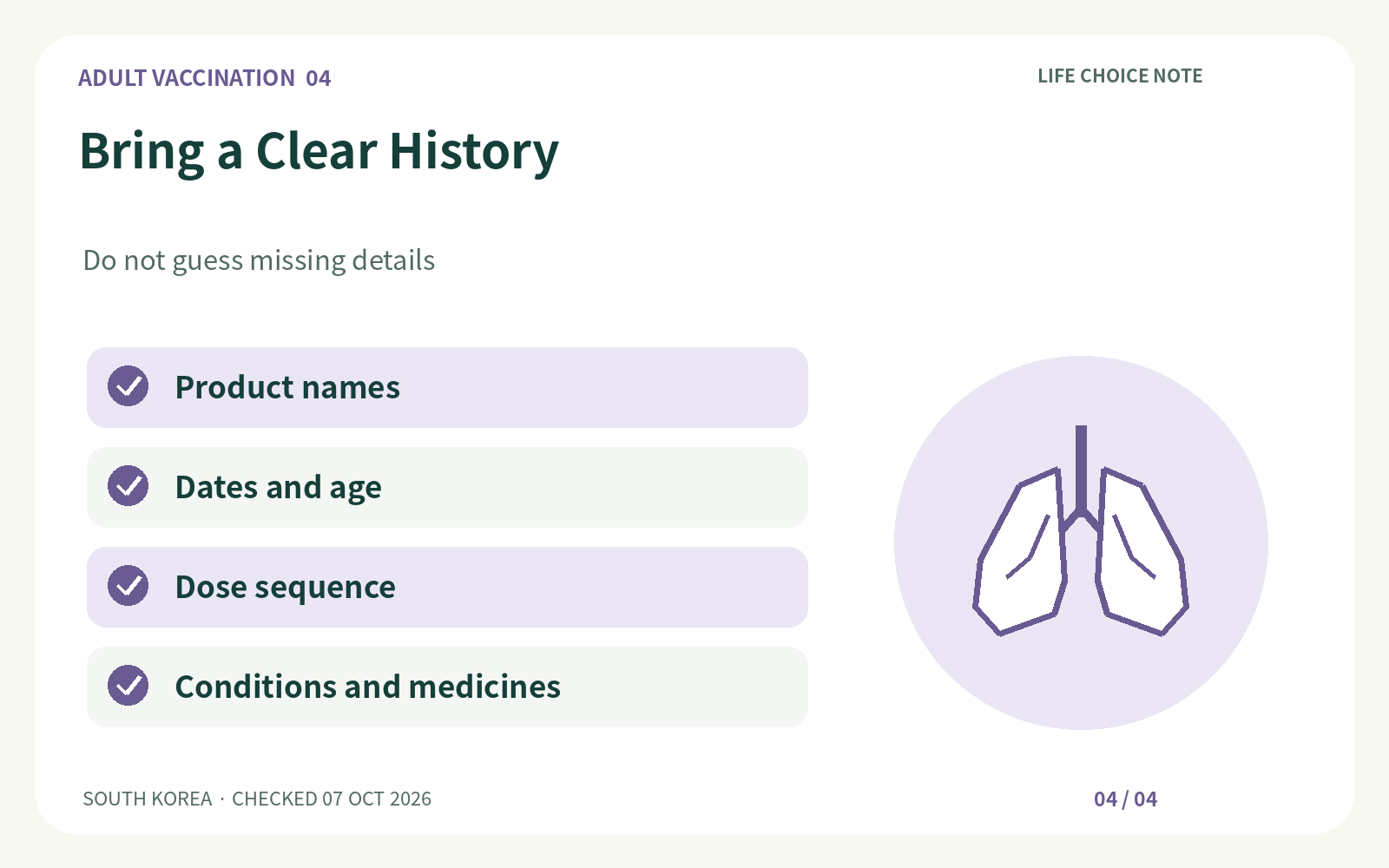
Ask: “Based on these products and dates, which pneumococcal options apply to me, and what would the full cost and funding be?” In Korean: “이 제품과 날짜의 접종기록을 기준으로 필요한 추가접종, 총비용과 지원 여부를 상담받고 싶습니다.” Confirm current stock and any later appointment needed.
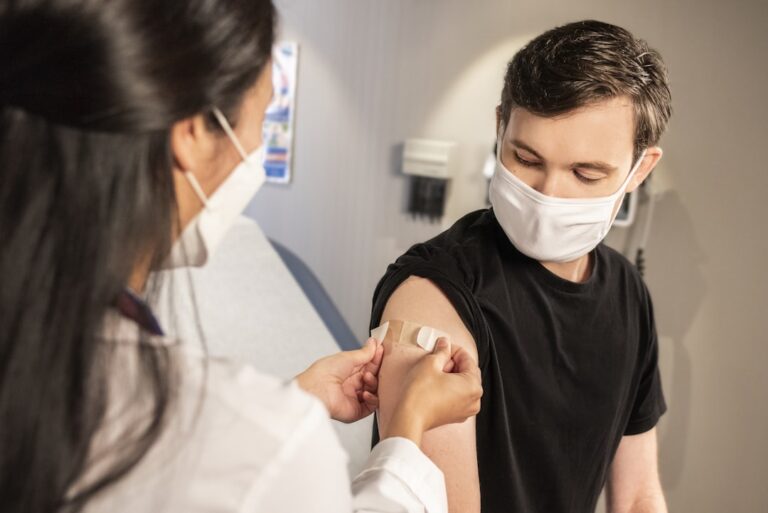
Mention serious previous allergies, medicines, treatment dates and pregnancy. The PCV21 label includes specific precautions and limits to pregnancy data. KDCA advises a clinician’s pre-vaccination assessment and 20–30 minutes of observation afterward. A suspected acute severe allergic reaction requires immediate medical attention. [1][3]
This article provides general health information. Decide on the product, additional doses and intervals with a qualified clinician who has reviewed your history; confirm funding and final charges with the provider.
Related published guides
- Flu Shots in Korea 2026–2027: Dates and Eligibility
- COVID-19 Vaccination in Korea 2026–2027: Who Is Eligible?
Sources
- 65세 이상 성인 폐렴구균 국가예방접종 · 질병관리청 · 2026-01-05 최종검토 · 2026-10-07 KST
- Recommendations for Adult Pneumococcal Vaccination in Korea: 2026 Update Incorporating the 21-Valent Pneumococcal Conjugate Vaccine · 대한감염학회, Infection & Chemotherapy · 2026-08-27 온라인 공개; 2026년 9월호 · 2026-10-07 KST
- 캡박시브프리필드시린지 허가사항 · 식품의약품안전처 의약품안전나라 · 최초허가 2025-08-27; 확인일 현재 공개 허가사항 · 2026-10-07 KST
- 질병관리청 본인 예방접종 관리·기록찾기 · 질병관리청 · 게시일 미표기 · 2026-10-07 KST
- 폐렴구균 감염증 예방접종 안내 · 질병관리청 · 2025-01-20 최종검토 · 2026-10-07 KST
- Pneumococcal Vaccine Recommendations · 미국 CDC · 2026-02-25 · 2026-10-07 KST