Adult Vaccines in South Korea: An Age and Health Checklist
Start with your history, then your situation
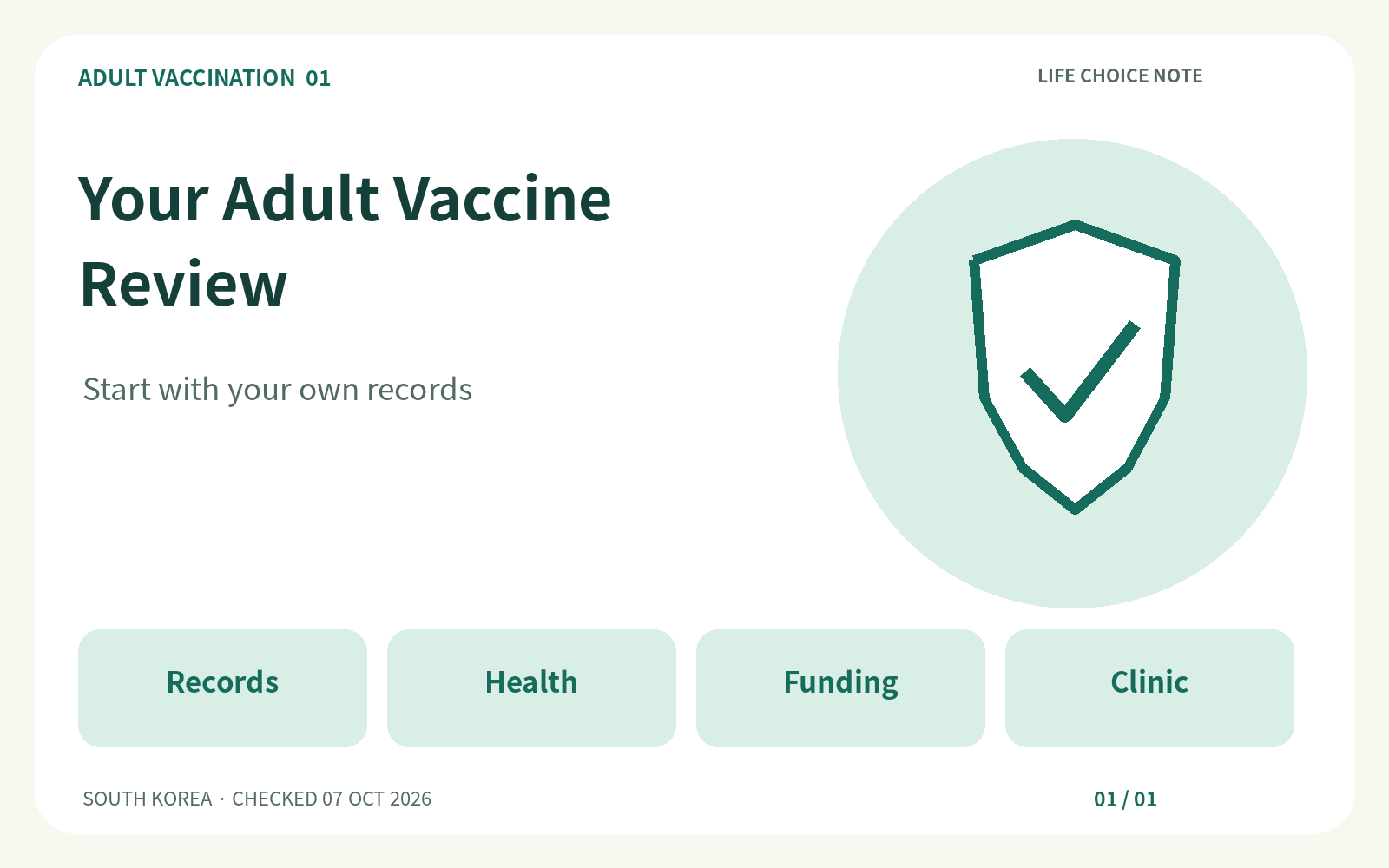
This guide is for adults using healthcare services in South Korea, including people who received earlier vaccines overseas. Information was checked on October 7, 2026. The most useful starting point is a review of your vaccination records, health conditions and upcoming plans. Korean guidance recognizes that age, medical conditions, occupation and circumstances can change what needs discussion. [1]
You do not need to arrive with a self-prescribed list of injections. Aim to give the clinician enough information to identify gaps, decide whether tests would help and explain your options. Keep confirmed records separate from memories and questions. A missing document is a task to investigate, rather than a reason to invent an approximate completion date.
1. Build a record you can bring to any clinic
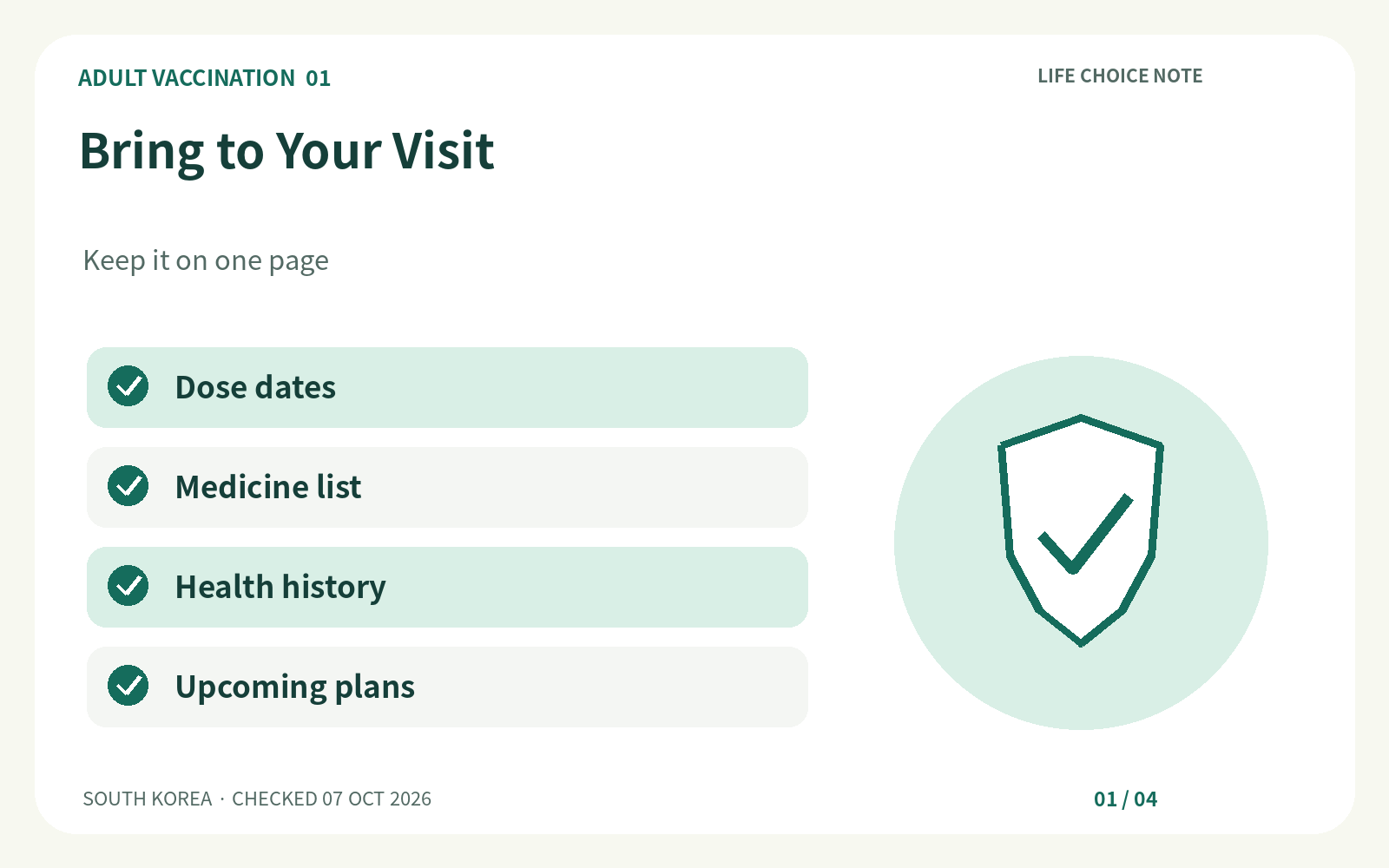
Check the KDCA Immunization Assistant website, known as 예방접종도우미. Its record-finding guidance describes access to electronically registered records from 2002 onward. Earlier doses and doses that were not registered may be absent. An empty result does not establish that you were never vaccinated. Complete sign-in and identity verification yourself. [2]
Collect paper certificates, vaccination cards and records from previous countries of residence. For each dose, note the vaccine name, product, date, clinic and supporting document. If you only remember a visit, label it as uncertain. Ask the original provider to check its records instead of guessing the product from its price or the country where you received it.
Useful Korean terms are 접종기록, vaccination record; 제품명, product name; and 접종일, vaccination date. Keep the original-language documents alongside any translation so the clinician can inspect exactly what the earlier provider recorded.
2. Use your age to frame questions
For younger adults, a review can start with childhood records and any unfinished or uncertain courses. In midlife, add newly diagnosed conditions, changes in medication, workplace exposure and travel plans. In later life, review previous pneumococcal vaccination and vaccines that need seasonal consideration. These are discussion prompts, not a universal list that every adult must receive. [1]
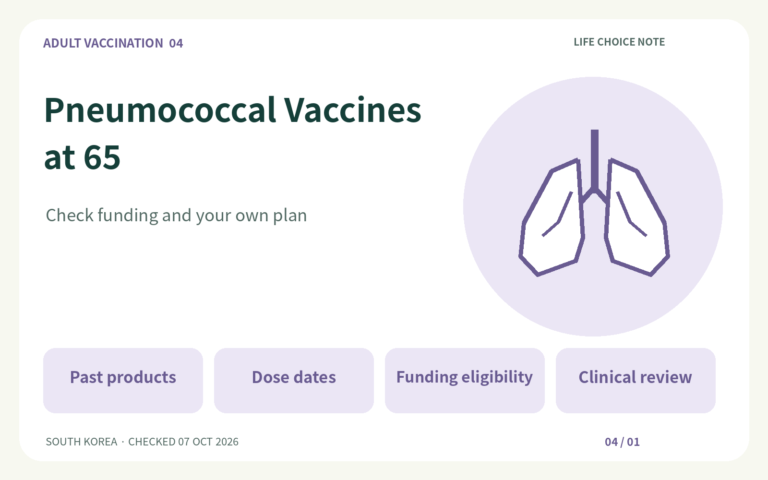
At age 65, two different Korean documents become particularly relevant. The national pneumococcal program funds PPSV23 for eligible older adults. The Korean Society of Infectious Diseases also has a 2026 clinical recommendation involving PCV20, PCV21 or PCV15 followed by PPSV23. Eligibility for funding and the best clinical plan are separate questions. [3][4]
3. Tell the clinic about treatment and deadlines
Bring your diagnosed conditions and an accurate medication list, including injections and planned treatment dates. Mention previous serious reactions to vaccines. If a medicine name is unfamiliar, bring the prescription or a clear medication list from your treating team. Do not stop prescribed treatment to fit a vaccine appointment without speaking to that team.
Pregnancy, plans to become pregnant and immune-suppressing treatment should be discussed before choosing a vaccine. MMR is a live vaccine and is contraindicated in pregnancy; immune compromise also requires careful assessment. A routine age checklist cannot safely resolve these situations. [5]
If you have a transplant history, tell the clinician even when you have complete older records. Some transplant recipients require a different vaccination plan. For example, the Korean pneumococcal guideline treats hematopoietic stem cell transplantation separately. [4]
Add any travel departure date, clinical placement, infant-care responsibility or documentation deadline. For school or employment, obtain the receiving institution’s requirements before your appointment. Ask which evidence it accepts instead of assuming that a clinic visit or a translated record will meet every requirement.
4. Read Korean approval, recommendations and funding separately
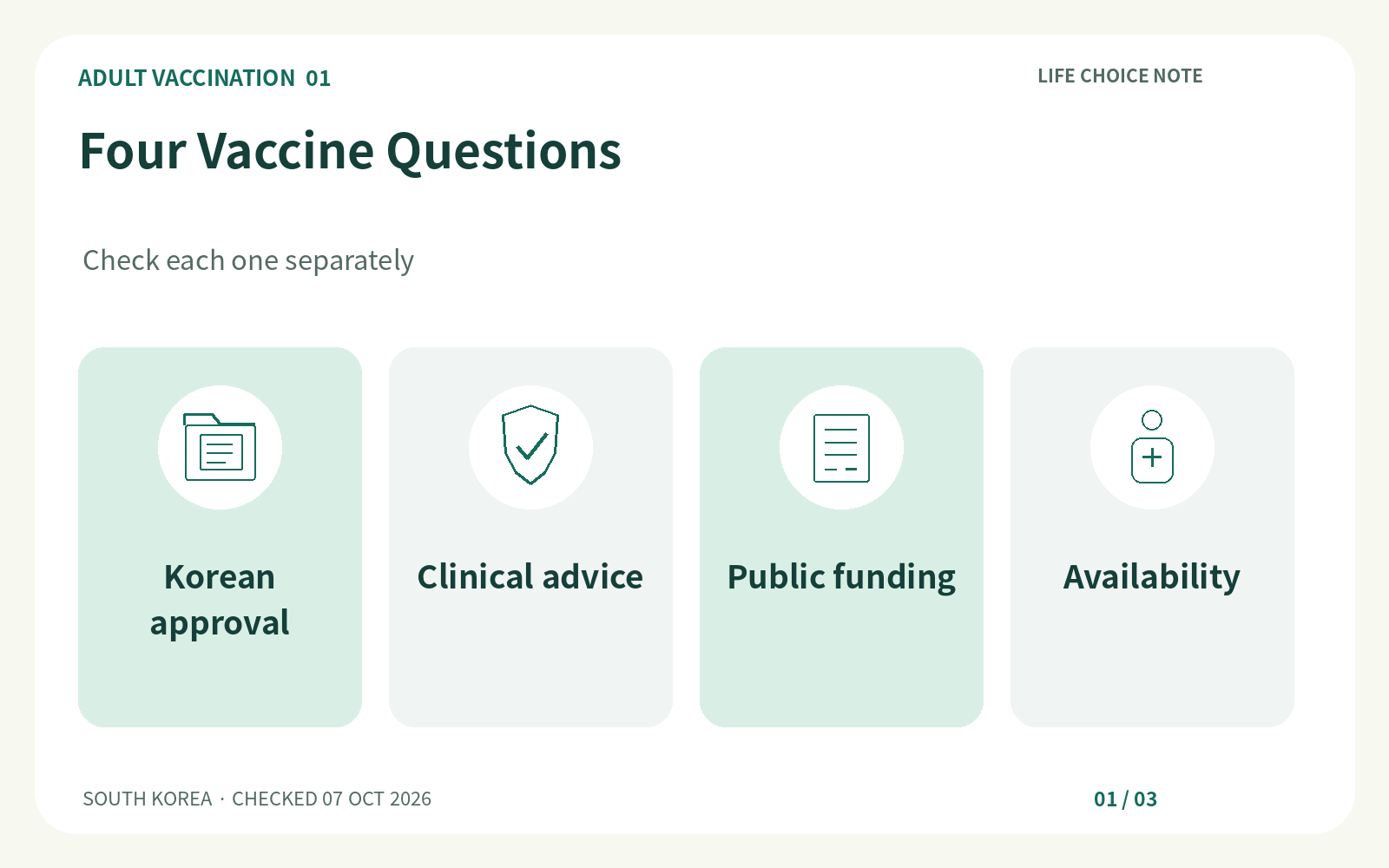
A product’s approved indication answers where it may be used. A clinical recommendation addresses who should consider it. A public program defines which eligible recipients and products receive funding. The clinic then confirms what it actually provides. These questions may have different answers for the same vaccine. [3][4][6]
For example, Korea’s 2026 adult HPV funding includes eligible low-income women aged 18–26, with specified birth-year and qualification rules. The funded product is HPV4, not HPV9. The addition of 12-year-old boys does not make adult men eligible for that national program. [6]
If you are a foreign resident, ask the provider or public health center to check your eligibility and required identification for the specific program. Do not assume that age alone settles administrative eligibility. An English-language U.S. recommendation should not be treated as a Korean funding rule.
Find the next guide for your question
This 14-part series starts with the present overview. Part 2 covers missing records and certificates; part 3, costs and public funding; and part 4, pneumococcal products and previous doses. Part 5 focuses on hepatitis A records and antibody-testing questions. Part 6 explains how to prepare hepatitis B results alongside vaccination history.
Part 7 addresses Td/Tdap history and adult booster questions. Part 8 covers HPV product eligibility and funding. Part 9 looks at evidence of immunity for MMR and varicella, while part 10 covers questions about delayed doses and coadministration. Part 11 focuses on pregnancy; part 12 on chronic illness, immune-suppressing treatment and coordinating care.
Part 13 separates RSV product approval, recommendations and support. Part 14 helps prepare for travel consultations with destinations, departure dates, vaccination records and certificate requirements. Choose the guide matching the uncertainty you want to resolve.
5. Leave with a workable next step
You can show the clinic this request: “I would like a review of my vaccination history. Which records need clarification, which vaccines should we discuss for my health situation, and what funding or out-of-pocket charges apply?” In Korean: “접종기록과 건강상태를 보고 필요한 예방접종과 지원 여부를 상담받고 싶습니다.”
For any proposed plan, ask about the product, remaining doses, timing, tests if needed and the total expected charge. Keep unconfirmed costs marked as unknown. Before leaving, record what was done today, what depends on additional documents and when you should return.
This article provides general health information, not a personal vaccination prescription. Agree on vaccine choices, tests and timing with a qualified clinician who has reviewed your records and health situation.
Related published guides
- Flu Shots in Korea 2026–2027: Dates and Eligibility
- COVID-19 Vaccination in Korea 2026–2027: Who Is Eligible?
- South Korea Vaccination Law 2026: What Changes and When?
Sources
- 질병관리청 표준·성인 예방접종 일정표 · 질병관리청 · 2024-01-15 최종검토 · 2026-10-07 KST
- 질병관리청 본인 예방접종 관리·기록찾기 · 질병관리청 · 게시일 미표기 · 2026-10-07 KST
- 65세 이상 성인 폐렴구균 국가예방접종 · 질병관리청 · 2026-01-05 최종검토 · 2026-10-07 KST
- Recommendations for Adult Pneumococcal Vaccination in Korea: 2026 Update Incorporating the 21-Valent Pneumococcal Conjugate Vaccine · 대한감염학회, Infection & Chemotherapy · 2026-08-27 온라인 공개; 2026년 9월호 · 2026-10-07 KST
- 월드컵 직관 전 건강 체크! 홍역 예방 가이드 카드뉴스 · 질병관리청 · 2026년 게시; 확인일 현재 공개 · 2026-10-07 KST
- HPV 국가예방접종 사업 · 질병관리청 · 2026-04-14 최종검토; 남아 확대 2026-05-06 시행 · 2026-10-07 KST