Red Yeast Rice Belongs on Your Medication List
You order red yeast rice online, put it beside your vitamins, and later receive a new prescription. When the pharmacist asks what you take, you mention your medicines but leave out the supplement. That omission can matter. A product sold for cholesterol support may expose you to a compound with the same chemical structure as a prescription statin.
Add it to the medication conversation first
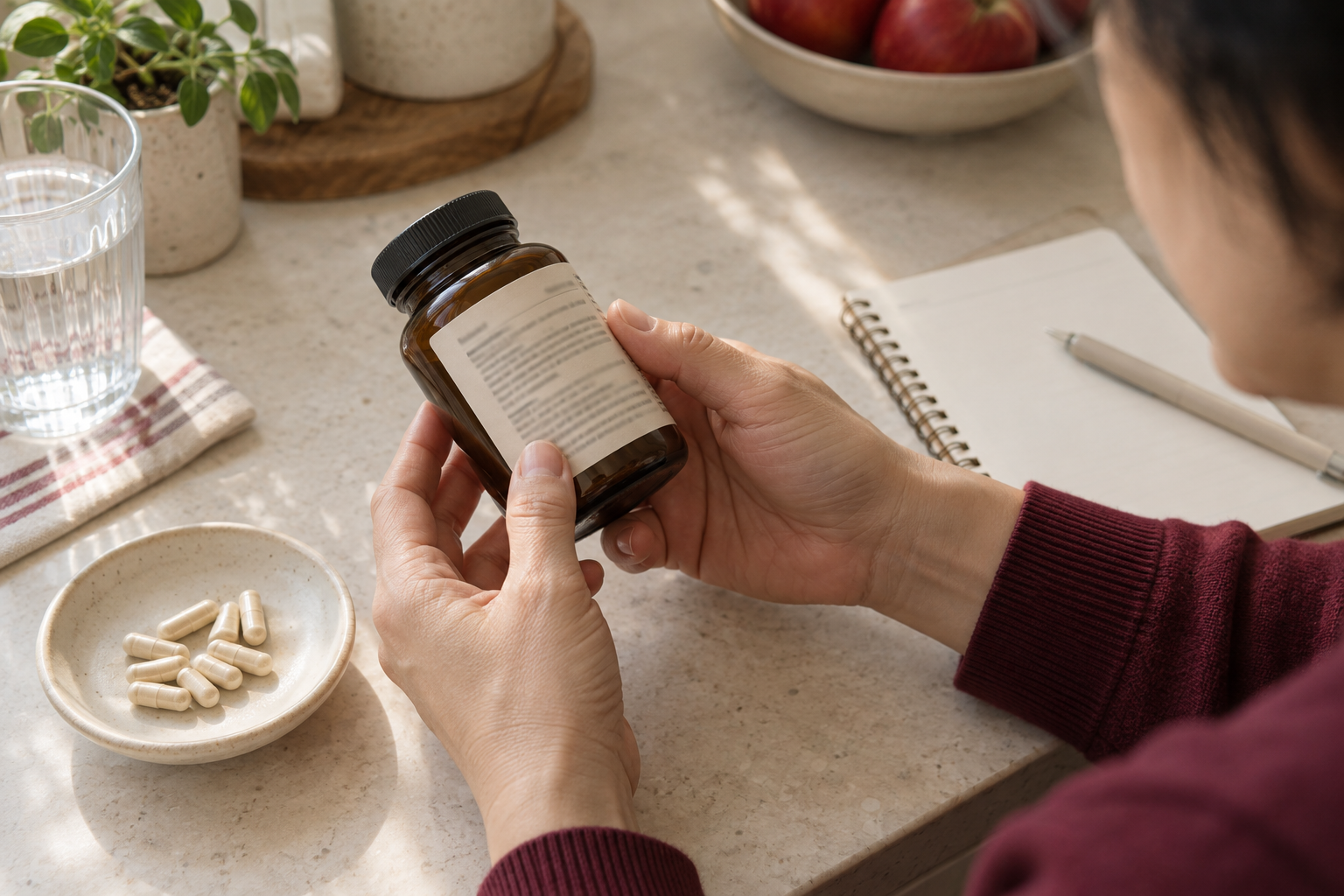
Red yeast rice belongs on your medication list, even when its packaging calls it natural. Its monacolin K lactone is chemically identical to lovastatin. Products containing substantial amounts can share statin adverse effects and interactions. Tell the pharmacist the complete product name, how much you actually take, and when you started. A photograph of both sides of the container is more useful than the description “a cholesterol supplement.” NCCIH overview
Interactions are not limited to another cholesterol prescription. The lovastatin prescribing information identifies problems with medicines such as clarithromycin, certain antifungals, and gemfibrozil, as well as grapefruit juice. These are examples, not a complete checklist for every red yeast rice product. Ask the prescriber or pharmacist to check your full regimen before combining products or starting a new medicine. Do not change prescribed treatment yourself. Lovastatin prescribing information
Pregnancy and breastfeeding are also reasons to avoid red yeast rice supplements. A history of liver or kidney disease, previous muscle reactions, and other supplements should be part of the discussion. Someone buying a product for a family member may not know those details. A gift chosen from favorable reviews can therefore bypass information needed to judge whether it is appropriate. Safety considerations
What the number on the bottle actually measures
A label may prominently display the weight of red yeast rice without stating its monacolin K content. Those are different quantities. Two containers showing the same amount of fermented rice cannot automatically be treated as equivalent doses of an active substance. Nor can the rice weight be converted into a lovastatin prescription dose using a simple ratio.
A 2017 study of 28 brands sold by mainstream US retailers illustrates the problem. Among the 26 products with detectable monacolin K, concentrations differed by more than sixtyfold for the same weight of red yeast rice. This was a snapshot of those products, not a measurement of every current brand or another country’s market. Its practical lesson is to avoid assuming that an ingredient name defines a consistent preparation. The product analysis
For US purchases, there is a specific regulatory distinction: NCCIH explains that products with enhanced or added lovastatin cannot be marketed as dietary supplements in the United States. Finding a product for sale does not demonstrate that its contents, claims, or suitability have been independently established.
A contaminant test answers only part of the question
Some red yeast rice products have contained citrinin, a contaminant that can damage the kidneys. A claim about citrinin addresses a different issue from the effects of monacolins. If a seller supplies test results, check which product and manufacturing lot were tested and which substances were measured. A logo or an attractive certificate should not replace that reading.
Quality testing does not turn a product into a proven substitute for your treatment. Independent testing can help evaluate identity, ingredient amounts, and contamination; NIH notes that quality seals do not guarantee safety or effectiveness. Even an accurately characterized product still needs to be considered alongside the person taking it. What quality seals can and cannot establish
In its 2025 safety reassessment, EFSA could not identify a daily monacolin intake from red yeast rice supplements free of safety concerns, including below 3 mg per day. This does not mean every user will be harmed. It means that a small advertised amount cannot be presented as a universally established safe threshold. The opinion is a safety assessment, not a dosing recommendation. EFSA’s reassessment
Ask whether the research matches the product and the person
Evidence is more specific than an ingredient category. A major Chinese trial studied Xuezhikang, a particular red yeast rice extract, in people who had already experienced a myocardial infarction. It found fewer major coronary events than placebo over an average of 4.5 years. That is meaningful evidence for the preparation and population studied, but it does not establish equivalent benefits for an arbitrary retail capsule or a healthy shopper. The randomized trial
When a sales page cites that trial, compare its preparation, population, and outcomes with the promise being made. A change in an LDL laboratory result and a reduction in heart attacks are distinct outcomes. Neither claim can simply be transferred to a different formulation because both products use the words “red yeast rice.” Missing composition information makes that transfer still less defensible.
Make the next step a treatment review
If muscle discomfort led you to look for alternatives, tell your clinician what happened rather than silently swapping products. The National Lipid Association describes supervised changes in statin choice, dose, or dosing frequency, and nonstatin therapies when needed. The aim is a tolerable plan that still addresses cardiovascular risk. A difficult experience with one regimen does not establish that every effective treatment is unsuitable. Statin intolerance guidance
Stop the red yeast rice supplement and seek medical advice if new muscle pain or weakness develops. Marked weakness, severe muscle pain, dark urine, or yellow skin or eyes warrants prompt medical assessment. These symptoms have multiple possible causes; bringing the packaging and a record of when symptoms began helps the clinician investigate. Do not wait for a routine cholesterol test to mention them. Symptoms requiring attention with lovastatin
Before reordering, ask for a plan that covers your medicines, symptoms, and follow-up. Bring the supplement label, the actual daily amount, recent test results, and any previous treatment changes. Agree on what you will use and when its benefits and tolerability will be reviewed. That conversation is more informative than another ranking of “natural cholesterol” products.
This article provides general health information, not an individual diagnosis or treatment plan. Sources checked September 23, 2026 (KST).
Related guides
- CoQ10 for statin-associated muscle symptoms
- How to check supplement–drug interactions
- How to check supplement quality
- How to read a supplement label
References
- NCCIH — Red Yeast Rice
- DailyMed — Lovastatin Prescribing Information, May 2026
- Cohen et al. — Variability in Strength of Red Yeast Rice Supplements (2017)
- NIH ODS — Dietary Supplements: What You Need to Know
- EFSA — Safety of Monacolins from Red Yeast Rice (2025)
- Lu et al. — Xuezhikang after Myocardial Infarction (2008)
- National Lipid Association — Scientific Statement on Statin Intolerance
- MedlinePlus — Lovastatin