Do You Need Long-Term Treatment After Your First Gout Flare?

Once a first gout flare settles, a different decision remains: should you start a daily medicine to prevent future problems? The answer depends on more than the number of attacks. A confirmed diagnosis, kidney health, kidney stone history, joint findings and your preferences all belong in the discussion. Korean, US and UK guidance approaches this decision somewhat differently.[1][2][3]
This article concerns urate-lowering therapy, or ULT. Its long-term purpose differs from that of medicines used to control the pain and inflammation of the current flare. Ask which role each prescribed medicine has before deciding that all your “gout tablets” are interchangeable.[4]
1. Start by confirming what has been diagnosed
A painful, swollen big toe and a high urate result can support suspicion of gout, but the clinical assessment still matters. Your clinician may review the pattern of symptoms, examine the joint and consider joint fluid testing or imaging when the diagnosis is unclear.[3][4] If you were told “possible gout,” ask whether that remains the working diagnosis and what would help confirm it. Starting a long-term treatment discussion does not remove the need to clarify an uncertain diagnosis.
A high urate result found at a health check, without previous gout flares or tophi, is a separate situation called asymptomatic hyperuricemia. Do not apply first-flare recommendations to that situation automatically.[2] For your appointment, separate the date of your first abnormal blood test from the date of your first painful joint episode. Bring the original results where possible. You do not need to label every past ache as gout yourself; describe what happened and let your clinician interpret the history.
2. When the US ACR strongly recommends treatment
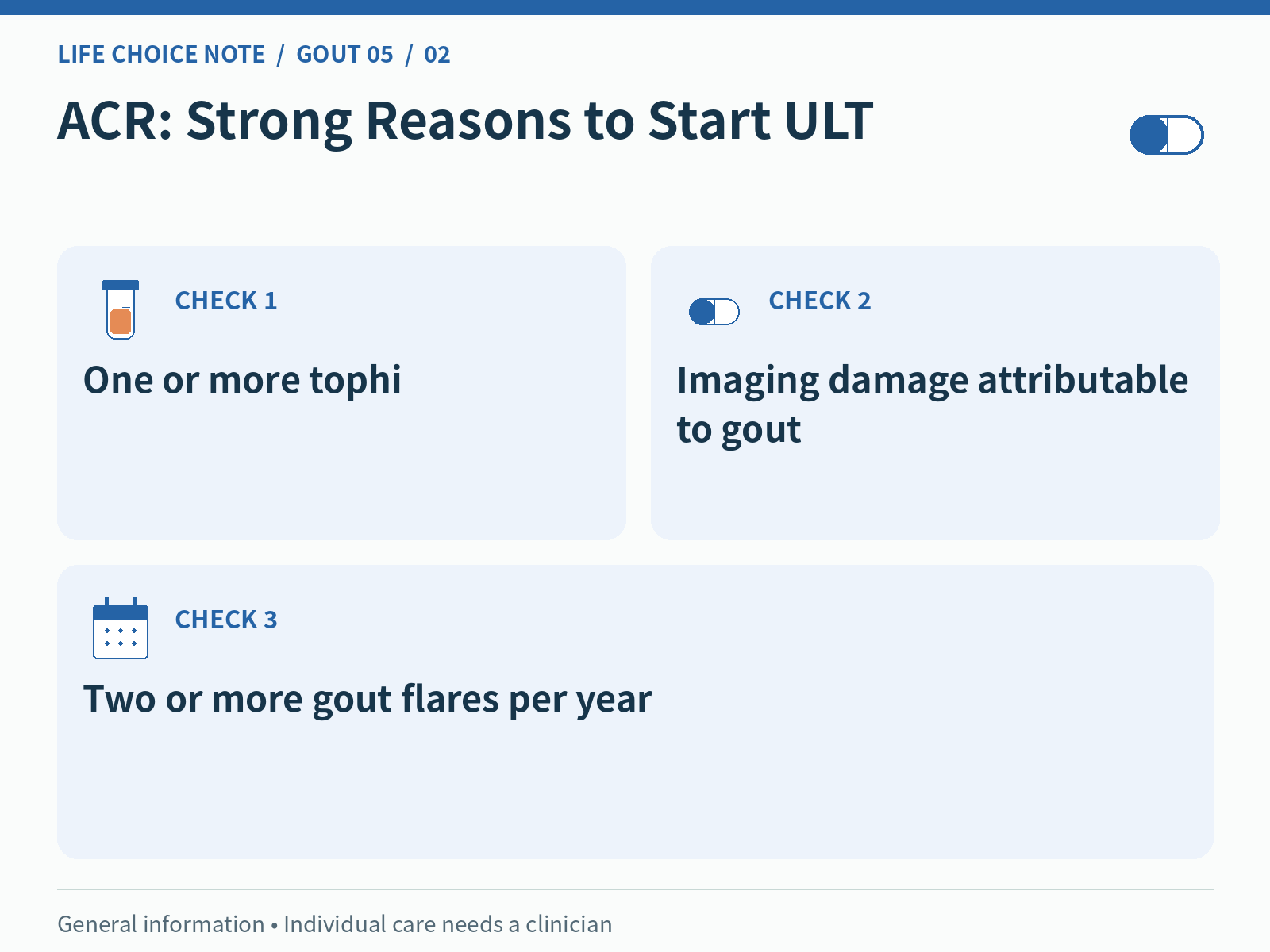
The American College of Rheumatology’s 2020 guideline strongly recommends starting ULT for gout with at least one tophus, imaging damage attributable to gout, or two or more flares per year. It also conditionally supports treatment after more than one previous flare even when attacks occur less than twice yearly.[2] A quiet recent year therefore does not erase the relevance of older attacks or established joint findings.
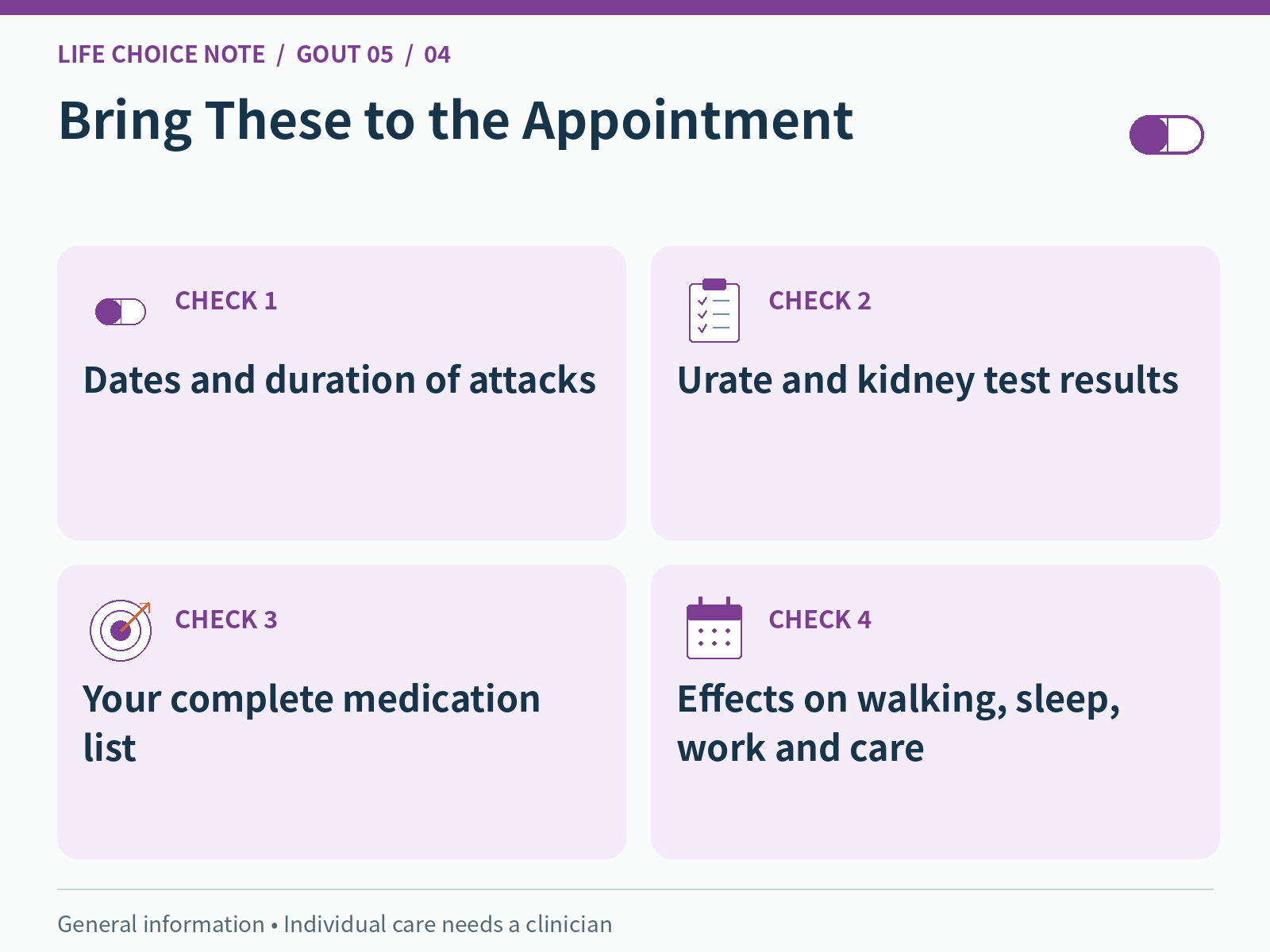
For a useful history, record episodes rather than only clinic visits. An attack you managed at home is still worth describing, including the affected joint, approximate date and duration. However, a lump is not automatically a tophus, and joint damage from another cause should not be relabelled as gout damage.[3][4] Bring reports and ask what has actually been confirmed. The aim is a reliable clinical picture, rather than trying to qualify for treatment by counting symptoms on your own.
3. A first flare can still justify a treatment discussion
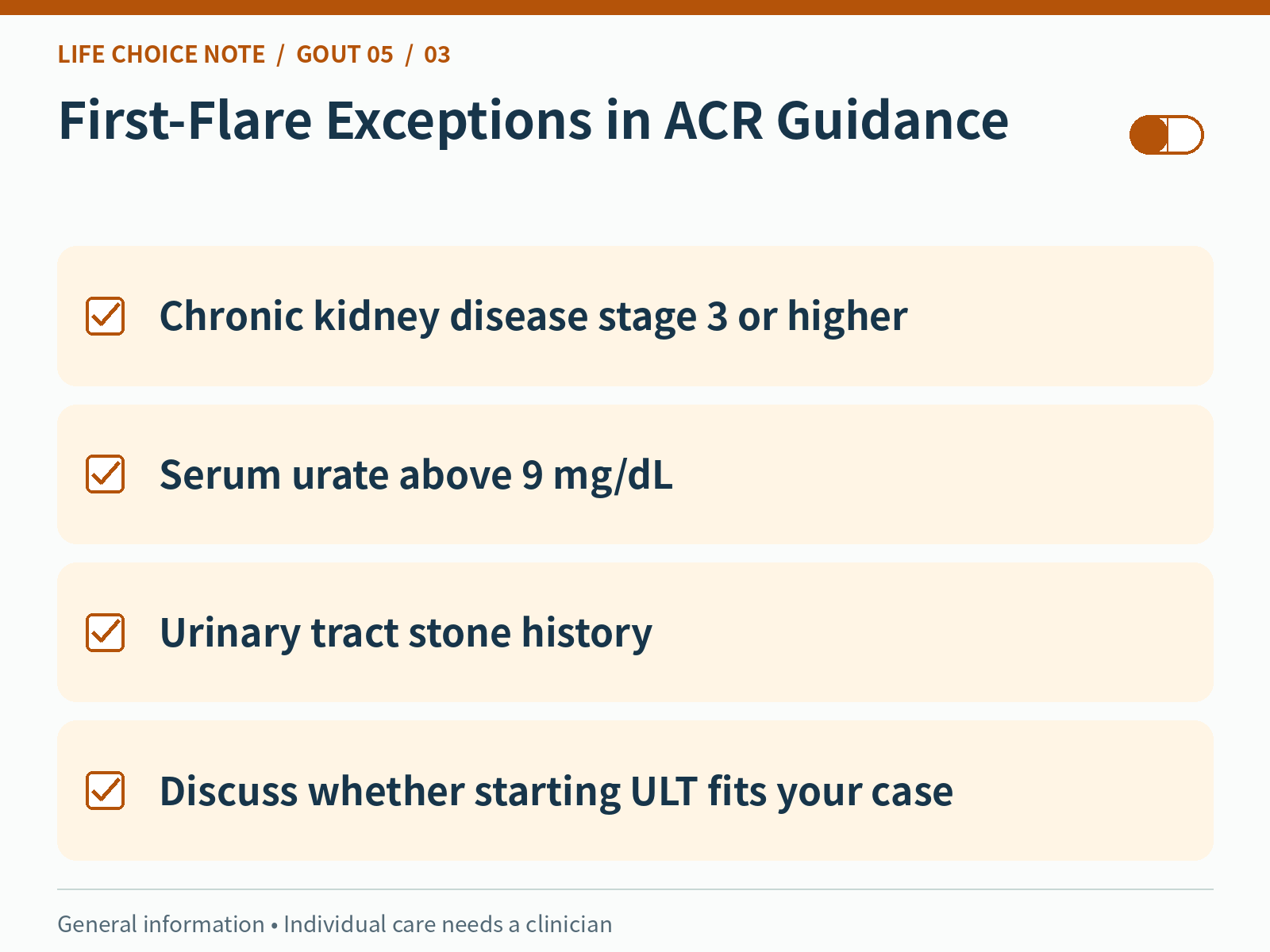
For an uncomplicated first flare, ACR conditionally recommends against routinely starting ULT. Its exceptions are chronic kidney disease at stage 3 or higher, serum urate above 9 mg/dL, or urolithiasis, meaning stones in the urinary tract. In those circumstances it conditionally recommends starting treatment.[2] These are US guideline recommendations for people with gout. The urate number is not a universal rule for everyone with an abnormal health-check result, nor a Korean insurance threshold.
Ask your clinician to confirm your kidney disease stage rather than assigning one from a single result yourself. Mention a previous stone even if it was treated years ago and is no longer painful. If records are unavailable, say what you remember and what remains uncertain. “I was treated for a stone but do not know its type” is useful information. It is better than assuming that every stone was caused by uric acid or leaving the history out entirely.
4. Korean and UK recommendations are not identical
The Korean College of Rheumatology’s 2023 guideline recommends ULT broadly for patients with gout unless it is contraindicated. A Korean clinician proposing treatment after a first flare is therefore not necessarily departing from local guidance. This recommendation should not be extended to every person with asymptomatic hyperuricemia, and it should not be presented as a guarantee that ULT protects everyone’s kidneys.[1]
The UK’s NICE guideline offers ULT for multiple or troublesome flares, CKD stages 3–5, diuretic treatment, tophi or chronic gouty arthritis. It also recommends discussing the option with people outside those groups after a first or later flare.[3] If you use healthcare in Korea, ask which features of your own case support the recommendation. Comparing the guidelines can inform that conversation, but choosing one foreign threshold does not settle an individual prescription or establish local coverage.
5. Describe how the attack affected everyday life
The effect of a flare is not fully captured by its frequency. NICE specifically includes troublesome attacks in its treatment recommendations.[3] Before your visit, note how long you could not wear normal shoes, walk comfortably, sleep or carry out work and caring responsibilities. This is a communication exercise, not a severity score or a way of diagnosing yourself. Concrete examples can help explain why one episode was especially difficult and what you most want treatment to prevent.
Discuss the practical costs of treatment too: taking a daily medicine, returning for blood tests, paying for care and dealing with concerns about side effects. If your work schedule makes appointments difficult, raise that before leaving with an unclear plan. Lifestyle changes remain valuable, but frequent flares or tophi usually need medication as a central part of management.[4] Choosing medication is not a judgment about how well you have tried to change your diet.
6. Leave with a plan whether you start now or not
If you and your clinician choose ULT, clarify the reason for treatment, your urate target, the next review date and what to do if an early flare occurs. Treatment is adjusted through follow-up rather than simply prescribed once and forgotten.[2][3] A small medication list with each drug’s purpose can help when you visit a different clinic or pharmacy in Korea. Use the current prescription instructions rather than combining them with directions from an older packet.
If you defer treatment, agree when to reconsider it and whom to contact if another attack develops. Conditional recommendations leave room for clinical circumstances and informed preferences; they do not mean that no follow-up is needed.[2] Seek prompt medical assessment for a suddenly painful, swollen joint accompanied by fever or feeling very unwell. A possible joint infection requires urgent attention and should not wait for a routine long-term gout appointment.[3]
What to bring to your appointment
- Confirm whether gout is established or still suspected.
- Bring a timeline of attacks and their effect on daily life.
- Bring kidney results and any stone or tophus records.
- List prescribed, over-the-counter and supplement products.
- Ask why treatment is recommended and when to review the decision.
Common questions
Must I wait for a second flare before starting medicine?
No. ACR lists first-flare exceptions, and Korean guidance supports a broader discussion of ULT in diagnosed gout. The decision should reflect your circumstances rather than a fixed waiting rule.[1][2]
Does a urate result below 9 mg/dL rule out treatment?
No. That number is one ACR first-flare exception. Tophi, gout-related damage, previous attacks and other clinical circumstances also matter.[2]
Can I try diet changes alone first?
Discuss that preference with your clinician. Lifestyle measures alone may be insufficient when gout causes frequent flares or tophi, so the consequences of delaying medication need consideration.[4]
General adult health information, not a diagnosis or personal prescription. International guidance does not replace individualized care, Korean prescribing requirements or local coverage decisions. Do not start, stop or change medicine yourself. Seek prompt care for an acutely painful joint with fever or marked illness.[3]
Related published reading
- CKD and Supplements: Bring the Bottle, Labs and Medicine List
- Supplements That Can Interfere With Lab Tests: Biotin and Beyond
- Previous: What Should You Do When a Gout Flare Starts?
- Next: Why Is the Gout Treatment Target Below 6 mg/dL?
Official and primary sources
- Korean guidelines for the management of gout · Korean College of Rheumatology · Published 2023-07-01 · Checked 2026-10-15
- 2020 American College of Rheumatology Guideline for the Management of Gout · American College of Rheumatology · Published June 2020 · Checked 2026-10-15
- Gout: diagnosis and management (NG219), Recommendations · National Institute for Health and Care Excellence (NICE) · Published 2022-06-09 · Checked 2026-10-15
- Gout: Diagnosis, Treatment, and Steps to Take · US National Institute of Arthritis and Musculoskeletal and Skin Diseases (NIAMS) · Last reviewed December 2023 · Checked 2026-10-15