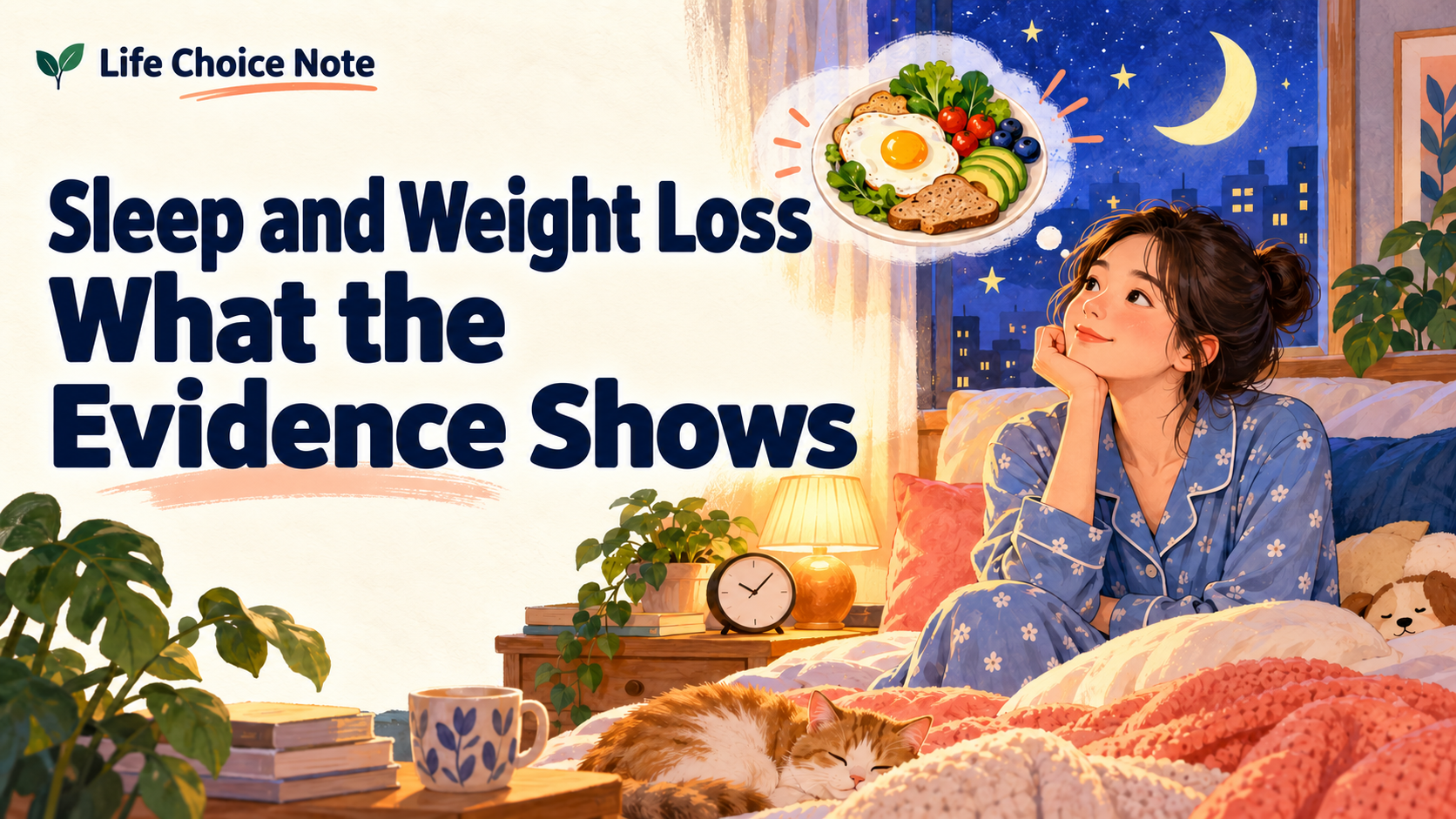
Sleep and Weight Loss What the Evidence Shows
After a short night, you may feel like eating more often or find meal preparation harder. Rather than treating this solely as a failure of willpower, consider both your opportunity to sleep and the quality of that sleep.
Adequate sleep is one part of healthy weight management. It cannot promise a fixed reduction in food intake or body weight. The useful question is what research actually shows and what can be changed in your own circumstances.
Sleep can affect appetite and everyday choices
Describe what happens after a short night
Enough time to sleep
Awakenings or breathing issues
Sleepiness and eating pattern
NIDDK explains that insufficient sleep may be associated with greater hunger, higher intake and changes in food choices. The response is not identical for everyone. Shift work, caring responsibilities, pain and medicines can all change the context.
Staying awake long enough to add another eating occasion is a different situation from skipping meals the next day because you are exhausted. A brief description of what actually happens is more useful than the label “poor sleep” alone.
An association between sleep and weight does not identify a single cause. Conditions or medicines may affect both, and a sleep disorder may need its own treatment. Eating support and sleep assessment can be part of the same plan.
Read the sleep extension trial with its limits
A result needs a population and duration
80 short-sleeping adults with overweight
Two weeks of sleep extension
No individual weight-loss guarantee
A 2022 randomized trial included 80 adults with overweight who usually slept less than 6.5 hours. During a two-week intervention, the sleep-extension group slept about 1.2 hours longer and consumed an estimated 270 kcal less per day than controls, on average.
Participants were 21–40 years old. This short intervention does not establish the same effect for older people, people already sleeping enough or those with insomnia or sleep apnea.
Do not enter 270 kcal as a guaranteed daily saving or convert it into a promised multi-year weight change. The finding supports further attention to sleep, while leaving long-term maintenance and individual weight responses uncertain.
Start with the opportunity to sleep
NHLBI recommends seven to nine hours of sleep for adults. Needs vary, and time in bed is not the same as time asleep. Reaching a number does not rule out a sleep problem.
If your wake time is fixed, consider when evening tasks could end. Finishing work or viewing a little earlier can create room for sleep. The purpose is to provide an opportunity, not to demand that you fall asleep immediately on schedule.
With caring responsibilities or shifts, look for feasible rest arrangements and support. Note constraints you cannot resolve alone for a consultation. Protecting sleep does not require removing all nourishing meals or suitable activity from the day.
Consider caffeine alcohol and light in context
NHLBI sleep-habit guidance suggests a consistent schedule, a quiet wind-down period and a dark, quiet, comfortable room. Start with a recurring barrier rather than trying to perfect every part of the environment at once.
If afternoon or evening caffeine seems linked to trouble falling asleep, note the drink and time. Sensitivity differs, so examine your pattern rather than assuming a universal cutoff. Do not use alcohol as a sleep aid or change sleeping medication on your own.
Consider adjustable disruptions such as notifications, bright light or noise. Repeated difficulty sleeping despite the opportunity calls for assessment rather than simply forcing longer time in bed. This article is not a treatment programme for insomnia.
A sleep diary should clarify the pattern
Keep context for a useful consultation
Bedtime and awakenings
Caffeine and naps
Snoring and daytime sleepiness
The Life Choice Note sleep diary offers a blank form for bedtime, waking, naps and relevant conditions. It does not automatically detect sleep or diagnose a sleep disorder.
Note when you went to bed, roughly how long falling asleep took, remembered awakenings, final wake time and daytime sleepiness. Mark uncertain values as approximate rather than repeatedly checking the clock overnight.
To explore eating patterns, add a short note about skipped meals, late snacks or unusual hunger the next day. Look for repeated situations rather than treating one day as proof of causation. Simplify the record or discuss the burden if monitoring increases anxiety.
Do not postpone snoring or sleepiness assessment until weight loss
NHLBI lists loud snoring, pauses in breathing, gasping and daytime sleepiness as possible sleep-apnea symptoms. A partner’s report of breathing pauses is relevant. Snoring alone is not a diagnosis, but a recurring pattern deserves assessment.
Do not wait to lose weight before seeking help. Persistent insomnia or severe tiredness and sleepiness despite adequate opportunity to sleep also warrant a discussion. A clinician can decide whether testing or treatment is needed.
Do not push through sleepiness while driving. Stop somewhere safe and arrange an alternative. This is a safety issue, independent of whether your weight is changing.
Common questions
Will more sleep make me eat 270 fewer calories
That is not guaranteed. It was an average between-group result over two weeks in selected participants, not a personal food allowance.
Does sleeping in at weekends solve every weekday sleep problem
It cannot be assumed to reverse all weekday sleepiness and its consequences. Review weekday sleep opportunities and the reasons the schedule is irregular.
If I sleep over seven hours but feel exhausted should I just sleep more
Duration may not be the only issue. Recurrent snoring, breathing problems, daytime sleepiness, insomnia or other symptoms may need assessment.
Sources and scope
Sources include official sleep guidance and a randomized sleep-extension trial. Population and intervention duration accompany the result; no long-term weight forecast is made. This does not replace care for sleep apnea or insomnia.
- NIDDK Factors Affecting Weight and Health · 2023-05 reviewed
- Tasali et al Sleep Extension and Energy Intake Trial · 2022-02-07 online; 2022-04-01 issue
- NHLBI How Much Sleep Is Enough · 2022-03-24 updated
- NHLBI Healthy Sleep Habits · 2022-03-24 updated
- NHLBI Sleep Apnea Symptoms · 2025-01-09 updated
Sources checked 5 October 2026, Korea time. General adult health information, not individual diagnosis, treatment or exercise prescription. This article has not undergone separate clinical expert review.